Genital warts: how to recognise them and what next
Have you noticed a tiny growth in your intimate area and are wondering if it is a condyloma? Condyloms, or genital warts, are among the most common sexually transmitted infections. They are caused by the human papillomavirus (HPV), are benign and are treatable. However, not every growth is a condyloma: some are part of normal skin structure. In this guide, we explain what condyloms look like, where they appear, how they are transmitted, whether they go away on their own and which harmless changes resemble them.
Genital warts in brief
The most important facts about condylomas fit into a few lines. Each point is explained in the sections that follow.
| What they are | Benign growths on the genitals and around the anus. They are also called genital warts. |
|---|---|
| Pathogen | HPV types 6 and 11 cause around 90% of genital warts. These are low-risk types, different from those that can cause cancer. |
| What do they look like | Small skin-coloured or slightly darker growths, flat or pedunculated, single or in groups. |
| Symptoms | Most commonly there are none. Itching, bleeding or discomfort during intercourse are possible. |
| Transfer | Through skin and mucosal contact during sexual intercourse, even when changes are not visible. |
| From infection to change | From several weeks to several months, and sometimes even years. |
| Do they go away on their own | With some people they pass, with others they stay the same or multiply. |
| Who to contact | A dermatovenereologist, for every new growth in the genital region or around the anus. |
What are condylomas and which HPV causes them
Genital warts (lat. condylomata acuminata) are warts of the genital and anal region and are among the most common sexually transmitted infections. They are also commonly known as venereal warts, and the term HPV warts is frequently heard. They are caused by the human papillomavirus, a large family of viruses whose types differ according to the site they affect and the consequences they cause.
In about 90% of cases, genital warts are caused by types 6 and 11. These are so-called low-risk types: they are not the same as the types that can cause cancer. [1] Therefore, a diagnosis of genital warts is not the same as finding high-risk HPV in a gynaecological swab.
The same person can carry multiple types of HPV at the same time, so regular gynaecological check-ups remain important. Warts themselves are not a reason for more frequent smear tests: the same schedule applies as for all other women. [1]
HPV is a very common infection and most often clears up without any signs. Genital warts only develop in a proportion of those infected, so someone can carry and transmit the virus without ever having had a visible lesion.
Genital warts are not the same as warts on the hands and feet. They are caused by different types of HPV and are generally not transmitted sexually; we write about them on the page wart removal.
What do warts look like
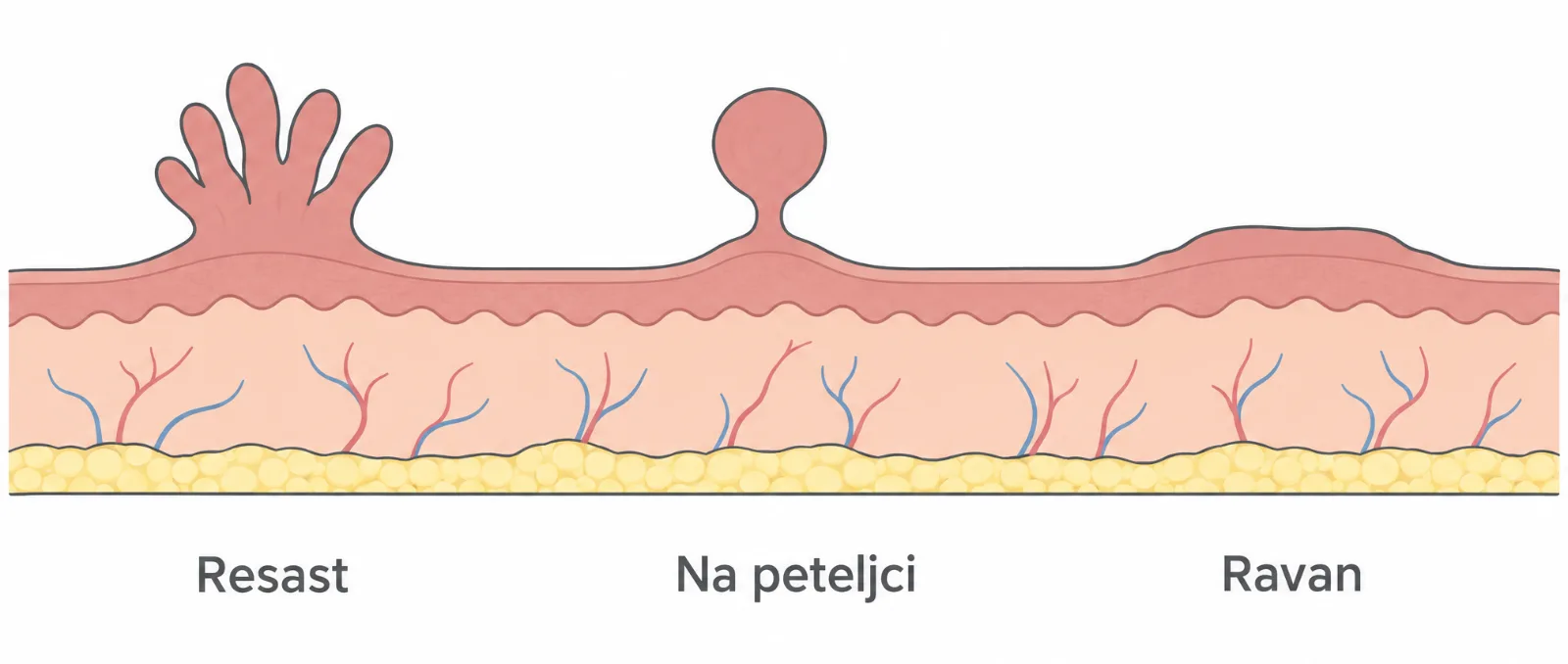
A typical wart is a small growth from 1 to 5 millimetres in diameter, flesh-coloured, pink or slightly darker than the surrounding skin, with an uneven, wrinkled surface. [2] There may be a single one, but more often there are several close to each other. When they merge, larger patches form whose surface resembles cauliflower.
Genital warts
This is the shape from which condylomas got their name: soft, raised growths, often on a narrow base or stalk, with a fringe-like surface.
Flat condylomas
Flat condylomas are only slightly raised above the skin and are smooth. They can be skin-coloured or brown, so they are easily overlooked or mistaken for a mole. Sometimes they are only discovered during an examination.
Genital warts in the early stage
Initially, these are one or more tiny growths, usually without pain and itching. Many people then attribute them to an ingrown hair or irritation after shaving. If such a change does not go away or a new one appears alongside it, it should be shown to a doctor.
Where do genital warts appear
Genital warts appear on the skin and mucous membranes of the genitals and around the anus, and less frequently in the groin and on the pubic area. They most commonly break out in places that are most exposed to friction during intercourse: in women at the entrance to the vagina, and in men under the foreskin of the penis. [2] Some changes are internal, so they can only be seen by a doctor.
Among women
They are most commonly at the entrance to the vagina, followed by the labia, the perineum and around the anus. [1] Roughly one in seven women with external condylomas also has lesions in the vagina, and about 6% on the cervix; these internal condylomas are discovered by a gynaecologist. [2] On the labia, condylomas initially look like tiny, soft, mucosa-coloured growths. They are often confused with vestibular papillae, which are a normal finding. External lesions are examined and treated by a dermatovenerologist, while lesions in the vagina and on the cervix are treated by a gynaecologist.
In men
They are most commonly under the foreskin of the penis, and in circumcised men on the shaft of the penis. [1] They also appear on the glans, around the opening of the urethra, on the scrotum, in the groin and around the anus. They are usually skin-coloured or slightly darker, raised or flat. On the glans, they are confused with pearly penile papules: tiny bumps arranged regularly around the edge of the glans, which are not a disease. Changes in the urethra are examined by a urologist.
Anal sphincter
Genital warts around the anus occur in both women and men, including individuals who have not had anal intercourse. [1] Alongside external lesions, changes sometimes exist inside the anal canal; in such cases, an examination by a proctologist is also advised.

Genital warts in the mouth and on the tongue
Oral warts are rare. The same types of HPV can cause growths on the lips, tongue and oral mucosa, but the virus affects the genital region much more often than the mouth. [3] A growth on the tongue therefore does not necessarily have to be the result of HPV. If it does not go away after a few weeks, it should be examined by a dentist.
Why antifungal creams and treatments for skin warts do not help
Antifungal creams do not work on genital warts because they are caused by a virus, not a fungus. Treatments for warts on the hands and feet are designed for the thick skin of the palms and soles, so they can damage the thin skin and mucous membranes of the genitals. The same applies to home remedies, such as apple cider vinegar or garlic. Medicines for genital warts that are applied at home do exist, but they are prescribed by a doctor, once an examination confirms that the lesion is indeed a genital wart.
Symptoms: itching, bleeding or no symptoms
Most people only notice a skin tag, without any symptoms. When symptoms do occur, they include itching, bleeding after injuring the growth, for example during shaving, and discomfort during intercourse.
Pain is atypical, but is possible with larger changes. A change that hurts, grows quickly, is hard, has an ulcer or differs clearly in colour from the surrounding skin should be examined without delay, as other diagnoses must be ruled out in such cases.
Genital warts often affect mood as well: anxiety, shame and a sense of guilt arise. That is understandable, but it is no reason to put off an examination.
How are they transmitted and how long does the incubation period last
Genital warts are transmitted through skin-to-skin and mucosal contact during vaginal, anal and oral intercourse. The virus is transmitted easily, even when the changes are not visible: before they appear and after they have been removed.
A condom reduces the risk, but does not eliminate it, as it does not cover all the skin that comes into contact.
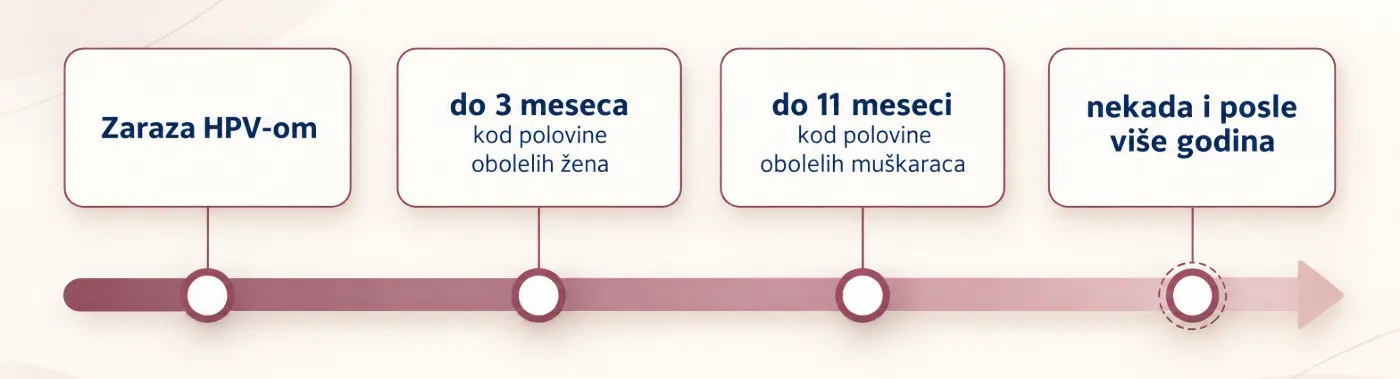
In research, genital warts appear in half of women within the first three months of infection, and in half of men within the first eleven months. [2] For the rest, more time passes, sometimes even several years. Therefore, genital warts cannot be used to determine either when the infection occurred or from whom, and their appearance in a long-term relationship does not imply infidelity.
Genital warts almost always occur through direct skin-to-skin and mucous membrane contact. Towels, toilets and swimming pools are not a common route of infection. Genital warts are more common in smokers, and the more one smokes, the more common they are, as well as in people with a weakened immune system. [2]
How to reduce the risk of transmission
- Condom until changes exist and until post-treatment follow-up. The risk is lower, but it does not disappear.
- No shaving or scratching over the lesions. That is how the virus spreads to the surrounding skin and more lesions appear.
- Partner overview, even when the partner has no visible changes.
- HPV vaccine, which we write about in the section near the end of the text.
Do genital warts go away on their own and are they dangerous
Sometimes they go away. If left untreated, genital warts may clear up, stay the same, or grow and multiply. [1] It is impossible to predict how they will affect a specific person, so a decision on monitoring or treatment is made during an examination.
Genital warts are not life-threatening. The HPV types that cause them are not the ones that can cause cancer. However, genital warts can spread, be transmitted to a partner and interfere with sexual intercourse, which are sufficient reasons to have them examined and, if necessary, treated. Treatment is not urgent, but untreated growths can grow and multiply, so it is easier to deal with them while they are small.
Greater caution is required in people with a weakened immune system. In their case, genital warts are more persistent and return more frequently, so the lesions are monitored more carefully.
Rarely, when left untreated for a long time or when immunity is weakened, condylomas grow into large, hard masses. At that point, a tissue sample and treatment by a specialist are required.
Condyloma-like lesions
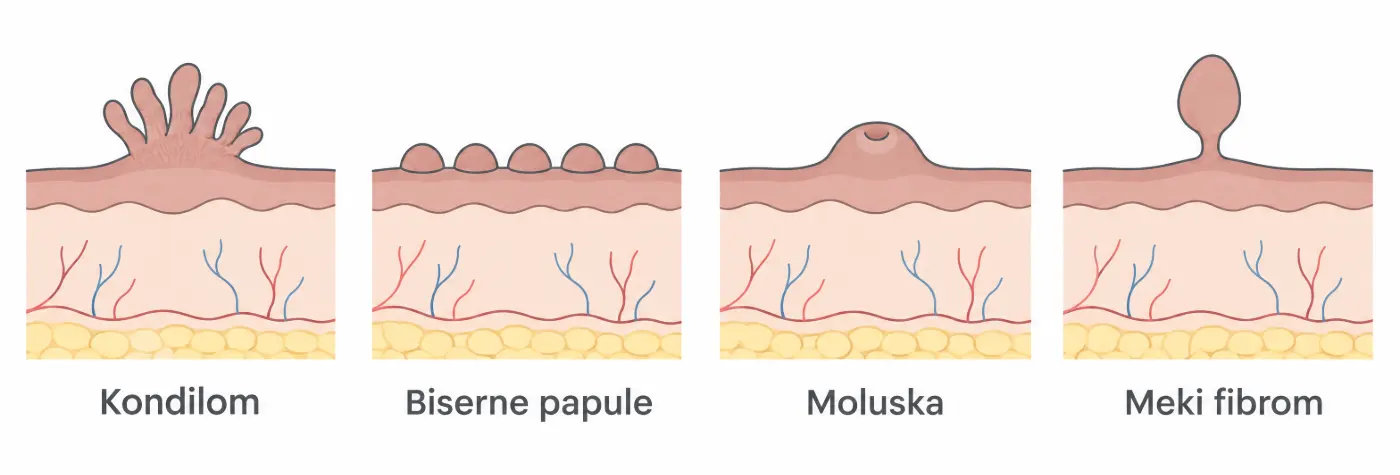
Many growths in the genital region are not condylomas; colloquially, they are also called pseudo-condylomas. Some are part of the normal structure of the skin and mucous membrane and are not treated, while others are other, most commonly harmless changes. The table shows those that are most often confused with condylomas.
| Promenade | What it looks like | What it is |
|---|---|---|
| Pearly penile papules | Fine, smooth, skin-coloured papules, regularly arranged in one or more rows around the margin of the glans | Normal variant; they are present in 8 to 43% of men in research; they are not contagious [4] |
| Vestibular papillae | Soft, thin folds at the vaginal entrance | Normal mucosal architecture; non-infectious |
| Fordyce spots | Small yellowish spots on the labia or the skin of the penis | Sebaceous glands, normal finding |
| Soft fibromas | Soft skin tags on a stalk, common in skin folds and also in the groin | They are not contagious; they are described on the page papilloma removal |
| Molluscs | Smooth, shiny bumps with a small central dimple | Contagious viral skin infection not caused by HPV; described on the page molluscum removal |
| Seborrhoeic keratoses | Brown waxy changes on the skin, as if glued on | They are benign and not contagious |
There are also changes that are not harmless. Condylomata lata are a sign of secondary syphilis, which is confirmed by a blood test. [1] Therefore, a lesion should not be assessed using pictures from the internet: a doctor makes the distinction through an examination and a dermatoscope.
How is the diagnosis made?
The diagnosis is made by examination. A dermatovenerologist most often recognises condylomas with the naked eye, while dermatoscope magnification helps with tiny lesions. [1] An HPV test and virus typing are not necessary, as the result changes neither the diagnosis nor the treatment. Nor is a Pap smear used to detect condylomas: it reveals early changes on the cervix.
A tissue sample for analysis is rarely taken: when the diagnosis is uncertain, when the lesion is dark, hard or fixed to the underlying tissue, when it bleeds or has a sore, and when it does not respond to treatment or worsens during treatment. In people with a compromised immune system, the doctor decides in favour of this more readily.
Since genital warts are sexually transmitted, tests for other sexually transmitted infections are also advised alongside them.
When to see a doctor
- when you notice a new growth on your genitals, in the groin area or around the anus;
- when a lesion grows, bleeds, hurts or changes colour;
- when your partner has genital warts, and if you have no lesions;
- when you are pregnant and notice growths;
- when genital warts return after treatment.
What does an examination look like
Dermatological examination No preparation is required. The doctor examines the skin of the genitals, groin and around the anus, asks when you noticed the changes and whether you have already treated them, and then explains the findings and options. The conversation and examination are confidential. You can also come for an examination when you are not sure whether a change is a wart: finding that everything is fine is also useful.
How are genital warts treated
Treatment removes the visible lesions, but not the virus itself. Condylomas are removed by a doctor using radiowaves, a laser or liquid nitrogen, or they are treated with topical therapy that the patient applies at home following a doctor's instructions. No method is reliably better than the others and none suits everyone, so the choice depends on how many lesions there are, their size and where they are located. [1]
Genital warts can return after treatment, especially in the first three months. That is why follow-up is part of the treatment, and any new lesion is dealt with while it is still small.
Removal by a doctor resolves visible changes in one or a few visits. Topical treatment takes weeks and requires patience and regular application. Sometimes the two options are combined: larger changes are removed, while small and widespread ones are treated at home.
What the procedure looks like, how long the recovery takes and what the price depends on is described on the page condyloma removal.
Genital warts in pregnancy
During pregnancy, genital warts can grow and multiply. [2] Topical treatment applied at home is not used at that time. Removal by a doctor is possible, and the decision on whether and when to do so is made together with the gynaecologist; treatment is often postponed, as the lesions frequently resolve on their own after childbirth.
A Caesarean section is not performed solely because of condylomas. It is considered when the lesions obstruct the birth canal or if delivery would lead to heavy bleeding. [1] Types 6 and 11 can, rarely, cause growths in the child's throat, but this risk is low. A pregnant woman who notices growths should inform the gynaecologist managing her pregnancy.
HPV vaccine and partner
The HPV vaccine does not work on genital warts that already exist. [1] It protects against virus types with which a person has not yet been in contact, including types 6 and 11. It provides the most benefit before the start of sexual activity, but it can also be discussed later.
In Serbia, the nonavalent vaccine is administered. According to the immunisation guidelines issued by the Batut Institute for 2026, it is recommended for children and young people aged 9 to 19. Young people aged 19 to 26 may receive it depending on available quantities, and individuals between 27 and 45 years of age when a specialist assesses that an indication exists for it. [5] For children aged 9 to 14, two doses are scheduled with an interval of six months, and from the age of 15, three doses over the course of six months. [5]
Adults receive the vaccine at the institute or public health bureau, at the student health service or from their chosen doctor. According to data from the Batut Institute, vaccination is free of charge for the stated age groups. [6] You can discuss whether the vaccine is suitable for you during an examination with a dermatovenereologist, who can also determine the indication for the age group from 27 to 45 years.
The current partner should be told about the diagnosis. Couples often share the same HPV, even when only one of them has visible lesions, so the appearance of genital warts does not indicate who infected whom. The partner can be offered an examination and tests for other sexually transmitted infections; an HPV test is not necessary for them. [1]
Have a question?
Frequently asked questions about genital warts
How do I recognise genital warts?
By small skin-coloured growths in the genital region or around the anus that were not there before and are usually painless. A doctor can make a reliable distinction from harmless changes through an examination.
Do genital warts go away on their own?
Sometimes yes, but it cannot be predicted in whom. They can also stay the same or multiply, so an examination is a sensible first step.
How soon after intercourse do genital warts appear?
After several weeks or months, and sometimes even after several years; in men usually later than in women. Therefore, the time of infection cannot be determined precisely.
Do genital warts mean that a partner has been unfaithful?
No. The virus can lie dormant for months and years, so genital warts can appear even in a long-term relationship.
Can genital warts cause cancer?
The types of HPV that cause genital warts are not the ones that cause cervical cancer. Regular gynaecological check-ups remain important, as you may also be carrying another type of the virus.
Can genital warts be transmitted through oral sex?
I can, but rarely: the virus affects the genital region much more often than the mouth.
Can I get genital warts from a swimming pool or through a towel?
That is not a common route of infection: the virus is transmitted through close skin-to-skin contact during sexual intercourse.
Should I go to the doctor?
A dermatovenerologist for all external changes on the genitals, in the groin and around the anus. Internal changes are examined by a gynaecologist, urologist or proctologist, depending on the location, and changes in the mouth by a dentist.
Book a consultation
Imedic policlinic is located at Kneza Miloša 23, 2nd floor, Belgrade, and is open every day from 9 am to 9 pm. Genital warts are examined and treated by dermatology and venereology specialists, Dr Marina Ćirović and Dr Sanja Kekić. Appointments can be booked by phone or, if you prefer, by sending a message to Viber or WhatsApp, to the number 064 237 0707. In the message, it is enough to write that you want an appointment with a dermatovenereologist; do not send photographs of the lesions.

Author: Dr Miloš Živković
Doctor in specialist studies of aesthetic, plastic and reconstructive surgery at the Faculty of Medicine, University of Belgrade; in practice she applies radiowave surgery and fractional CO2 laser.
Updated:

Author: Dr Marina Ćirović
Specialist in dermatovenereology; she graduated from the Faculty of Medicine, University of Belgrade in 2015.
Updated:
Expert sources
- Centres for Disease Control and Prevention. Sexually Transmitted Infections Treatment Guidelines, 2021 – Anogenital Warts. https://www.cdc.gov/std/treatment-guidelines/anogenital-warts.htm
- Gilson R, Nugent D, Werner RN, Ballesteros J, Ross J. 2019 IUSTI-Europe guideline for the management of anogenital warts. J Eur Acad Dermatol Venereol. 2020;34(8):1644–1653. https://doi.org/10.1111/jdv.16522
- Morgan J, Oakley A. Anogenital warts. DermNet, 2003; revised 2021. https://dermnetnz.org/topics/anogenital-warts
- Duffill M. Pearly penile papules. DermNet, 2008. https://dermnetnz.org/topics/pearly-penile-papules
- Institute of Public Health of Serbia „Dr Milan Jovanović Batut“. Professional-methodological instruction for the implementation of mandatory and recommended immunisation of the population for 2026, section 6.2. https://www.batut.org.rs/download/SMU%20za%20sprovodjenje%20imunizacije%202026.pdf
- Batut published new data: since the beginning of the year, 335 people aged 27–45 have received the HPV vaccine. UNA, 6 May 2026 (data from the „Dr Milan Jovanović Batut“ Institute of Public Health of Serbia). https://una.rs/zivot/zdravlje/batut-objavio-nove-podatke-od-pocetka-godine-335-osoba-uzrasta-27-45-godina-primilo-hpv-vakcinu


