Jawline, Chin and Lower Face Tightening
Lower face tightening restores a clearer jawline, chin contour and the transition between the face and neck. Sagging in this area of the face is caused by loose skin, fatty tissue that has dropped towards the jawline, excess tissue beneath the chin or loss of bone support, and these causes often occur together. At Imedic poliklinika in Belgrade, depending on the assessment, we use Morpheus8, Attiva radiofrequency, Ultraformer III, collagen stimulators and hyaluronic fillers. When the changes also affect the neck and décolletage, the plan continues with the treatments described on our page about neck and décolletage rejuvenation.
Lower face tightening – at a glance
| What it treats | Sagging jawline, jowls, double chin, less defined chin and sagging neck skin |
|---|---|
| Treatments | Morpheus8, Attiva radiofrequency, Ultraformer III, collagen stimulators and hyaluronic fillers |
| Anaesthesia | Depends on the method: numbing cream, local anaesthesia or none |
| Duration of treatment | 30 to 60 minutes, depending on the method |
| Number of treatments | Depends on the method and findings, usually one to three |
| Result | Tightening: gradual, over two to three months; fillers: immediate |
Jawline: why does it attract so much attention?
The jawline is the boundary between the face and the neck, and it is the first thing people notice when it starts to lose definition. We experience the face as a shape first, and only then do we notice the details. Before we see fine lines or complexion, the eye catches the outer contour in a fraction of a second — from the cheekbones, across the jaw, to the tip of the chin.
The lower third of the face is unique: it is the only line on the face that is not seen as a surface, but as a clear boundary. Any disruption along it is noticed faster than any change on the cheeks. While the tissue is in place, the only edge that can be seen is the jawbone itself. It casts a clean shadow and the eye follows it without interruption. When the tissue slips over that edge, another edge forms above it — a soft bulge of dropped tissue. Instead of a single boundary, the eye now sees two parallel lines, and reads the space between them as heaviness in the lower face.
The triangle of youth inverts
On a younger face, the widest point is the cheekbones, from where the face tapers towards the chin. When fat tissue begins to move downwards, that point falls to the jaw — and the shape inverts. We also judge age by the shape of the face, not just by wrinkles. That is why someone with a good complexion and without a single pronounced wrinkle can look tired and older than they are.
The zone that makeup cannot fix
Makeup corrects the complexion and hides texture. It cannot hide the shadow cast by sagging tissue. Contouring helps in photos, but its effect disappears with movement, speech and on video calls — where the camera sits lower than eye level and further shortens the transition between the chin and the neck. That is why patients are not just looking for better skin. They are also looking for a clear line separating the face from the neck.
The chin, double chin and jawline are not the same problem
A less prominent chin, excess fatty tissue beneath it, and sagging skin along the jawline disrupt the same contour, but each of those problems requires a different approach. That is why the consultation first establishes which problem dominates, and only then is the treatment chosen.
Hyaluronic acid fillers are considered when the proportion needs to be corrected or support replenished, for example when the chin is less defined or the jaw angle has lost its definition. Collagen stimulators are chosen when the jawline needs refreshing and at the same time the quality and firmness of the skin need to be improved.
When submental fat, jowls or minor excess skin predominate, the plan includes Attiva radiofrequency, Morpheus8 or Ultraformer III. These treatments reduce fatty tissue and tighten the skin, but do not change the proportion of the chin itself, so in many patients they are combined with fillers or collagen stimulators.
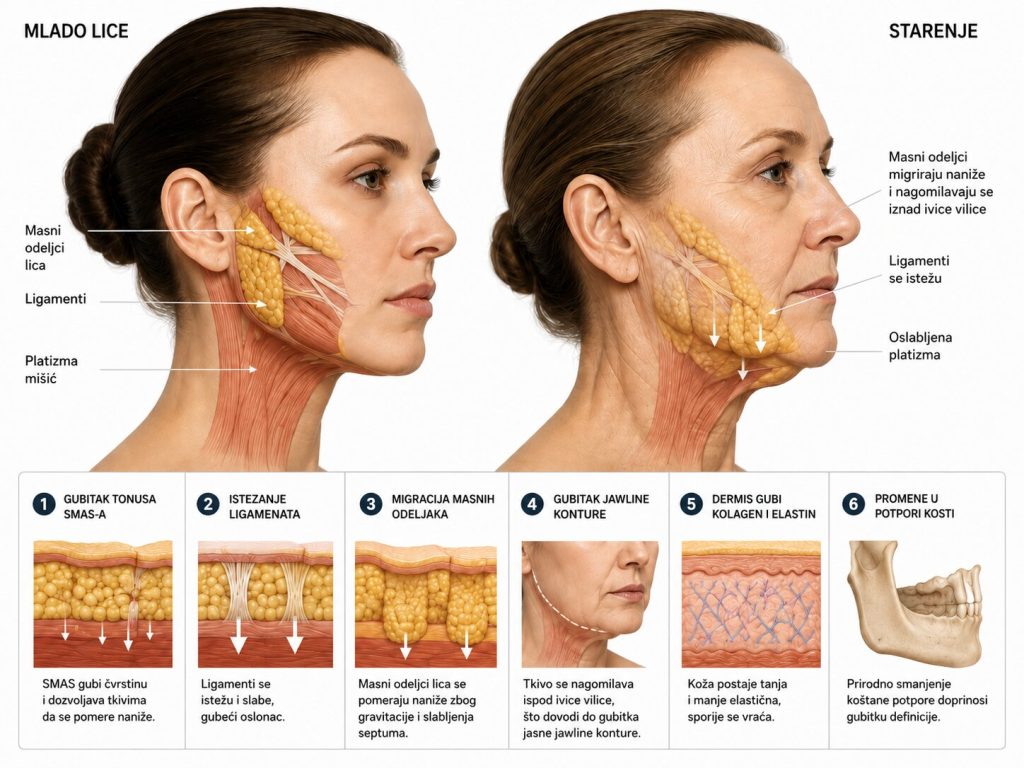
Four deep layers: why the face loses its shape
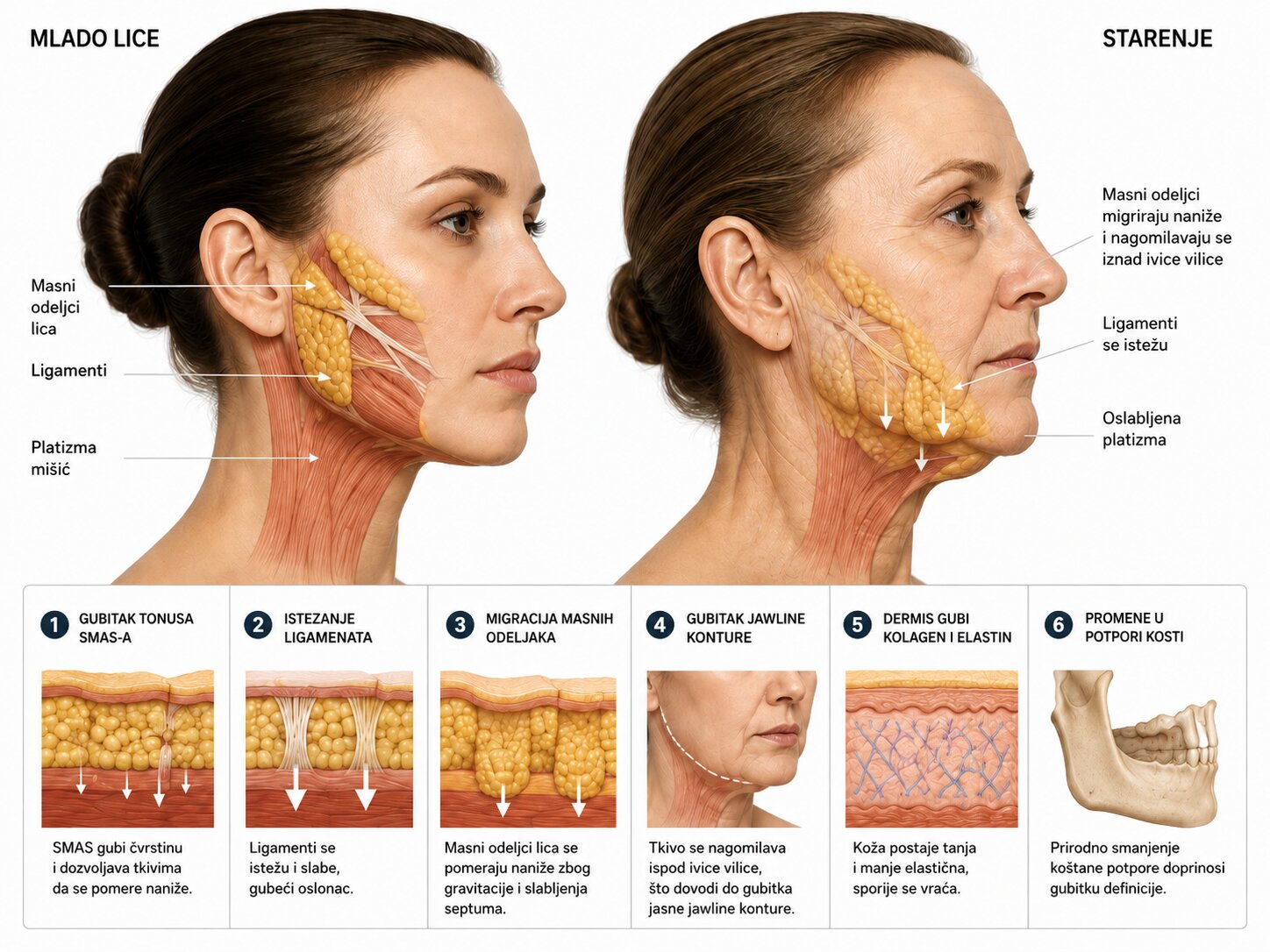
The face does not age in a single layer. Change takes place on four levels simultaneously — and precisely for this reason, two people who come in for an examination with the same concern often leave with different recommendations.
Connective support weakens, but the ligaments hold
Ligaments act like sturdy “clasps” that hold tissue tightly against the bone. In the lower third of the face, the key structure is the mandibular ligament, located midway along the lower border of the jaw.
As the tissue around it loses tone and slides downwards, it stops and accumulates right above that point. This is how jowls form — sagging pouches beside the chin, with the characteristic indentation in front of them. That indentation is not a separate wrinkle: it is the spot where the ligament has stayed in place, while everything around it moved.
Fat tissue shifts downwards
Facial adipose tissue is not a single entity, but a series of separate pads with their own connective tissue septa. With age, these pads do not disappear — they migrate. Gierloff and colleagues demonstrated this migration on CT scans in 2012.
What once sat high on the cheek gently slides towards the jawline, while the compartment it started from empties out. The lower face begins to look creased and heavy — so sudden weight loss often makes it look older, rather than fresher.
The dermis loses its elasticity
The dermis contains collagen and elastin fibres — a network that gives skin its firmness. When you pinch the skin on the back of your hand and let go, how quickly it springs back depends on them.
Over the years, that network weakens and loses its proper arrangement. The skin returns more slowly after every stretch — and it stretches daily, during speech, chewing, and sleeping on one's side.
The jawbone loses volume
The mandible is not a static structure. Shaw and colleagues demonstrated that the angle of the jaw becomes more obtuse with age, and the height of the jaw body and chin decreases — more pronounced in women, especially after the menopause.
The result? The same envelope of skin and tissue now has to fit a shorter and narrower frame. The tissue inevitably gathers where gravity pulls it — right along the jawline.
This is the reason why someone in their fifties notices a change even though they haven't gained or lost weight. The frame has changed, not what covers it.
Which treatment addresses which layer?
Since the problem occurs at various depths, one size does not fit all.
Morpheus8 — dermis and subcutaneous tissue
How it works: It combines microneedling and radiofrequency energy. The needles penetrate the skin and release heat only at their tip, in the deeper layers, whilst the surface remains unaffected. The depth varies within the same treatment — along the jawline, where the skin is thinner, a shallower depth is used; towards the jowls, it goes deeper.
Effect: Heat tightens the connective tissue and triggers the creation of new collagen — a combination described by Dayan and colleagues. It acts on two of the four processes: the thinned dermis and relocated fatty tissue. It does not reach the SMAS.
Recovery and result: redness lasts 2–3 days, makeup can be worn the next day. The final effect is visible after 8–12 weeks. It is most commonly performed in a series of three treatments. You can read all about preparation and the procedure on our page about Morpheus8 treatments.
Attiva — subdermal jawline tightening
How it works: A cannula is inserted through a single entry point and guided just beneath the skin, while radiofrequency energy heats the tissue from within. A sensor in the cannula monitors the tissue temperature, while a thermal camera simultaneously measures the surface temperature.
Effect: it instantly contracts existing collagen fibres, so the tissue is tightened during the procedure itself, and in the following months it stimulates fibroblasts to create new collagen. Along the jawline, the skin has the least support beneath it — there is no fat pad or bone to hold it taut, unlike across the cheeks. That is why tightening that very layer is what restores the transition between the face and the neck.
Recovery and result: Mild swelling lasts for a few days and is most noticeable on the first morning. One to two treatments are usually sufficient. When laxity is accompanied by excess tissue under the chin, we address both in the same procedure, so Attiva is often combined with double chin removal. Read more about the device on our page about Attiva radiofrequency.
Ultraformer III — SMAS layer at 4.5 mm
How it works: it uses focused ultrasound which passes through the superficial layers without heating and converges at a single point at a specified depth. For the lower third, we use the 4.5 mm transducer — that is where the SMAS is located.
Effect: it works on the deep supporting structures, the exact same ones that are tightened during a surgical facelift. White and colleagues demonstrated on anatomical specimens that heating zones can be created precisely within the SMAS while preserving the surrounding tissue, and Alam and colleagues confirmed improvement within 90 days in a clinical study with blinded evaluators.
When it is the right choice: when the skin is still of good quality, but the jawline has lost its definition due to a drop in the tone of deeper structures. When the problem lies in skin quality, the treatment will yield less than expected.
Recovery and result: there is no downtime, although the skin may be slightly red for a few days. The result develops over three months. It is usually done once a year. We have written in more detail about how focused ultrasound works and who it suits in a separate article.
When tightening is not enough: fillers and collagen stimulators
When the skin is not significantly sagging, and the face is still losing its contour, the problem is usually loss of bone support. In that case, tightening only gathers the tissue onto a frame that is itself smaller than before.
Collagen biostimulators stimulate the body to create its own connective tissue over a wider area. The material degrades over time, leaving behind the collagen that the body has produced itself — which is why the result appears gradually and treatment is done in a series. This is the choice when tissue density is desired rather than a sharp line. Read more about the collagen stimulator.
Hyaluronic acid fillers are placed deep, against the bone — by the angle of the jaw or on the chin — and they make up for lost bone volume. The effect is visible immediately and, unlike stimulators, it can be corrected. For the lower third we use denser products, because they are required to hold their shape. See examples of chin and jawline contouring with fillers.
Comparative overview of methods by depth and recovery
| Method | Depth of action | Number of treatments | Recovery | When results appear |
|---|---|---|---|---|
| Morpheus8 | Dermis and subcutaneous tissue | Usually three, at least a month apart | Redness for 2–3 days | After 8–12 weeks |
| Attiva | Under the skin, along the jawline, double chin and neck | One to two | Mild swelling for a few days, possible bruising | Initial tightening immediately, then gradually over the months |
| Ultraformer III | SMAS layer, 4.5 mm | One to two, annual maintenance | No downtime, possible slight redness | Gradually, full effect after about three months |
| Collagen stimulators | Deeper dermis and subcutaneous tissue | Series, depending on the product | Possible mild swelling and bruising | Gradually, over several months |
| Hyaluronic acid fillers | On the bone: jaw angle and chin | Usually one, with a follow-up visit | Possible swelling and bruising for a few days | Immediately |
Lower face tightening before and after
Before and after photographs show how a correctly chosen treatment can restore a more defined jawline, soften jowls and tighten the transition between the face and neck. The change depends on the initial condition, skin quality and the method chosen during the consultation.

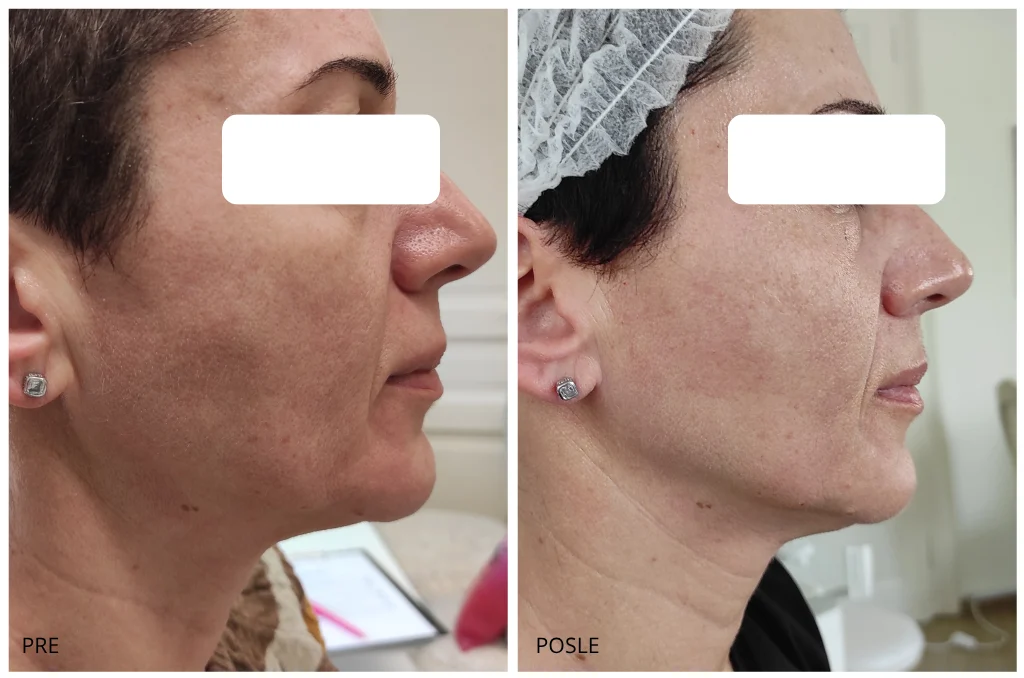
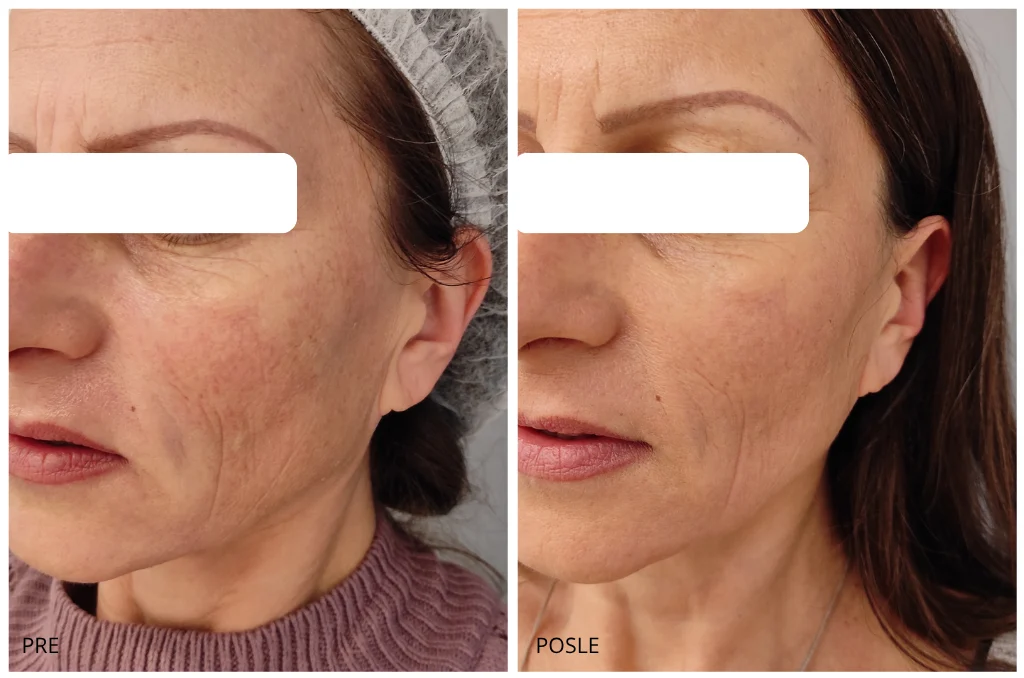
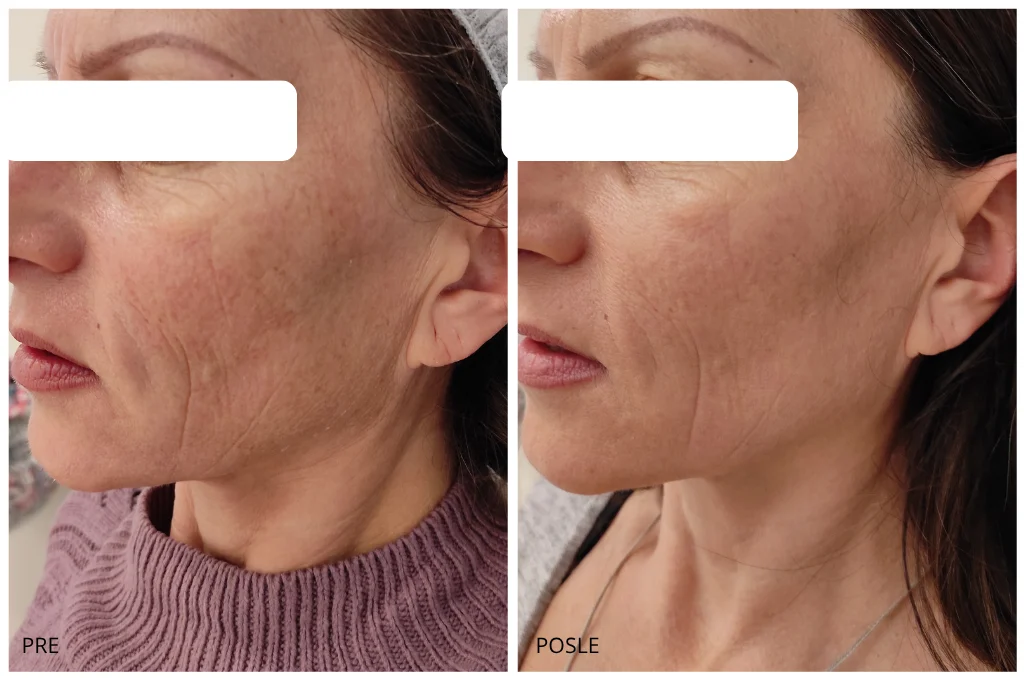
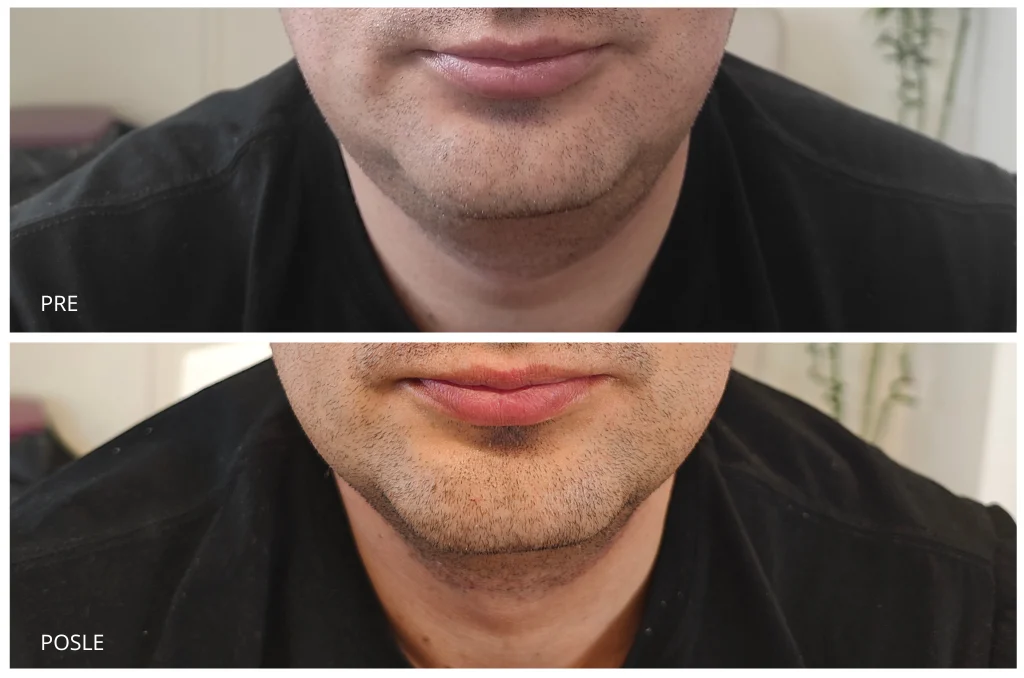
Results are individual. The photographs show the outcomes in specific patients and do not guarantee that the same treatment will produce the same result in every person.
Treatments
Morpheus8, Attiva, Ultraformer III, collagen stimulators and fillers
Number of treatments
Usually from one to three
Result
Tightening: over two to three months; fillers: immediate
When is it time for treatment
The best results are achieved when treatment is started while the laxity is mild to moderate. At that stage, the skin and supporting structures still respond well to collagen stimulation, and the result looks natural. Signs that it is time for a consultation are:
- the jawline looks less defined in profile photos than before
- mild jowls are appearing
- the transition between the face and neck looks softer or fuller
- makeup and lighting no longer hide the shadow along the jawline
In most people, these changes become noticeable after the age of 35, but age is not the only criterion. Heredity, changes in body weight and skin quality influence when they will appear and how fast they progress. Preventive treatments can slow down the process, whereas for more advanced changes the plan combines several methods.
Neck and double chin: why they are assessed together with the jaw
The jawline does not end at the face. The boundary between the face and neck also depends on what is happening beneath the chin: excess fatty tissue in the double chin, sagging neck skin, and horizontal wrinkles can blur the contour even when the jawline itself is well preserved.
That is why the profile is always checked during an examination. If fatty tissue under the chin is dominant, the plan includes double chin removal, which is often performed in the same procedure as Attiva tightening. When the problem is lax, thin neck skin, treatments that act on skin quality and firmness are chosen, such as Morpheus8 and Ultraformer III treatments. In the case of pronounced vertical neck bands and a large excess of skin, non-surgical treatments have a limited effect.
Lower face tightening price
You can view the current prices of radiofrequency and ultrasound tightening treatments in the laser treatments price list, and the prices of fillers and collagen stimulators in our aesthetic treatments price list.
Have a question?
FAQs about lower face tightening
Do I need chin filler or a double chin treatment?
This depends on whether chin projection, fatty tissue, skin or a combination of these is dominant. A filler does not remove excess fatty tissue, and skin tightening does not alter every anatomical proportion of the chin. Therefore, a consultation first determines what is causing the issue, so the plan often consists of two treatments.
When are non-surgical treatments not enough?
In cases of pronounced excess skin or major anatomical changes, the result may be limited. In such instances, it is important to assess whether a surgical opinion would better meet expectations, and we state this as early as the first consultation.
When can the tightening result be seen?
With Attiva radiofrequency, part of the tightening is visible immediately, while the rest develops over the coming months. With the Morpheus8 treatment, the final effect is visible after 8 to 12 weeks, and with the Ultraformer III treatment over about three months. The effect of the hyaluronic filler is visible immediately.
How long does the recovery take?
After the Ultraformer III treatment there is no downtime, only mild redness is possible. After the Morpheus8 treatment the redness lasts for two to three days, and after Attiva radiofrequency, mild swelling can last for several days, with a possible bruise.
Can the treatments be combined?
Yes, and that is often the best choice. In most people, lower face laxity results from a combination of two or three processes, so skin tightening is combined with fillers, collagen stimulators or the removal of a double chin. The sequence and interval between treatments are determined by the doctor.
When is the treatment not performed?
Non-surgical treatments have clear limitations. They are not recommended or require special assessment when:
- there is a large excess of skin hanging below the jaw or on the neck, as a surgical lift gives a more realistic result in that case
- you are pregnant or breastfeeding
- there is an active infection, inflammation or cold sores (herpes) in the treatment area
- you have metal implants or an implanted electronic device (for radiofrequency treatments)
- you have an active autoimmune disease, a clotting disorder or a tendency to form keloids
- the expectations are unrealistic, for example the result of a surgical lift after a single treatment
During the consultation, we clearly state when a non-surgical approach cannot deliver the result you expect and when it is better to consider surgery.
Book lower face tightening in Belgrade
Imedic poliklinika is located at Kneza Miloša 23, 2nd floor, Belgrade. Opening hours: Monday–Sunday, 9:00–21:00.
Appointments can be booked by phone: 064 237 0707. If you contact us from abroad, we are also available via Viber and WhatsApp on the same number.

Author: Dr Ivica Jeremić
PhD in Medical Sciences (Molecular Medicine and Immunology), rheumatology subspecialist, dermatology resident.
Expert sources
- Gierloff M, Stöhring C, Buder T, et al. Aging changes of the midfacial fat compartments: a computed tomographic study. Plast Reconstr Surg. 2012;129(1):263–73.
- Shaw RB Jr, Katzel EB, Koltz PF, et al. Aging of the mandible and its aesthetic implications. Plast Reconstr Surg. 2010;125(1):332–42.
- Dayan E, Chia C, Burns AJ, Theodorou S. Adjustable depth fractional radiofrequency combined with bipolar radiofrequency: a minimally invasive combination treatment for skin laxity. Aesthet Surg J. 2019;39(Suppl 3):S112–9.
- White WM, Makin IRS, Barthe PG, Slayton MH, Gliklich RE. Selective creation of thermal injury zones in the superficial musculoaponeurotic system using intense ultrasound therapy: a new target for noninvasive facial rejuvenation. Arch Facial Plast Surg. 2007;9(1):22–9.
- Alam M, White LE, Martin N, et al. Ultrasound tightening of facial and neck skin: a rater-blinded prospective cohort study. J Am Acad Dermatol. 2010;62(2):262–9.


