Hyaluronic acid dermal fillers in Belgrade
Are you noticing the first fine lines on your face, are your dark circles becoming more pronounced, and are your cheeks losing their firmness? You might be considering a subtle lip augmentation or a gentle enhancement of your cheekbones. Hyaluronic acid fillers can offer solutions for these changes, as well as for improving the overall quality and freshness of your skin. We perform treatments at our clinic in central Belgrade, with a plan tailored to your facial anatomy.
Prices of hyaluronic acid fillers
The price depends on the amount of product (the number of millilitres) and the area being treated. A smaller amount is sufficient for a subtle correction, whereas more product is required in cases of pronounced volume loss. The doctor determines the treatment plan and amount during the consultation.
| Quantity / treatment | Price |
|---|---|
| Hyaluron filler 1 ml | £30.000 |
| Hyaluronidase filler 1.5 ml | 41.000 RSD |
| Hyaluronic acid filler 2 ml | 50.000 RSD |
| 3 ml and more | 24.000 RSD per millilitre |
| Lips – Juvederm Smile (0.55 ml) | 17.500 RSD |
| Lips – Belotero (0.6 ml) | 17.500 RSD |
| Lips – Teosyal Kiss (0.7 ml) | 24.000 RSD |
| Removal of hyaluronan with hyaluronidase | 17.500 RSD |
Prices are in dinars. Payment by card in instalments is also available.
Hyaluronic fillers at a glance
| What it treats | Loss of volume, wrinkles, dark circles, lips and facial contours |
|---|---|
| Anaesthesia | Anaesthetic cream; certain preparations also contain a local anaesthetic |
| Duration of treatment | 15 to 30 minutes, depending on the area |
| Result | Visible immediately, final after the swelling subsides |
| Duration of results | Depends on the area: lips 6 to 12 months, cheekbones up to two years |
| Amount of product | Determined after a consultation and analysis of facial proportions |
What are hyaluronic fillers?
Facial fillers – where hyaluronic acid fillers are used
What are hyaluronic acid fillers used for?
Hyaluronic fillers are used when the face loses volume or when a specific area needs precise correction. They are most commonly applied for:
- nasolabial folds and marionette lines
- lips
- dark circles and tear troughs
- cheekbones and the middle third of the face
- chin and jawline
- temples
- fine lines around the mouth
Apart from the face, they are also applied to the neck, décolletage and hands.
Fillers do not resolve every wrinkle. Wrinkles caused by muscle movement (on the forehead, between the eyebrows, around the eyes) usually require a different treatment, and filler is then used only as a complement.
Hyaluronic lip fillers
The lips are one of the most requested areas. Dermal fillers are used to correct volume, contour, asymmetry and downturned corners of the mouth, with an emphasis on proportion to the rest of the face.
How much filler goes in the lips – 0.5 ml or 1 ml, how the recovery goes and how long the result lasts is explained on the lip fillers page.
Hyaluronic fillers for nasolabial and marionette lines
Nasolabial folds (lines from the nose to the corners of the mouth) and marionette lines (lines from the corners of the mouth to the chin) develop due to volume loss and tissue sagging with age. These changes often give the face a tired or sad expression.
Hyaluronic acid fillers are used to soften them, restore tissue support and freshen up facial expression. A modern approach involves natural correction – without exaggerated “filling”, but rather by preserving facial expressions and character.
The effect is visible immediately, and the result is a softer, more rested and rejuvenated appearance.
Hyaluronic acid fillers for under-eye hollows
Volume loss in the under-eye area creates a shadow and the appearance of chronic fatigue. A precisely placed filler can soften the depression, reduce the shadow and refresh the look, but the shadow under the eye is not always caused by volume loss.
Which type of dark circles you have and which treatment works for them is explained on our page about removal of dark circles under the eyes.
Hyaluronic fillers for cheekbones
Restoring volume to the cheekbones raises the midface and gives a subtle lifting effect. This is one of the key anti-ageing areas as it influences overall facial harmony.
Cheek filler often indirectly softens nasolabial folds as well.
To see what cheekbone correction looks like in practice, take a look at our case study of cheek and chin filler rejuvenation.
Hyaluronic acid fillers for chin and jawline
Used for:
- jawline contouring
- profile enhancement
- chin projection
- balancing facial proportions
In women they give a more elegant facial contour, and in men a more prominent and defined jawline. When, alongside the loss of contour, there is also tissue sagging, the filler is combined with other methods — we wrote about this in our article about tightening of the lower third of the face.
The chin and jawline contouring plan is shown in our case study on facial contouring with fillers.
Fillers for fine lines and the perioral region
They can also be used for fine lines around the lips (so-called “smoker's lines”), most commonly in combination with expression line treatments, as well as for refreshing the skin around the mouth and cheeks.
Hyaluronic acid fillers for temples
Hollow temples give the face a tired and gaunt appearance, and are often overlooked as the cause. Filler placed deep into this area restores the smooth line from the forehead to the cheekbones. In a clinical trial, about three-quarters of patients still showed improvement after one year.
Hyaluronic fillers for the neck
On the neck, filler is used for horizontal lines that are visible even when the neck is at rest. It is applied in a very thin layer and in small amounts. In a review of studies, about half of patients needed a top-up within a year. Other neck and décolletage treatments are described on our page about neck and décolletage rejuvenation.
Hyaluronic fillers for hands
As we age, the skin on our hands becomes thinner, making tendons and veins more visible. A filler restores some of the lost volume to the back of the hand. The treatment is usually performed using a cannula, and the swelling subsides within a few days.
When veins and tendons are accompanied by blemishes or dry skin, the filler is combined with other treatments. Read more about this on our page about hand rejuvenation.
How long do hyaluronic acid fillers last and when is the treatment repeated?
The hyaluronic acid filler gradually breaks down in the tissue, so the treatment is repeated after a certain time. How long the result lasts depends primarily on the area:
| Area | Approximate duration |
|---|---|
| Lips | 6 to 12 months |
| Nasolabial folds | up to a year |
| Cheekbones and middle third of the face | 12 to 24 months |
| Chin and jawline | about a year |
| Temples | about a year |
| Dark circles | up to a year, in some cases longer |
What affects the duration:
- Mobility of the area. In the lips, which are constantly moving, filler breaks down faster than in the cheekbones.
- Type of product. Thicker and more strongly cross-linked fillers last longer.
- Amount and depth of application.
- Sun and heat. UV radiation and heat accelerate the breakdown of hyaluronic acid. Therefore, for the first two weeks after the treatment, saunas and radiofrequency treatments on the same area should be avoided.
What does the treatment involve?
Following a detailed examination and analysis of facial proportions, the areas to be treated and the amount of product required for a natural and balanced result are determined.
Prior to the application itself, the skin is thoroughly cleansed and disinfected, and then an anaesthetic cream is applied to make the treatment as comfortable as possible. Most modern fillers also contain a local anaesthetic in their composition, which further reduces discomfort during the procedure.
The hyaluronic acid filler is then applied into the appropriate layer of the skin or, in certain areas, directly on the bone – depending on the aim of the treatment and the desired effect.
The treatment itself lasts on average from 15 to 30 minutes, depending on the area being treated. Following the application, a gentle massage of the treated zone is performed in order to evenly distribute the filler and ensure a smooth, natural look without any bumps.
The result is visible immediately, while the final effect is assessed after any swelling subsides in the coming days.
Hyaluronic acid fillers before and after

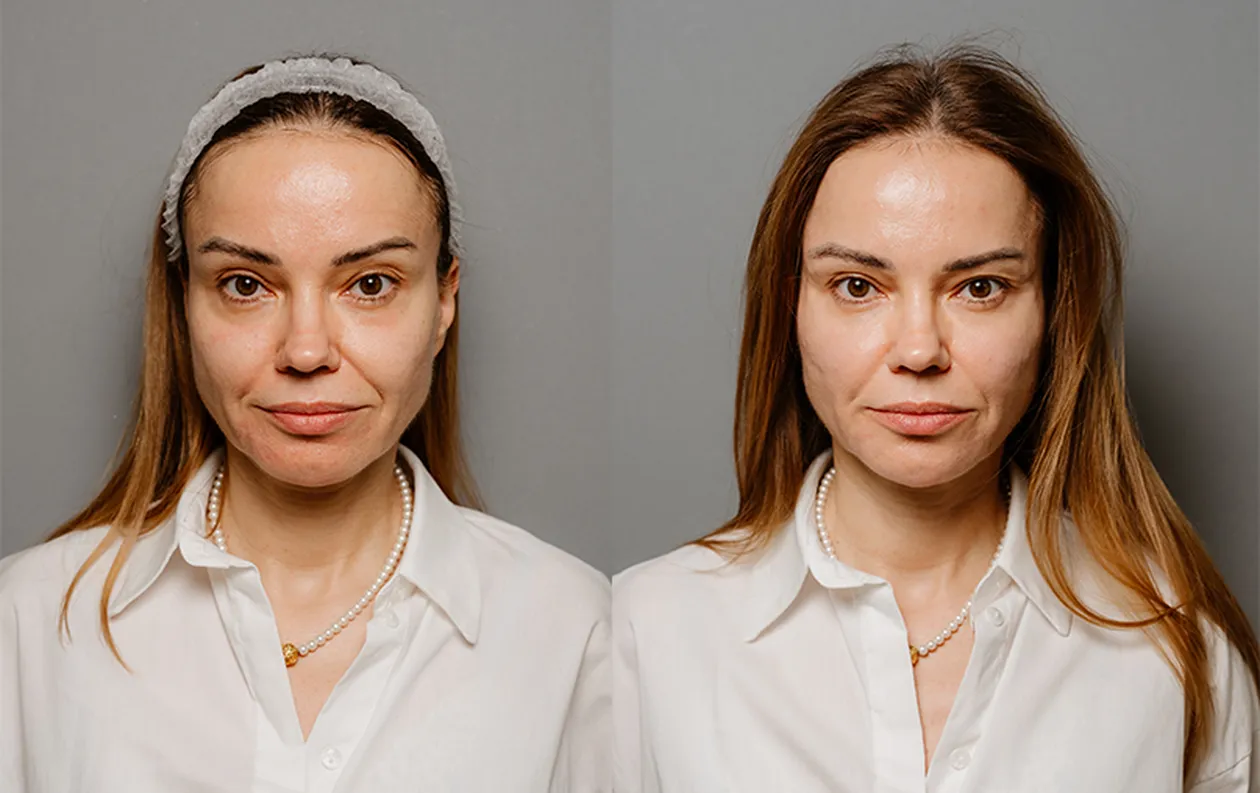


In the case studies, you can see how we treated the cheekbones, chin and other areas of the face. Alongside the photographs, we explain what changes the patient wanted and what the treatment plan looked like. The result depends on the initial anatomy, the amount of product and the treatment plan. We wrote in more detail about what the planning looks like and what is realistically achievable in our case study of facial contouring, and more photographs can be found in the article about rejuvenation with fillers.
Result
Visible immediately, final after the swelling subsides
Duration of treatment
15 to 30 minutes, depending on the area
Duration of results
In the lips for 6 to 12 months, in the cheekbones for up to two years
Have a question?
Answers to frequently asked questions
Is the treatment painful?
An anaesthetic cream is applied prior to the treatment, and most fillers also contain a local anaesthetic. The injections are generally felt as a brief stinging sensation or pressure. The lips are more sensitive than the cheekbones or chin.
Are hyaluronic acid fillers safe?
Hyaluronic acid fillers are considered safe when administered by a doctor who knows facial anatomy. The most common reactions are temporary swelling, bruising and tenderness. Serious complications are rare, and the advantage of hyaluronic acid fillers is that they can be dissolved with an enzyme.
What amount of filler is needed?
There is no exact answer to this question. Essentially, it all depends on what you want to achieve, as well as the individual needs of the patient, facial proportions and skin quality. Therefore, a plan is created for each procedure and treatment according to the patient's needs.
However, we know this is something you want to know, so here is a rough idea of how much hyaluronic acid is needed for the most common treatments.
- Lip enhancement most commonly requires the injection of 0.5 to 1ml of hyaluronic acid;
- Filling the nasolabial folds takes 1 to 2 ml;
- Cheekbone correction requires approximately 1ml per side of the face;
- When it comes to removing dark circles under the eyes, this usually requires around 2 ml of hyaluronic acid;
- If you want to shape your chin and lower jawline, that is the lower third of the face, then around 3ml of hyaluronic acid fillers will be necessary;
- To correct the area around the temples, the so-called temporal region, between 1 and 2 ml is required;
- The increasingly popular 8-point lift with hyaluronic acid will require around 4ml of hyaluronic acid.
Please note that these are only approximate quantities and the doctor will only be able to determine how much filler needs to be injected after examining and assessing your face.
When will I see the first results?
The result is visible immediately after the treatment. Swelling and minor bruising may be present in the first few days, so the final appearance is assessed after about two weeks.
What is important to know before the treatment?
During the examination, the doctor observes the entire face: how it looks at rest, while you speak, and when you smile. Based on this, they suggest which area it makes sense to treat first.
It is important that you also have realistic expectations. The shape of lips or cheekbones that looks nice on another person may not suit your proportions. The goal is a natural look, without an exaggerated effect.
We recommend planning your injectable treatment at least two weeks before an important event. If a series of treatments is required, the plan should start earlier to allow enough time for the full effect to develop.
How do you know if you need dermal fillers?
Fillers are considered when you notice volume loss, hollows or asymmetry that bothers you. At the consultation, the doctor assesses whether filler is the right choice or whether another treatment would be a better solution.
Which hyaluronic fillers do we use?
We use fillers from manufacturers with a long history of clinical use: Juvederm (Volite, Volift, Volux, Volbella), Teosyal, Restylane, Belotero and Maili. All have a CE mark for use in Europe, and most are also approved by the US FDA. The product is chosen according to the area: softer for the lips and fine lines, firmer for the cheekbones and jawline.
For patients who need both volume and an improvement in skin quality, we also use the hybrid product HArmonyCa, which combines hyaluronic acid with a collagen stimulator.
Application with a needle or cannula – what is the difference?
Application with a fine needle enables exceptional precision, particularly when defining contours and achieving a lifting effect. With this technique, it is also possible to place the filler deeper, including application onto the bone, which provides stronger support and a more pronounced lifting effect. Mild bruising and swelling may occur, which are transient and subside over the following days.
Application with a cannula involves a smaller number of punctures – often just one entry point, through which micro-deposits of filler are distributed using the cannula. The advantage of this technique is a lower risk of bruising and injury to blood vessels, as well as a quicker recovery. This method is particularly suitable for larger and more sensitive areas.
The choice of technique depends on the area, the patient's anatomy and the treatment goal – and in practice, both methods are often combined to achieve the best result.
How should I look after my face after dermal fillers?
Follow the instructions you receive for the treated area. Do not press or massage the injection sites without a doctor's recommendation. At your treatment, you will also receive specific guidelines for makeup, exercise and skincare.
What if lumps appear, or the filler moves?
We know you may be wondering whether complications can occur with hyaluronic acid fillers. This happens very rarely, provided that you have entrusted your face to professionals at a reputable medical facility.
However, in certain cases it is possible that one of the following situations may occur.
Hyaluronic acid lumps
It might sound frightening, but this is not a serious complication. Lumps most often result from improper injection technique. As we have mentioned, after applying the filler, the doctor will gently massage the treated area, precisely in order to prevent the appearance of lumps. Hyaluronic acid needs some time to fully blend with the tissue, but if you notice lumps even after three weeks, the doctor will expertly remove them. This is done by massage or by dissolving the filler with an enzyme called hyaluronidase.
Too much filler
Sometimes patients come to us who have previously had filler applied elsewhere and are not satisfied with the appearance. In such cases, the excess is broken down using the enzyme hyaluronidase. The effect can be seen within a few hours to two days.
Filler migration
This will happen very rarely, but it is possible for the filler to migrate if you press on or vigorously massage the treated part of the face after the treatment. Therefore, it is important that you do not do this.
When you should see a doctor immediately
A rare but serious complication is the blockage of a blood vessel by a filler. The signs are severe pain, pale or dark blue skin at the treatment site, and visual disturbances. If you notice these during or after the treatment, contact a doctor immediately. The doctor then administers hyaluronidase, according to the protocol for such cases.
Adverse reactions
The most common reactions are temporary swelling, bruising and tenderness of the treated area. With cannula application, bruising is less frequent than with a needle. An allergic reaction to the product occurs very rarely.
Are dermal fillers allowed during pregnancy and while breastfeeding?
No. The safety of fillers during pregnancy and breastfeeding has not been established, so the treatment is postponed until breastfeeding is finished.
What is the difference between hyaluronic acid and a hyaluronic filler?
Hyaluronic acid is naturally found in the skin and binds water. In creams and serums, it acts on the surface. A filler is a gel made of cross-linked hyaluronic acid, which is injected into or beneath the skin and retains its shape for months. Non-cross-linked hyaluronic acid is used in skin boosters and biorevitalisation, for hydration without adding volume.
Does it matter which filler is used?
Yes. Fillers vary in density and elasticity. A softer gel is chosen for the lips, and a firmer one, which provides support, for the cheekbones and jawline. That is why different types of products are often used on the same person, each for its specific area.
Can filler be dissolved?
Yes. Hyaluronic filler is broken down by the enzyme hyaluronidase. It is used when the result is uneven, when the filler has migrated or in case of complications.
Where is the treatment carried out and when can you come?
Hyaluronic acid filler treatments are performed at Imedic poliklinika, Kneza Miloša 23, 2nd floor, Belgrade. The location is right in the city centre, just a few minutes' walk from Slavija and Nikola Pašić Square.
We are open every day, Monday to Sunday, from 9 am to 9 pm. Treatments are scheduled after a consultation, during which the area to be treated and the amount of product required are assessed.
Contraindications
Hyaluronic fillers are considered safe in modern aesthetic medicine, but there are clearly defined situations in which their application is not recommended or must be postponed. Absolute contraindications include active skin or systemic infections, herpes in the treatment area, malignant disease, coagulation disorders, known hypersensitivity to the ingredients of the preparation, as well as pregnancy and the breastfeeding period. The treatment is also not performed in cases of autoimmune diseases in the active phase, due to the increased risk of adverse immunological reactions.
Relative contraindications involve conditions that require additional assessment and caution, such as inflammatory skin conditions (acne, dermatitis, active rosacea), therapy with medications that affect blood clotting, a tendency to form keloid scars, and recent dental or aesthetic procedures in the same area. Therefore, prior to any application of hyaluronic acid fillers, a detailed medical history and individual assessment are necessary in order to carry out the treatment safely and with optimal results.
Book a hyaluronic acid filler treatment in Belgrade
Imedic poliklinika is located at Kneza Miloša 23, 2nd floor, Belgrade. Opening hours: Monday–Sunday, 9:00–21:00.
Appointments can be booked by phone: 064 237 0707. If you contact us from abroad, we are also available via Viber and WhatsApp on the same number.

Author: Dr Ivica Jeremić
PhD in Medical Sciences (Molecular Medicine and Immunology), rheumatology subspecialist, dermatology resident.
Expert sources
- FDA: dermalni fileri — primena i rizici (informacije američkog regulatora)
- Murray i saradnici, 2021 — smernice za začepljenje krvnog suda posle hijaluronskog filera (J Clin Aesthet Dermatol)
- DeLorenzi, 2017 — protokol hijaluronidaze kod vaskularnih komplikacija (Aesthet Surg J)
- Rzepniewski i saradnici, 2024 — trajanje hijaluronskih filera (Dermatol Rev)
- Wong i saradnici, 2026 — fileri za horizontalne linije vrata, sistematski pregled (ASJ Open Forum)
- Garg i Mysore, 2022 — dermatološke i estetske procedure u trudnoći (J Cutan Aesthet Surg)


