Cellulite subcision
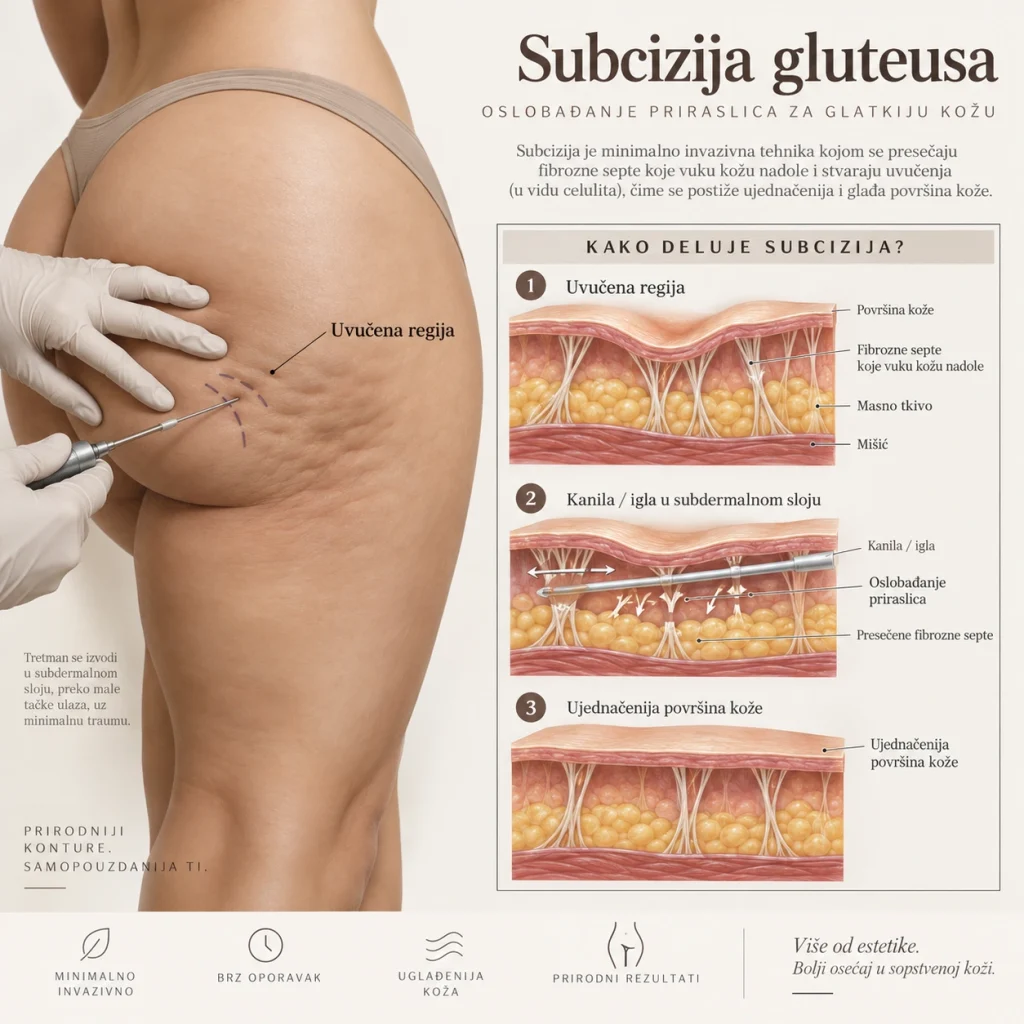
Dimples on the thighs and buttocks that remain visible even when you are standing still, regardless of exercise and weight, are usually not caused by fat. They are caused by rigid connective tissue septa beneath the skin, which pull it downwards like tight threads. Cellulite subcision targets them directly: using a fine needle, the fibrous bands are released, and the skin is smoothed out. At Imedic poliklinika, subcision is performed in combination with mesotherapy to simultaneously improve the quality of the tissue in the treated area.
Cellulite subcision – at a glance
| What it treats | Dimples in pronounced, fibrous cellulite on the thighs and buttocks |
|---|---|
| Method | Release of fibrous septa with a fine needle, under local anaesthesia, in combination with mesotherapy |
| Number of treatments | Usually one treatment per area; a repeat session can be planned after at least 2 months |
| Result | Assessed at the follow-up visit, once swelling and bruising have subsided |
| Treatment plan | Decided at the consultation, with you standing, based on the number and depth of the dimples |
Why cellulite dimples form
Beneath the skin lies a layer of fatty tissue, divided by connective tissue septa into smaller compartments. In women, these septa are more frequently arranged vertically, from the skin towards the deeper layers. When they thicken over time and become more rigid, they pull on the skin at the points where they are attached, while the fatty tissue between them bulges out. This is how the familiar uneven surface, with dimples and protrusions, is formed.
Because of this, the dimples are more pronounced when you stand, when you pinch the skin or when you tense your muscles, and less so when you lie down. Milder cellulite responds well to device-based treatments that improve circulation and skin firmness. With fibrous cellulite, where the septa are rigid and visibly pull the skin inward, it is necessary to act directly upon them, and that is the role of subcision.
Read more about the types of cellulite and the treatments for each of them in our article on cellulite treatments.
How cellulite subcision is performed
What is cellulite subcision?
Subcision is a minimally invasive procedure in which fibrous septa that cause dimples are released beneath the skin. The doctor inserts a thin needle through a small puncture parallel to the skin surface and uses it to cut the septa at the site of each depression. Once the septum no longer holds the skin down, the skin lifts and flattens.
Over the coming weeks, the freed space fills with new connective tissue, which helps the skin remain smoother. The puncture marks are tiny and fade quickly.
Who is it for?
Subcision is intended for indentations on the thighs and buttocks that are clearly visible even when standing relaxed, without tensing the muscles. These are most commonly single or grouped indentations on the back and outer sides of the thighs and on the buttocks.
For mild cellulite, which is visible only when the skin is pinched, non-invasive treatments are preferred, such as Shockwave therapy. When the main problem is sagging skin or excess fatty tissue rather than indentations, skin tightening and body contouring treatments are chosen. The doctor will assess which approach suits you at the consultation.
What does the treatment involve?
Assessment and marking are done while you are standing, as this is when the indentations are best seen. The doctor marks each indentation to be treated with a pen. The area is then disinfected and local anaesthetic is administered, making the procedure itself tolerable.
A needle is used to release the septa beneath each marked depression through a small puncture. Afterwards, the doctor presses on the treated area for a few minutes to reduce bleeding beneath the skin and the formation of larger bruises. Mesotherapy of the area is also performed during the same appointment.
Why is it combined with mesotherapy?
Subcision acts on the bands that pull the skin inwards, but it does not change the quality of the tissue around them. Body mesotherapy introduces active substances into the treated area and complements the effect of subcision on skin texture and firmness. Therefore, at Imedic poliklinika, cellulite subcision is performed together with mesotherapy, in the same session.
Recovery after subcision
Following the treatment, the treated area is sensitive and swollen, and bruising also appears. This is an expected reaction, as the procedure is performed beneath the skin. The bruises usually fade over the course of a few weeks. In some patients, temporary brown spots remain at the site of the bruises, which fade on their own over time.
You can return to everyday activities quickly, but intensive exercise and strenuous activity should be postponed for 1 to 2 weeks. During the first few weeks, compression garments are worn, which reduce swelling and help the tissue recover properly. If pain or swelling increases instead of subsiding, contact your doctor.
Results and how long they last
The first changes are visible once the swelling and bruises subside, and the final appearance is assessed at the follow-up examination. The aim is for the depressions to be shallower and less noticeable, and the skin more even.
As the fibrous bands causing the dimples are released, the result is long-lasting. In studies, the results were still present 2 years after treatment. The appearance of new dimples is influenced by body weight changes, hormones, and hereditary predisposition, so any new dimples can be treated in the same way.
Contraindications
Subcision is not performed during pregnancy and breastfeeding, in the presence of an active infection or skin inflammation in the area to be treated, in blood clotting disorders, and in case of an allergy to local anaesthetic. Before the treatment, tell your doctor about all the medicines you are taking, especially blood thinners, as well as any tendency towards keloids or the formation of darker spots after skin injuries.
Subcision and other cellulite treatments
Subcision treats the dimples, whereas cellulite most commonly has multiple causes simultaneously. That is why it is frequently integrated into a broader plan, alongside treatments that improve circulation, skin firmness and muscle tone: Shockwave therapy, Alma PrimeX, Emsculpt and lymphatic drainage. We have described the entire protocol and the role of each treatment on our page about anti-cellulite treatment.
Subcision is also used for depressed acne scars, but it is a different procedure, described on our page about acne scar subcision.
Cellulite subcision price
Cellulite subcision is priced per area and includes mesotherapy. You can view the price, as well as packages where subcision is combined with other body treatments, in our body treatments price list.
Have a question?
Frequently asked questions about cellulite subcision
Is cellulite subcision painful?
The procedure is performed under local anaesthesia, so you will mostly feel pressure during the treatment. The most unpleasant part is the administration of the anaesthesia itself. After the treatment, the area is tender to the touch for a few days, similar to a bad bruise.
How many treatments are needed?
Usually, one treatment per region is enough. If, after recovery, some dimples remain untreated or only partly smoothed, the treatment can be repeated after about 2 months at the earliest.
When are the results visible?
The result is assessed once the swelling and bruising subside, usually after a few weeks. The tissue continues to firm up gradually even after that, so the final appearance is evaluated at the follow-up examination.
Does subcision reduce thigh circumference?
Subcision does not reduce the circumference of the area, as it does not remove fatty tissue. It smooths out depressions and evens out the skin surface. To reduce circumference and fat deposits, other body treatments are used, and these can be combined with subcision.
Which areas can be treated?
Cellulite subcision is performed on the thighs and buttocks, where fibrous cellulite most commonly occurs.
When can I return to exercise and swimming?
Light activities can be resumed immediately. Intensive exercise, saunas and swimming pools should be avoided for 1 to 2 weeks, until the punctures close and the swelling subsides. Exact recommendations are given by the doctor after the treatment.
Does cellulite return after subcision?
Dimples that have been treated usually stay flatter for a long time after the treatment. However, the tendency towards cellulite remains, so new dimples may appear over time, especially after major changes in body weight. Regular exercise and a stable weight help the results to last longer.
Book cellulite subcision in Belgrade
Imedic poliklinika is located at Kneza Miloša 23, 2nd floor, Belgrade. Opening hours: Monday–Sunday, 9:00–21:00.
Appointments can be booked by phone: 064 237 0707. If you contact us from abroad, we are also available via Viber and WhatsApp on the same number.

Author: Dr Ivica Jeremić
PhD in Medical Sciences (Molecular Medicine and Immunology), rheumatology subspecialist, dermatology resident.
Expert sources


