Laser tattoo removal
We perform laser tattoo removal using the Q-switched Nd:YAG laser. The laser breaks down the pigment in the skin, so the tattoo fades from one treatment to the next. We remove black and multi-coloured tattoos on the face and body, as well as tattooed eyebrows. The number of treatments depends on the size, colour and density of the pigment, and the gap between treatments is 6 to 8 weeks.
Laser tattoo removal – in brief
| When it is done | At the earliest six months after getting a tattoo |
|---|---|
| Laser | Q-switched Nd:YAG |
| Anaesthesia | Cooling gel, anaesthetic cream if necessary |
| Number of treatments | On average 6 to 8 treatments spaced 6 to 8 weeks apart |
| Result | Lightening after the first treatment; the whole process can take a year or longer |
| Recovery | Redness, mild swelling and a feeling of warmth lasting from several hours to several days |
| After treatment | Sun protection with a high SPF for at least two weeks |
What the number of treatments depends on
The number of treatments is affected by the colour, quantity and depth of the ink, the size of the tattoo, its age and the part of the body it is located on. Dark, single-colour and older tattoos fade more quickly. Multi-coloured tattoos and tattoos that have been reworked or covered with a new one require more treatments. On the hands and feet, where circulation is poorer, the pigment is removed more slowly.
On average, 6 to 8 treatments are required, spaced 6 to 8 weeks apart, so the whole process takes a year or longer. A tattoo can be removed no earlier than six months after being inked, once the skin has completely healed. A laser can also be used just to lighten a tattoo when you are planning to cover it with a new one.
How a laser removes a tattoo
How does a laser work on a tattoo?
Tattoo ink is located in the dermis, the deeper layer of the skin. The laser sends energy in pulses lasting a few nanoseconds, and this energy is absorbed by the pigment. The ink particles are broken down into tiny fragments, which the body gradually removes via the lymphatic system. This is why the tattoo fades from treatment to treatment, while the surrounding skin remains unharmed.
Which colours are removed with a laser?
The 1064 nm wavelength is used for dark colours: black, blue, grey, and dark green. The 532 nm wavelength is used for red, orange, and yellow. Black and dark blue fade the fastest. Green and turquoise shades fade more slowly, and white and skin-toned colours can darken after treatment, so a test pulse is performed on them first.
Q-switched Nd:YAG laser
The Q-switched Nd:YAG is a medical laser that we use at Imedic to remove tattoos and tattooed eyebrows. The same laser is also used for blemishes, hyperpigmentation and skin rejuvenation with the ClearLift treatment. The 1064 nm wavelength penetrates deep into the skin and can also be used on darker skin tones. After the treatment, you can return to your usual daily activities, and the treated skin should be protected from the sun.
Can a tattoo be completely removed?
A tattoo can usually be removed completely or faded so much that it is barely noticeable. Single-colour, dark tattoos are the easiest to remove. Multi-coloured tattoos and tattoos that have been reworked require more treatments. After removal, a slightly lighter mark sometimes remains on the skin.
Laser tattoo removal before and after
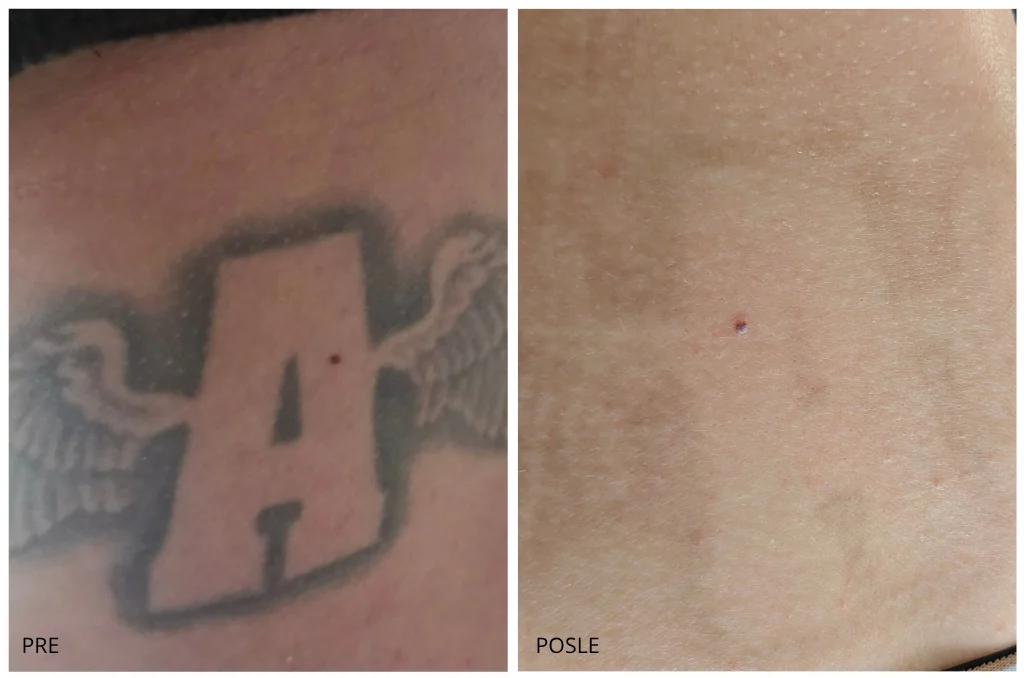
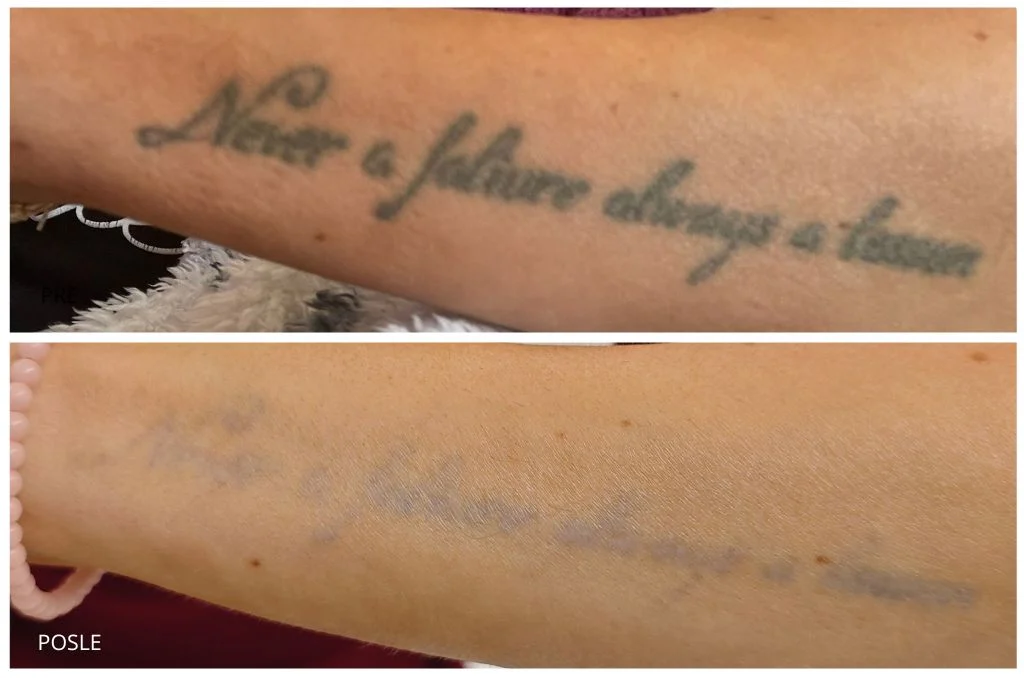
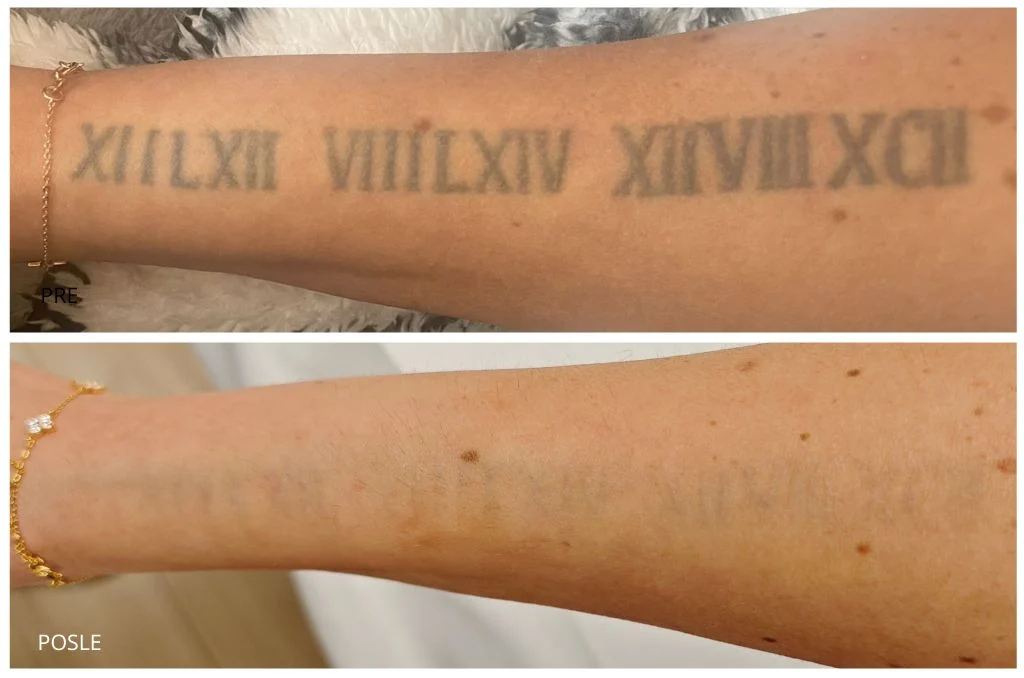
The tattoo fades gradually, from one treatment to the next. The photographs show arm tattoos before and after treatment with a Q-switched Nd:YAG laser.
Number of treatments
On average 6 to 8
Time between treatments
6 to 8 weeks
Result
Lightening after just the first treatment
Cost of laser tattoo removal
The price of laser tattoo removal depends on the size of the area being treated. You can view approximate prices in our Price list. For an accurate assessment and price information, you can send photographs of the area via Viber or WhatsApp on 064 237 0707, after which you will receive an individual assessment and treatment recommendation.
Have a question?
Answers to frequently asked questions
Preparation for laser tattoo removal
No special preparation is required. Before the first treatment, we assess the skin type, depth and colour of the pigment, and if necessary, we also perform a test pulse to determine the optimal energy intensity. During the treatment, the eyes are protected with special goggles. A neutral gel with a cooling effect is applied to the area, and if necessary, an anaesthetic cream for more sensitive patients. The laser breaks down the pigment in the skin with short, powerful pulses, while the patient may feel a slight stinging sensation. After each treatment, the tattoo becomes lighter.
Recovery
Following the treatment, redness, mild swelling and a sensation of warmth are possible, which subside within a few hours to a few days. The area is cooled and cared for with the cream we recommend. The skin should be protected from the sun for at least two weeks and a high-SPF sunscreen applied regularly. During the removal process, peels and aggressive cosmetic treatments on that area are not recommended.
How many treatments are needed?
The number of treatments depends on the size, colour, pigment density and age of the tattoo. Professional and multi-coloured tattoos require more treatments. On average, 6–8 treatments are needed, spaced 6–8 weeks apart. The removal process is gradual and can take a year or longer.
When are the first results visible?
Lightening is visible after just the first treatment, but the true effect can only be assessed through a series of treatments. The body gradually eliminates the broken-down pigment via the lymphatic system, so the results appear gradually.
Is tattoo removal painful?
The sensation during the treatment is most commonly described as a brief, mild stinging or the snap of a rubber band against the skin. The discomfort is short-lived, and if necessary, we use an anaesthetic to make the treatment more comfortable.
Who are the candidates?
Candidates are individuals who wish to remove or significantly lighten a tattoo from any part of the body, including sensitive areas. Treatments are safe when performed with a medical laser and with proper skin assessment.
Does a scar remain after tattoo removal?
When treatment is carried out with a medical laser and the intervals between treatments are respected, scarring is rare. The skin at the tattoo site may temporarily be lighter or darker, and this usually fades over the course of a few months. A scar that formed when the tattoo was originally done remains visible even after the ink is removed.
Can cream or iodine remove a tattoo?
No. The ink is in the dermis, which creams do not reach. Iodine, acids and tattoo removal creams can cause chemical burns and permanent scarring, and they do not remove the tattoo.
Are tattooed eyebrows also removed?
Yes. Tattooed and powder brows are removed using the same laser. Read more about the treatment on our page about laser eyebrow removal.
How much does tattoo removal cost?
The price depends on the size of the tattoo and the number of treatments required. Please send a photograph of the tattoo via Viber or WhatsApp to 064 237 0707, and you will receive information on the price and number of treatments. Approximate prices can be found in the laser treatments price list.
Contraindications
The treatment is not recommended during pregnancy and breastfeeding, in cases of active skin infections, malignant diseases, uncontrolled chronic conditions, nor for individuals taking photosensitising medications or who have active vitiligo and psoriasis in the treated area.
Book tattoo removal in Belgrade
Imedic poliklinika is located at Kneza Miloša 23, 2nd floor, Belgrade. Opening hours: Monday–Sunday, 9:00–21:00.
Appointments can be booked by phone: 064 237 0707. If you contact us from abroad, we are also available via Viber and WhatsApp on the same number.

Author: Dr Ivica Jeremić
PhD in Medical Sciences (Molecular Medicine and Immunology), rheumatology subspecialist, dermatology resident.
Updated:


