Attiva radiofrequency
Attiva radiofrequency – in brief
| What it treats | Mildly to moderately lax skin and minor excess fat: lower face, double chin, neck, eyelids, stomach, upper arms, and thighs |
|---|---|
| Anaesthesia | Local injection anaesthesia |
| Duration of treatment | 30 to 60 minutes, depending on the area |
| Number of treatments | On average 2 |
| Result | Gradual tightening and a clearer contour over the coming weeks |
| Recovery | Possible slight redness or swelling, as well as minor bruising at the puncture site |
What is Attiva?
Attiva radiofrequency treatment
How does it work?
Attiva works by heating, in a controlled way, the subcutaneous tissue that contains collagen, elastin and collagen fibres – the structures that determine the firmness and elasticity of the skin. This process is often described as endodermal skin tightening and it is based on Subdermal Induced Heat technology, which enables action in deeper tissue layers.
Radiofrequency energy passes beneath the middle layer of the skin and creates controlled heat, with the temperature being monitored throughout the treatment by a sensor on the cannula and a thermal camera. The treatment is minimally invasive and does not damage the surface layer of the skin. Under the influence of heat, there is immediate contraction of lax collagen fibres, which is the first step in the skin-tightening process.
At the same time, heat also affects subcutaneous adipose tissue. In areas with a minor excess of fat, controlled heating can lead to a reduction in fat cell volume, which further contributes to defining the contour of the treated region, particularly in areas such as the double chin, lower face and stomach.
Collagen is the most abundant protein in the human body and represents the basic structure of the skin. Skin firmness, elasticity, and resistance to wrinkles depend on its quantity and quality. As the skin ages, and also under the influence of various external factors, collagen production decreases and collagen fibres weaken. Because of this, the skin gradually loses its tone, becoming looser and less elastic.
Attiva radiofrequency targets exactly this process. Radiofrequency energy stimulates fibroblasts, the cells that are responsible for the production of collagen and elastin. In this way, it stimulates the production of new collagen, while existing collagen fibres are renewed and reorganised.
At the same time, microcirculation and cell metabolism also improve, meaning the skin is better supplied with oxygen and nutrients. As a result, the skin becomes firmer, tighter and fresher-looking, whilst the effect develops further over the coming weeks as the collagen remodelling process continues.
Effects of Attiva treatment
Attiva radiofrequency works through the controlled heating of subcutaneous tissue, which triggers the skin's natural regeneration processes. Treatment effects are based on collagen stimulation and the remodelling of existing collagen fibres, which is why improvements in skin quality and firmness develop gradually over the coming weeks.
It is important to emphasise that Attiva does not provide an artificial or instantaneous tightening effect. The changes that occur are the result of biological processes in the skin, which is why the results look natural and develop as collagen gradually regenerates.
Patients can most commonly expect:
- improvement of skin firmness and tone
- tightening of mildly to moderately lax skin
- more clearly defined contour of the lower face and double chin
- reduction of small subcutaneous fat deposits in certain areas
- improvement of skin quality and texture
Results usually become noticeable a few weeks after the treatment, while the full effect develops as the process of new collagen creation continues.
Attiva is intended for people who have mild to moderate skin laxity and who want to improve tone and contour without sudden changes in appearance. In cases of pronounced excess skin or very deep wrinkles, other treatments or a combination of procedures may be necessary.
Who is a good candidate for Attiva radiofrequency?
Attiva radiofrequency is intended for people who notice loss of skin firmness and elasticity, mild to moderate laxity and the appearance of wrinkles that occur as a consequence of ageing. The treatment is most frequently applied to areas where loss of skin tone first appears, such as the lower face, double chin, neck, eyelids, as well as the eye and lip area.
Besides the face, Attiva can also be applied to the body in areas where there is skin laxity and reduced tone, such as the stomach, upper arms, thighs or knees.
Attiva is suitable for people who want to improve skin firmness and contour definition through the stimulation of natural regenerative processes in the tissue. It is important to emphasise that this treatment is not intended to resolve pronounced excess skin or very deep wrinkles, but for individuals whose goal is the natural improvement of skin quality with realistic expectations in accordance with the condition of the tissue.
Which areas can be treated?
Attiva radiofrequency can be applied to various areas of the face and body where there is a loss of skin firmness, tissue sagging, or minor excess subcutaneous fat. The treatment is most commonly used in areas that first show signs of ageing or loss of skin tone.
The most commonly treated areas are:
- lower face – improvement of the jawline contour and reduction of skin laxity
- double chin – skin tightening and reduction of minor excess fatty tissue
- neck – improvement of skin tone and firmness
- eyelids – lower eyelid skin tightening
- décolletage – improvement of skin texture and elasticity
- stomach – skin tightening with a potential effect on minor excess fatty tissue
- upper arms – improved tone of lax skin
- thighs and knees – skin tightening and improvement of its quality
The treatment areas and plan are determined after an examination, in accordance with the skin condition and the goal we want to achieve.
What does the treatment involve?
The treatment begins with an examination and assessment of the region to be treated. After the treatment area has been marked, local injection anaesthesia is applied to make the procedure as comfortable as possible for the patient.
A thin electrode is inserted through a small puncture in the skin to deliver radiofrequency energy precisely into the subcutaneous tissue. The physician treats the selected region with controlled movements, while the temperature is monitored using a sensor on the cannula and a thermal camera. Temperature control reduces the risk of tissue overheating, but does not eliminate all treatment risks.
Radiofrequency energy acts in the deeper layers of tissue, where it causes heating of collagen fibres and stimulation of new collagen production, and in certain regions it can also help reduce small subcutaneous fat deposits.
The duration of the treatment depends on the area being treated, but the procedure usually takes between 30 and 60 minutes. Following the treatment, mild redness or swelling of the treated area is possible.
Attiva radiofrequency before and after
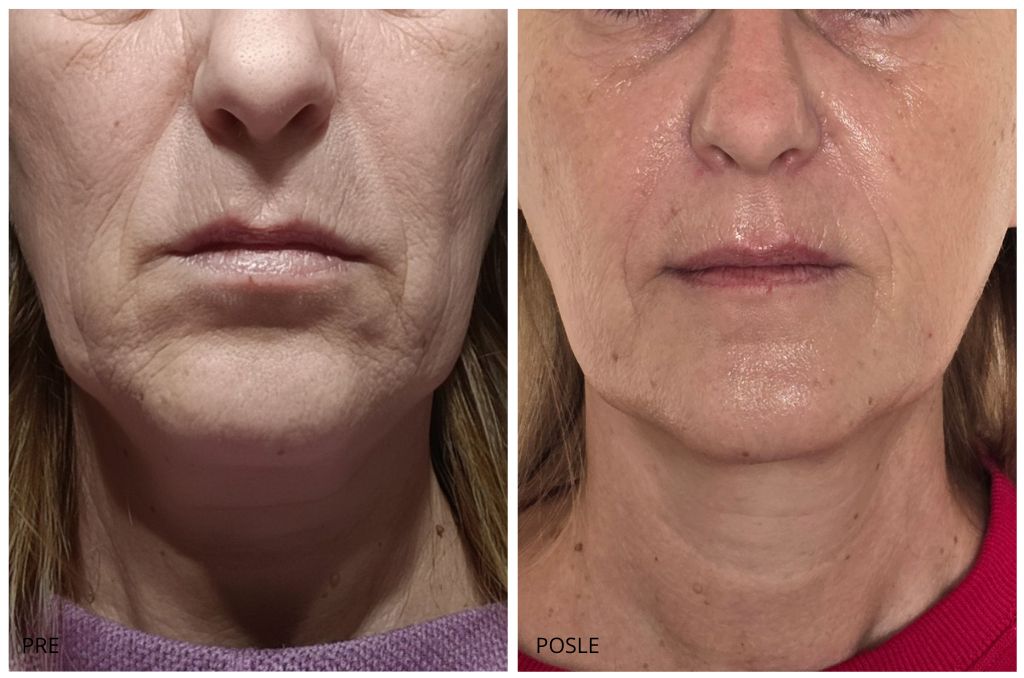
Attiva radiofrequency tightens the skin and gives a clearer contour to the lower part of the face. The photographs show the lower third of the face before and after treatment: the skin is tighter, and the folds near the lips and chin are softer.
Number of treatments
On average 2
Duration of treatment
30 to 60 minutes, depending on the area
More pronounced effect
In 4 to 6 weeks
Attiva treatment price
The price of the Attiva treatment depends on the region being treated and the extent of the procedure. Smaller areas, such as the eyelids or the area around the lips, have a lower price, while larger areas, such as the face, neck or stomach, are more expensive due to the scale of the treatment. Prices for different areas, such as the face, double chin, neck or body, can be found in our Price list.
Have a question?
Answers to frequently asked questions
Is any preparation needed before the treatment?
Prior to the treatment, a detailed consultation is carried out with a doctor, during which the condition of the skin is assessed and it is determined whether Attiva is the appropriate choice or part of a combined protocol. No special preparation is required before the procedure itself.
Is the treatment painful?
Thanks to local injection anaesthesia, the treatment is well tolerated in most cases and is not considered painful.
Are there any side effects?
The treatment is performed through a small puncture in the skin, without incisions. After the treatment, swelling and bruising at the puncture site are possible; these resolve on their own. The doctor discusses possible adverse reactions with the patient during the pre-treatment consultation.
How long does the recovery take?
Bruises usually fade within a few days, depending on the area and individual skin reaction. Swelling can last for up to 14 days.
When can the results of the Attiva treatment be seen?
Initial changes in firmness can be observed earlier, and a more pronounced effect develops over the next four to six weeks. The plan depends on the region; most commonly, two treatments are considered.
When and why is Attiva combined with the Morpheus8 treatment?
Attiva and Morpheus8 are combined when different tissue depths need to be targeted and different causes of skin laxity. Attiva works primarily on the deeper subcutaneous tissue and connective structures responsible for tightening and contour, while Morpheus8 affects skin quality, texture, fine wrinkles and the tone of more superficial layers.
What does combining Attiva and Morpheus8 involve?
The treatments are not carried out on the same day. Most commonly, Attiva is performed first to achieve the initial tightening and redefine the contour, and then, after a certain time interval, Morpheus8 is introduced to improve skin quality and provide additional collagen stimulation. The exact schedule is determined by the doctor after an examination.
Who is this combination recommended for?
The combination is recommended for individuals who have moderate to pronounced skin laxity, a loss of firmness, and simultaneously compromised skin texture, fine lines, or enlarged pores. It is particularly useful for the lower face, neck, double chin, and certain areas of the body where the skin has lost its tone.
Is the combination always necessary?
No. For milder changes, Attiva or Morpheus8 can be performed on its own. The combination is applied when the doctor assesses that a single treatment on its own cannot provide an optimal result.
Contraindications
The Attiva treatment is not recommended during pregnancy and breastfeeding, in cases of active skin infections, herpes, pronounced inflammatory skin conditions, nor for individuals with a pacemaker or metal implants in the treatment area.
Related topics
Book an Attiva treatment in Belgrade
Imedic poliklinika is located at Kneza Miloša 23, 2nd floor, Belgrade. Opening hours: Monday–Sunday, 9:00–21:00.
Appointments can be booked by phone: 064 237 0707. If you contact us from abroad, we are also available via Viber and WhatsApp on the same number.

Author: Dr Ivica Jeremić
PhD in Medical Sciences (Molecular Medicine and Immunology), rheumatology subspecialist, dermatology resident.






