Removal of under-eye bags
In the mirror, the same shadow under the eyes keeps reappearing, no matter how much sleep you have had. Concealer covers it less and less effectively, and photographs taken in overhead lighting further emphasise a tired and hollow facial appearance. Behind seemingly identical dark circles can lie completely different causes: a depression in the tear trough area, pigmentation, thin skin through which blood vessels are visible, or swelling. Each of these problems requires a different approach, so a treatment that works for one person may have no effect on another or make the dark circles more noticeable. That is why the first step is not the choice of treatment, but the assessment of the cause. Only once it has been determined what is creating the shadow or darker appearance beneath the eyes can a precise correction plan be made, because a wrong choice in this region is more easily visible than anywhere else on the face.
Removal of dark circles – in brief
| What is being treated | Tear trough and under-eye hollow, alongside an assessment of the cheek region that supports the lower eyelid |
|---|---|
| Treatments | Hyaluronic filler, Juvelook, polynucleotides, Jalupro Young Eye, tranexamic acid with Dermapen and eyelid laser treatment |
| Amount of filler | Determined individually, on average up to 2 ml |
| Anaesthesia | Anaesthetic cream |
| Duration of treatment | 30 to 60 minutes |
| Filler result | Visible immediately, final after 10 to 14 days |
| Recovery after fillers | Without bed rest, with a return to commitments on the same day |
| Longevity of filler results | About 12 months |
Why does a shadow form under the eye
The appearance of dark circles does not depend solely on the skin. At the transition between the lower eyelid and the cheek lie the bone, subcutaneous adipose tissue, and ligaments that together maintain a smooth contour. When their relationship changes, light no longer falls evenly and a shadow appears beneath the eye, even when the skin colour is unchanged. With age, the bone of the midface gradually loses volume and recedes. This reduces the support for the soft tissues of the lower eyelid and the upper part of the cheek. The change is not sudden, but over time the transition between the eye and the cheekbone becomes less uniform.
At the same time, subcutaneous fat tissue diminishes or changes position. The ligaments connecting the skin to deeper structures remain in place, becoming more noticeable when the surrounding tissues lose volume. This creates a depression extending from the inner corner of the eye towards the cheekbone — the tear trough. The skin in this region remains extremely thin, which is why any change beneath it is more easily noticed. When the depression is accompanied by thinned skin, more visible blood vessels or pigmentation, the under-eye circle can appear even darker. Therefore, the same external appearance does not necessarily have the same cause in every person.
The cheek is always assessed together with the under-eye area., as the lower eyelid relies on the upper part of the cheek. When the cheek region loses volume, that support weakens, the transition becomes sharper, and the tear trough appears deeper. In some patients, therefore, support to the cheekbone is restored first, and only then, if necessary, is the trough treated directly. Such a sequence allows for a more natural correction and prevents attempting to compensate for the lack of support with an excessive amount of filler under the eye.
What type of dark circles do you have?
Stand by the window, turn your face towards the natural light and slowly raise your chin. Observe whether the shadow under your eyes diminishes while the skin colour remains the same, or whether discolouration, swelling and bags are present regardless of the angle of the light. This simple check can indicate the likely cause, but does not replace an examination.
| What does it look like | Probable cause | What we do |
|---|---|---|
| A shadow that shrinks when you lift your chin to the light | Hollowness and tear trough | Hyaluronic filler |
| The brownish colour that remains in every light | Pigmentation | Tranexamic acid with Dermapen |
| A bluish tint through which tiny blood vessels are visible | Thin skin | Juvelook |
| Pronounced swelling in the morning, which subsides by midday | Fluid retention | Determining the cause before any treatment |
| A bag that does not change during the day | Fat pads | Surgical approach |
| Wrinkled and sagging skin of the lower eyelid | Changed skin quality | Laser eyelid treatment |
Types of dark circles
Hollow under-eyes and tear trough
As the years go by, the bone of the midface gradually recedes, the fat pads lose volume or change position, while the ligaments weaken. This is how a depression forms that extends from the inner corner of the eye towards the cheekbone.
Under-eye circles look darker because the hollow casts a shadow, so it diminishes when you lift your chin towards the light. This is the only type of under-eye circle where filler acts on the very cause, replacing the missing support.
Dark circles from pigmentation
In pigmentation, the darker colour is located within the skin. It is most commonly brown, does not change under different lighting and may spread towards the outer corner of the eye or the upper eyelid.
Possible causes are a hereditary predisposition, sun exposure without adequate protection, frequent eye rubbing due to allergies, or pigmentation remaining after inflammation. A hyaluronic acid filler does not change skin colour and, in cases of inappropriate indication, may further accentuate the shadow.
Read more about the causes and treatment options on the page hyperpigmentation.
Dark under-eye circles due to thin skin
The skin of the lower eyelid is very thin. When it thins further, the blood vessels beneath it become more visible, which is why dark circles take on a bluish or purplish hue.
You can recognise them by stretching the skin gently beneath the eye. If the shade becomes more pronounced rather than disappearing, the cause is likely the translucency of the thin skin. The aim of the treatment is to gradually improve its quality and thickness, rather than filling the area.
Find out more about the treatment Juvelook.
Puffiness under the eyes
Puffy under-eye bags have a distinct daily rhythm: they are most pronounced after waking up, and gradually subside during the morning. They can have a purplish tint, while the border between the lower eyelid and the cheek is often blurred.
Hormonal changes, allergies, a higher salt intake, lack of sleep or poorer lymphatic drainage can be behind the puffiness.
Bags under the eyes
Under-eye bags appear as a distinct bulge with a clear border and do not change significantly from morning to evening. They are caused when the fat pad pushes against the weakened septum of the lower eyelid.
For pronounced bags, the realistic solution is a surgical approach. Hyaluronic acid filler does not remove them and can make them more noticeable. For mild bags, it can sometimes soften the transition between the lower eyelid and the cheek, but only after a careful assessment of the anatomy.
When dark circles require a medical examination
Dark circles under the eyes are most commonly the result of anatomy, genetics, and skin ageing. However, they are sometimes a sign of a condition that needs to be checked before any aesthetic treatment. Consult your GP or an appropriate specialist if:
- if dark circles appeared or suddenly worsened in a short period
- The under-eye swelling lasts throughout the day, not just in the morning
- Along with dark circles under your eyes, do you feel constant fatigue, lethargy or notice paleness of the skin, as that can be a sign of anaemia
- you notice changes in body weight, dry skin, facial swelling or sensitivity to cold, which may indicate a thyroid disorder
- dark circles under the eyes are accompanied by itchy eyes, sneezing and a blocked nose, as allergies can cause dark shadows and swelling
- the change is expressed in only one eye, accompanied by pain, redness or a change in vision
When the underlying cause is treated, dark circles often fade on their own. Aesthetic treatment then only makes sense once a health-related cause has been ruled out or is under control.
Which treatment for which type of dark circles
In most patients there are multiple causes at the same time, so treatments are often combined. The table serves as a guide, and the final plan is determined during the consultation.
| Type of dark circles | The most commonly chosen treatment | Number of visits |
|---|---|---|
| Sunken, tear trough | Hyaluronic filler, including an evaluation of the cheekbone region | Usually one treatment, with a follow-up after two weeks |
| Dark circles caused by pigmentation | Tranexamic acid with Dermapen | Series, according to the intensity of pigmentation |
| Dark circles due to thin skin | Juvelook or polynucleotides | Juvelook three sessions every six weeks; polynucleotides three to four treatments every two to four weeks |
| Fine lines and dehydrated skin | Jalupro Young Eye | Three treatments every two weeks |
| Wrinkled and sagging eyelid skin | CO2 laser or Attiva radio waves | According to the examination findings |
| Puffiness under the eyes | First, the cause of the swelling is investigated; in the case of malar oedema Attiva or Morpheus8 | According to the examination findings |
| Pronounced eye bags | The surgical approach, which we do not perform in the polyclinic | — |
Treatments we offer for dark circles
Tear trough dermal filler
Hyaluronic acid filler is used when the under-eye area looks darker due to hollowness and shadowing, rather than pigmentation or thin skin. Its role is not just to “fill” the groove, but to replace the missing support and soften the transition between the lower eyelid and the cheek.
In cases of a more pronounced tear trough, the volume of the cheek region is also assessed. If cheek support is weakened, the treatment plan may first involve the cheekbone and then direct correction of the under-eye area. The treatment makes no sense when pigmentation, persistent swelling or pronounced bags predominate.
Read more about the procedure on the page hyaluronic fillers.
Juvelook for skin quality and thickness
Juvelook is chosen when the skin beneath the eyes is thin and tiny blood vessels can be seen through it, giving the region a bluish or purplish tint. As a collagen stimulator, it works gradually on the quality and thickness of the skin.
This treatment does not replace lost volume and does not fill the tear trough. Therefore, it is not a substitute for a hyaluronic acid filler when the main problem is hollowness, but is chosen when the change originates from the skin itself.
Find out more about the treatment Juvelook and others collagen stimulators.
Polynucleotides for thin and tired under-eye skin
Polynucleotides are chosen when the skin under the eyes is thin, dry and tired, and blood vessels are visible through it. They have a regenerative effect on the quality of the skin, so after a series of treatments the skin looks denser and more rested.
The treatment plan usually comprises three to four sessions spaced two to four weeks apart. Polynucleotides do not fill the tear trough and do not remove bags, but they can be a good choice before or after fillers, when it is also necessary to improve the skin itself.
Read more about the treatment on the page polynucleotides.
Jalupro Young Eye for fine lines and dehydration
Jalupro Young Eye is a skinbooster designed for the eye area. It combines hyaluronic acid and amino acids, which provide the skin with hydration and support for regeneration. It is chosen for fine lines, dehydrated skin and a tired appearance, when hollowness is not the main issue.
Three treatments are usually required at two-week intervals, and the effect lasts for four to six months. This treatment does not restore lost volume, so it is not a substitute for a filler in cases of pronounced tear troughs.
Read more about the product on the page skin boosters and biorevitalisation.
Tranexamic acid with Dermapen
The combination of tranexamic acid and Dermapen is intended for dark circles where brownish pigmentation is the dominant problem. The needles create controlled micro-channels in the skin, through which a preparation aimed at reducing melanin production is applied.
The treatment is planned in a series, and the number of visits is determined by the severity of the pigmentation and the skin's reaction. It is not intended for the correction of hollows, fatty pads, or excess skin on the lower eyelid.
Find more information on the pages Dermapen and Melanostop.
Laser eyelid and under-eye treatment
When the main problem is wrinkled and sagging lower eyelid skin or fine lines, treatments that improve skin quality and tightness are chosen. Depending on the findings, the plan may include CO2 laser or Attiva radio waves.
These treatments do not replace lost volume, so they are not a substitute for a filler in the case of a pronounced tear trough. Neither do they remove the fat pads that cause permanent under-eye bags.
When is surgery necessary?
In the case of pronounced bags and excess skin on the lower eyelid, the most realistic solution may be a surgical approach. We do not perform this procedure, but during the consultation we clearly state when non-invasive and injectable treatments cannot provide an appropriate result and when surgery needs to be considered.
Malar oedema can be treated with procedures Attiva and Morpheus8, following review and assessment of the cause of the swelling.
Dark circles under the eyes before and after
Before and after photographs show how a correctly chosen treatment can lessen shadows, soften the transition between the lower eyelid and the cheek, and make the eye area look more rested. The change depends on the underlying cause of the dark circles, facial anatomy, and the type of correction performed.


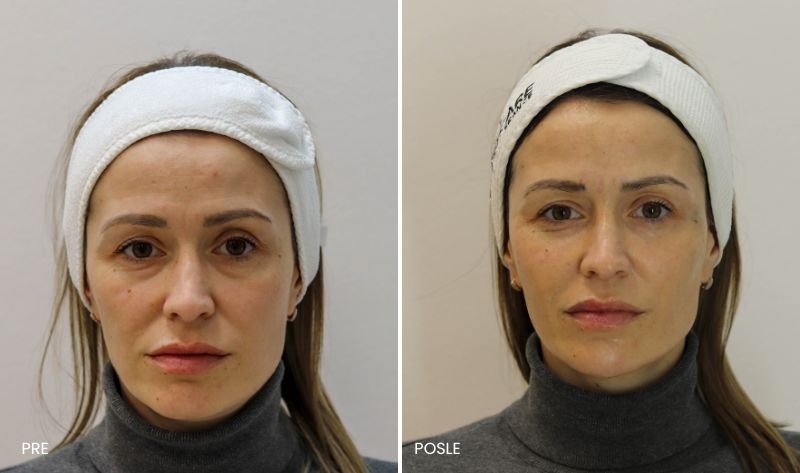

Results are individual. The photographs show the outcomes in specific patients and do not guarantee that the same treatment will produce the same result in every person.
Filler result
Visible immediately, final after 10 to 14 days
Recovery
Return to duties on the same day
Duration of results
About 12 months
Under-eye filler step by step
What does the treatment look like?
The treatment begins with an examination and assessment of the cause of the dark circles, the depth of the tear trough, and the support in the cheek region. After cleansing the skin, an anesthetic cream is applied, and then the hyaluronic acid filler is precisely injected into the predetermined areas.
Finally, the transition between the lower eyelid and the cheek, as well as the symmetry of both sides of the face, is assessed. The entire procedure takes approximately 30 to 60 minutes, depending on whether only the tear trough is treated or the treatment plan also includes the cheek region.
Needle or cannula?
A blunt cannula can reduce the possibility of direct blood vessel injury and bruising, but it does not completely eliminate the risks of an injection treatment. A needle allows for the very precise placement of a small amount of filler in an exact location.
The choice depends on the anatomy, the depth at which the filler is placed, and the specific area being corrected. A needle and a cannula can be combined in the same treatment when different techniques are required for different points.
How many ml of filler go under the eyes?
The quantity is determined individually, and on average up to 2 ml is used. This does not mean that the entire amount is applied directly under the eyes — the plan can also include the cheekbone area when it is necessary to restore support to the lower eyelid.
In this region, precision is more important than volume. With a more pronounced crease, correction can be carried out gradually, over multiple sessions, in order to avoid an overfilled look and unnecessary pressure on the delicate tissues under the eye.
Recovery and swelling
Mild swelling, redness, tenderness or bruising may occur following the treatment. Make-up should not be applied for the first 24 hours, while workouts, saunas and alcohol should be avoided for the next 24 to 48 hours.
Sleeping on your back with your head slightly raised is recommended, without pressing or massaging the treated area. If severe or increasing pain, a sudden change in skin colour, visual disturbances or other unusual symptoms occur, a doctor must be contacted immediately.
How long does the result last?
The result lasts approximately 12 months, but its duration varies depending on the type of filler, the treated area, anatomy and individual metabolism. The change is visible immediately after application, but the initial swelling can affect the appearance.
The final assessment of the results is carried out after 10 to 14 days, once the region has settled. Only then is it decided whether an additional touch-up is needed.
Tyndall effect and when filler can make appearance worse
The Tyndall effect is a bluish or greyish-blue shadow that can appear when a hyaluronic acid filler is placed too superficially. It is more noticeable in very thin skin and, following an examination, can be corrected by using hyaluronidase, an enzyme that breaks down the hyaluronic acid filler.
Filler can worsen the appearance when a patient has prominent bags, persistent swelling or dominant pigmentation, because in that case additional volume does not address the cause of the problem. Therefore, the decision on treatment is not made solely on the basis of shadow depth, but after an assessment of the skin, subcutaneous tissue, cheekbone support and the presence of swelling.
Price of under-eye bag removal
The price depends on the cause of the dark circles and the treatment chosen following the examination. Hyaluronic filler and Juvelook do not have the same application method or treatment plan, so you can view their current prices in price list of aesthetic treatments.
When the cheek region is corrected alongside the under-eye area, the price depends on the entire correction plan, not just the tear trough treatment. The price for CO2 and other lower eyelid skin treatments is available at price list for laser treatments.
Have you got a question?
Frequently asked questions about dark circles under the eyes
Can dark circles under the eyes be completely removed?
It depends on their cause. Hollows and shadows can be significantly alleviated with properly performed correction, while with pigmentation and thin skin, a gradual improvement is expected rather than necessarily the complete disappearance of the darker shade. In the case of pronounced bags, the best result may require a surgical approach. No treatment can guarantee the complete removal of dark circles in advance.
Does dermal filler brighten dark under-eye circles?
Hyaluronic filler does not lighten pigment in the skin. When the dark appearance is the result of a depression, the filler can soften the shadow by smoothing out the transition between the lower eyelid and the cheek. If the colour is brownish due to pigmentation or bluish due to thin skin and visible blood vessels, a different approach is needed.
Why does the area under my eye feel "fuller" than expected after the treatment?
Temporary fullness immediately after the treatment is most often the result of swelling and does not represent the final result. The region needs time to settle, so the result is assessed at the follow-up appointment. If the fullness does not subside or is accompanied by severe pain, skin discolouration or other unusual symptoms, you should contact the doctor who performed the treatment immediately.
Does the treatment hurt?
Sensitivity depends on the type of treatment and individual pain threshold. Before injection procedures, an anaesthetic cream is applied, so short stings, pressure or mild tightness are usually felt. With laser treatments and microneedling, heat, stinging or discomfort may occur, the intensity of which depends on the applied parameters.
How soon can I get back to my duties?
Most patients can return to their daily routine on the same day. However, swelling, redness or bruising may be temporarily visible. If you have an important event, it is best to plan the treatment well in advance so that the area settles completely.
Can filler be removed if I don't like it?
Hyaluronic acid filler can be dissolved using hyaluronidase. Prior to that, an examination is required, because initial swelling does not necessarily mean that too much filler was used. The decision to use hyaluronidase is made after assessing the position of the filler, the appearance of the region, and the time that has passed since the treatment.
Do eye creams help?
Creams can hydrate the skin, temporarily relieve morning puffiness and, depending on their composition, contribute to a more even appearance of pigmentation. They cannot make up for lost volume, change the position of fat pads or remove a pronounced tear trough or bags. Their effect therefore depends on what is causing the dark circles.
Are polynucleotides a replacement for filler in the under-eye area?
Not always. Filler is used when the aim is to fill in hollows, and polynucleotides when we want to improve the quality of thin skin around the eyes. Sometimes these methods are combined.
When is the treatment not performed?
The treatment is not performed if there is an active infection, inflammation, or herpes in the region, nor during pregnancy and breastfeeding. A special assessment is required in cases of blood clotting disorders, therapy that affects bleeding, and autoimmune diseases in an active phase. Therapy prescribed by another doctor should not be stopped independently; the decision regarding the safety and timing of the procedure is made at the consultation.
Book an under-eye treatment in Belgrade
The Imedic Polyclinic is located at Kneza Miloša 23 street, 2nd floor, Belgrade. Opening hours: Monday–Sunday, 9:00–21:00.
Appointments are made by phone: 064 237 0707. If you contact us from abroad, we are also available via Viber and WhatsApp on the same number.
Treatment planning
We recommend planning your injectable treatment at least two weeks before an important event. If a series of treatments is required, the plan should start earlier to allow enough time for the full effect to develop.
Related topics

Author: Dr Ivica Jeremić
Doctor of Medical Sciences (Molecular Medicine and Immunology), subspecialist in rheumatology, dermatology resident.
Expert sources


