Laser hair removal in Belgrade
Laser hair removal after a series of treatments permanently reduces the number of unwanted hairs, and those that remain are thinner, lighter and grow more slowly. There is less shaving, irritation and ingrown hairs. In our polyclinic in Belgrade, we perform it using two medical lasers, Lumenis LightSheer Desire and Alma Soprano Titanium, and we tailor the treatment to the skin type, hair colour and thickness, and the sensitivity of the area.
Laser hair removal – a brief overview
| Lasers | Lumenis LightSheer Desire and Alma Soprano Titanium |
|---|---|
| Result | Permanent reduction in hair growth; the remaining hairs are finer, lighter and grow more slowly |
| Number of treatments | Individual, assessed during consultation |
| Time between treatments | About 6 weeks for the face, 6 to 8 weeks for the body |
| Maintenance | Most commonly one treatment a year |
| For whom | Best for darker and thicker hair; the laser does not work on grey and very light hairs |
What is laser hair removal?
Permanent hair removal: is the result really permanent?
Professional literature discusses permanent hair reduction, and not about permanent removal, and this difference is not just a formality. After a completed series of treatments, the number of hairs in the treated area is permanently reduced, and those that remain are usually thinner, lighter and grow more slowly.
What a laser cannot do is guarantee that not a single hair will ever appear again. Hormonal changes, such as pregnancy, the menopause or treatment with certain medications, can activate follicles that were previously dormant. In such cases, one maintenance treatment a year is usually sufficient to maintain the achieved result.
The number of treatments is individual and is assessed at the consultation, and the interval between treatments is about 6 weeks for the face and 6 to 8 weeks for the body.
Areas we treat
Laser hair removal is performed on almost all facial and body regions, except for the eye, nose, and inner ear canal areas. Regions can be combined within the same appointment.
Face and neck
Top lip, chin and jaw, cheeks, sideburns, neck.
Arms and torso
Underarms, forearms or full arms, shoulders, back, chest, stomach and the line below the navel.
Intimate area
Groin, partially or completely, as agreed.
Legs
Lower legs, upper legs or full legs.
For women, treatments are most commonly done on the upper lip, underarms, bikini line, and legs, and for men on the back, shoulders, chest, and neck. Prices for individual areas and packages can be found in laser hair removal price list.
The lasers we use for hair removal
Which lasers do we use in our polyclinic?
Alma Soprano Titanium
The second medical laser we use for laser hair removal is Alma Soprano Titanium, a device by the company Alma Lasers, one of the leading manufacturers of medical laser equipment. This system has been developed for the safe and efficient removal of unwanted hair across various skin types and body areas.
The laser works on the principle of absorbing light energy into the hair pigment. The energy is converted into heat which acts on the hair follicle and gradually reduces its ability to produce new hair.
Characteristics of Alma Soprano Titanium system
- SHR In-Motion technology
The treatment is performed with continuous movements of the probe over the skin, whereby the energy is distributed evenly and the hair follicle is heated gradually. This mode of operation makes the treatment more comfortable and enables treatment of larger skin areas. - Three wavelengths in one system
The laser combines three wavelengths that act at different depths of the hair follicle: 755 nm – suitable for finer and lighter hairs, 810 nm – acts on the most common hair types, and 1064 nm – penetrates deeper and is used for stronger and darker hairs. - Larger working probe
A larger probe surface area allows faster treatment of larger body regions, such as the legs or back, while the shape of the applicator allows treatment on smaller and more sensitive areas, such as the face, underarms or bikini line. - ICE Plus cooling system
An integrated cooling system keeps the skin comfortable during treatment and reduces the sensation of heat on the skin's surface, which increases patient comfort.
Lumenis Lightsheer Desire
Lumenis LightSheer Desire is a medical diode laser that has been used for years in dermatology and aesthetic medicine for unwanted hair removal. It was developed by Lumenis, one of the pioneers of laser technology in medicine.
This system uses an 805 nm wavelength diode laser, which is efficiently absorbed by the hair pigment. The laser energy is converted into heat that acts on the hair follicle, thereby reducing its ability to produce new hair.
The LightSheer Desire is especially well known for its strong and precise laser energy, which is why it is often used for coarser and darker hair, where a more intensive action on the follicle is required.
Key features of the LightSheer Desire system
- 805 nm diode laser
This wavelength enables effective action on hair pigment and follicle depth. - High pulse energy
A laser can deliver high energy in controlled pulses, which enables a powerful action on the hair follicle. - High-Speed Vacuum Assisted Technology
The special applicator gently draws in the skin during the treatment. This brings the follicle closer to the energy source, enabling more effective laser action. - Large applicator work surface
It allows for faster treatment of larger body regions such as the legs, back, or chest. - Integrated skin cooling system
It helps make the treatment more pleasant and protects the skin's surface during application.
Why do we use two different lasers?
Every technology has its advantages. In practice, this means that we can choose a laser that suits a specific skin type, hair colour and body region.
- LightSheer Desire is often used for coarser and darker hair
- Alma Soprano Titanium enables very comfortable treatments on different skin and hair types
By combining these two technologies, we can tailor the treatment more precisely to each patient and achieve more stable results.
Laser hair removal: all the benefits!
Laser hair removal has numerous advantages over traditional hair removal methods, such as shaving or waxing. The most important ones are:
- Long-term reduction of hair growth
After a series of treatments, the hairs become sparser, thinner and grow more slowly. - Precise action on the hair follicle
The laser targets the hair root, without damaging the surrounding skin. - Suitable for various facial and body regions
Laser hair removal can be performed on the legs, arms, underarms, bikini line, face and other parts of the body. - Less irritation compared to waxing or shaving
It reduces the appearance of redness, minor cuts and irritations that are common with traditional hair removal methods. - It helps with ingrown hairs
Regular treatments reduce the number of ingrown hairs and inflammatory skin lesions. - Visible hair reduction after just the first treatments
After a few procedures, the hairs become finer, grow more slowly and are significantly sparser.
Results before and after the treatment
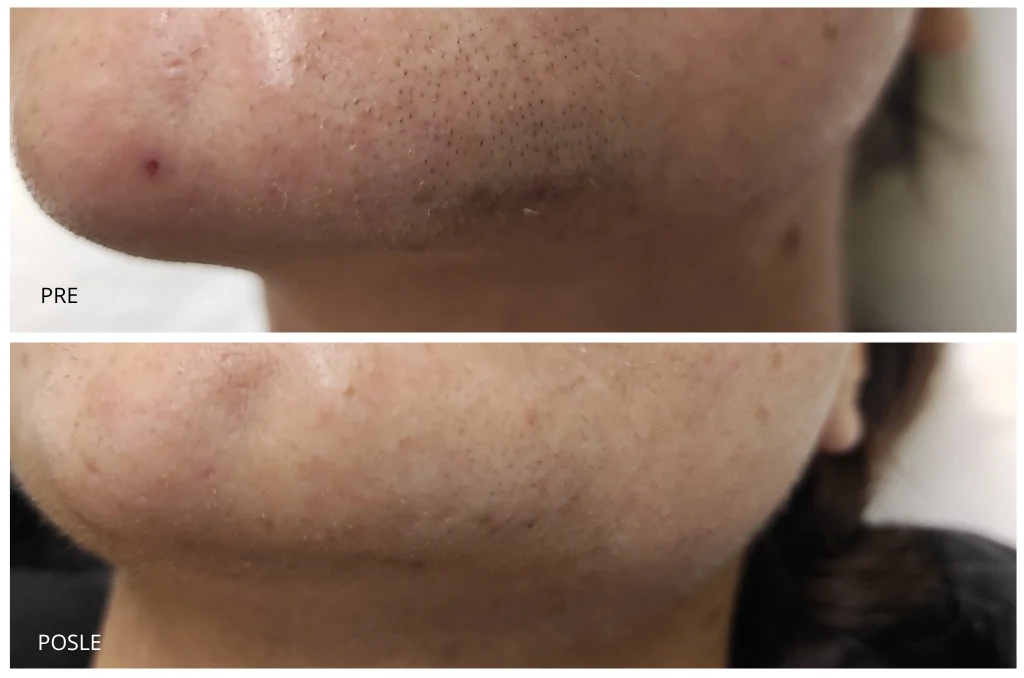
Result after one session of laser beard hair removal.
Number of treatments
Individual, assessed during consultation
Time between treatments
About 6 weeks for the face, 6 to 8 weeks for the body
Maintenance
Most commonly one treatment a year
Laser hair removal price
The price of laser hair removal depends on the area being treated, the size of the surface and the number of treatments required. You can view current prices for individual areas on the page Price list. For patients who opt for treatment packages, which are available at discounted prices, payment in instalments is also made possible.
Answers to frequently asked questions
Who is laser hair removal for?
Laser hair removal is intended for anyone who wants a permanent reduction in the number of unwanted hairs, without the daily shaving and the irritation that comes with it. It gives the best results on darker and thicker hair on lighter skin, whereas on very light, red and grey hairs the laser is less effective because they contain little pigment.
Does laser hair removal work on light and grey hairs?
The laser works via pigment: the light is absorbed into the hair melanin and damages the follicle with heat. Grey, white and very light blonde hairs have almost no pigment, so the laser cannot act on them. With red and very light hairs, the result is poorer and harder to predict.
For such hairs, the method of permanent removal is electrolysis, or electrical epilation, where the follicle is destroyed hair by hair using an electric current, regardless of the colour. We do not perform this treatment at our polyclinic. During the consultation, we assess the colour and type of hair and tell you openly whether you can expect results from laser hair removal.
What does laser hair removal preparation look like?
Four weeks before the treatment, hairs must not be removed from the root by tweezers, wax or sugaring paste. Before coming to the treatment, hairs are removed with a razor. It is recommended to avoid intensive sunbathing and solariums in the period prior to epilation. On the day of the treatment, lotions, creams or deodorant should not be applied to the area being treated. It is important to inform the doctor about any medication you are taking.
Detailed, step-by-step instructions can be found in the text complete pre-treatment preparation.
How many laser hair removal treatments are needed?
One treatment is not enough because not all hairs are in the same growth phase. The laser only affects hairs that are in the active, anagen phase. Therefore, multiple treatments at regular intervals are necessary.
The exact number of treatments cannot be determined in advance and varies from patient to patient. It depends on the area, skin type, hair colour, density and thickness, as well as hormonal status. We make an assessment during the consultation and monitor progress from one treatment to the next.
The gap between treatments is about 6 weeks for the face and 6 to 8 weeks for the body.
How long does a treatment take?
The duration depends entirely on the size of the region. Underarm hair removal takes about a minute, one arm about two minutes, and one leg about seven minutes. Several regions can be done in the same appointment, so even then the treatment is measured in minutes. Because of this, patients most often schedule it during a break or between two commitments.
Is maintenance of the achieved results necessary?
In most cases – yes. Following the completed course of treatments, results are usually maintained with occasional top-up treatments once a year for the body, and once to twice a year for the face.
Hormonal changes, such as pregnancy, menopause or treatment with certain medications, can activate follicles that have been dormant until then, so maintaining them is necessary somewhat more frequently.
On which parts of the body can laser hair removal be performed?
Laser hair removal can be performed on almost all regions of the face and body, except for the eye area, nose and inside of the ear canals. The medical laser penetrates only a few millimetres into the skin and acts exclusively on the hair follicle, without affecting the lymph or milk glands.
Does laser hair removal differ for men?
The principle is the same, but male hair is generally thicker and stronger at the root, so more treatments are usually required than for women. Men most often choose the treatment because of ingrown hairs, irritation and rashes after shaving, excessive hair on the back, shoulders and chest, or because the nature of their work and sport demands smooth skin. Fewer hairs in the armpits also means less retention of sweat and unpleasant odour.
Is laser hair removal painful?
Laser hair removal is not considered a painful procedure. During the treatment, a mild stinging sensation may be felt, but thanks to the skin cooling systems built into medical lasers, discomfort is minimal.
Does laser hair removal accelerate hair growth or damage the skin?
No. The medical laser targets the hair follicle precisely, whilst the surrounding skin is protected by a cooling system that operates throughout the entire treatment. Mild redness that sometimes occurs subsides within a few hours.
Laser hair removal does not accelerate hair growth or make them stronger. After each treatment, the hairs are sparser, thinner and grow more slowly. The impression that they grow faster usually comes from shaving and waxing in the period between treatments.
What is the difference between a cosmetic and a medical laser?
The difference lies in the device's power, depth of action, and who is permitted to use it. Cosmetic devices operate at a significantly lower energy level, so they act more superficially and provide weaker and shorter-lived results. Medical lasers reach the hair follicle and require trained personnel and operation under medical supervision.
In practice, the difference can be seen in the number of treatments required and how long the result lasts. That is why, before booking, it is worth checking what device is used and who is performing the treatment.
Skin care after laser hair removal
Following the treatment, mild redness may occur, which subsides within a few hours. The application of a soothing cream is recommended for the next few days. Exposure to the sun and sunbeds should be avoided for two weeks, and afterwards the use of products with a high protection factor is mandatory. Between treatments, hairs must not be plucked from the root.
Who performs laser hair removal in our polyclinic?
Laser hair removal is performed by a registered nurse or technician with a valid licence and years of experience in dermatological and laser procedures.
Do you protect moles during laser hair removal?
All moles and dark skin changes must be covered with a protective white pencil during the treatment.
Are the parts of the device disinfected?
All equipment and appliance parts that come into contact with the patient's skin must be disinfected before and after every treatment, in accordance with medical protocols.
Ingrown hairs and laser hair removal
Laser hair removal reduces ingrown hairs and folliculitis. When the laser damages the follicle, fewer hairs grow into the skin, making inflammations less frequent.
We more frequently choose Lumenis LightSheer Desire for pronounced ingrown hairs, because vacuum technology brings the follicle closer to the energy source and enables more precise action on deeper hairs.
Lip fillers and laser hair removal
Laser hair removal does not affect hyaluronic acid lip fillers. When removing hair above the lips, exclusively the skin around the lips is treated. A gap of 3 to 4 weeks after filler application is recommended.
Is laser hair removal worth it compared to shaving and waxing?
Shaving and waxing are a lifelong recurring expense and chore, accompanied by irritation, ingrown hairs and constantly monitoring when the hair is “long enough”. Laser hair removal is a limited number of treatments followed by only occasional maintenance.
Prices by region and packages, which are available at discounted prices and with payment by instalments, can be found in laser hair removal price list.
Is laser hair removal performed during pregnancy and while breastfeeding?
No. Laser hair removal is not performed during pregnancy and breastfeeding. If you started a series of treatments earlier, you continue with them once breastfeeding is finished. Hormonal changes during this period can stimulate the growth of new hairs, so at the very next treatment it is assessed how many more treatments are needed.
Contraindications
Laser hair removal is not performed during pregnancy and breastfeeding. Contraindications include certain chronic diseases, malignant diseases, epilepsy, vitiligo, psoriasis, treatment with photosensitive medications, fresh scars, as well as fixed braces when it comes to facial hair removal.
Book laser hair removal in Belgrade
The Imedic Polyclinic is located at Kneza Miloša 23 street, 2nd floor, Belgrade. Opening hours: Monday–Sunday, 9:00–21:00.
Appointments are made by phone: 064 237 0707. If you contact us from abroad, we are also available via Viber and WhatsApp on the same number.

Author: Dr Ivica Jeremić
Doctor of Medical Sciences (Molecular Medicine and Immunology), subspecialist in rheumatology, dermatology resident.
Updated:


