
Acne scar treatment in Belgrade
Acne scars can be shallow or deep, narrow or wide, and the same face often features several different types. Therefore, the treatment is chosen after an examination, depending on the appearance of the scars, the condition of the skin, and the result the patient wants to achieve. At the Imedic Polyclinic in Belgrade, the plan may include fractional CO2 laser, subcision, TCA CROSS, microneedling or other appropriate treatments, most often in combination. During the examination, we discuss the expected improvement, recovery and the sequence of procedures, and we monitor the results throughout the therapy. Scars cannot be completely removed, but with treatments they can be significantly mitigated, and the skin becomes smoother and more even.
Acne scars – in brief
| Examination | Assessment of the type, depth and distribution of scars, skin condition and previous treatments |
|---|---|
| Treatments | Fractional CO2 laser, subcision, TCA CROSS, TCA peel, microneedling (Dermapen), Morpheus8, punch excision, hyaluronic acid fillers, collagen stimulators; for raised scars, corticosteroid injections |
| Treatment plan | A treatment plan, usually a combination of multiple procedures, that is adapted according to the skin's response |
| Results | Gradually, over several months |
Are they blemishes or scars?
After acne clears up, marks often remain on the skin, but not all marks are scars. Spots they are colour changes – red, pink or dark flat spots on the skin. They are caused by inflammation and increased pigmentation and usually fade over time, while their disappearance is accelerated by sun protection, appropriate skincare and treatments.
Scars are changes in skin texture. They occur when deep inflammation damages tissue, and the skin creates too little or too much collagen—the protein that gives skin its firmness—during the healing process. When there is a lack of collagen, depressions form (atrophic scars), and when there is too much, the scar rises above the skin. Scars do not disappear on their own, but they can be significantly mitigated with treatments.
If the acne is still active, treatment is planned first, and more about that can be found on the page acne treatment.
What types of scars are there?
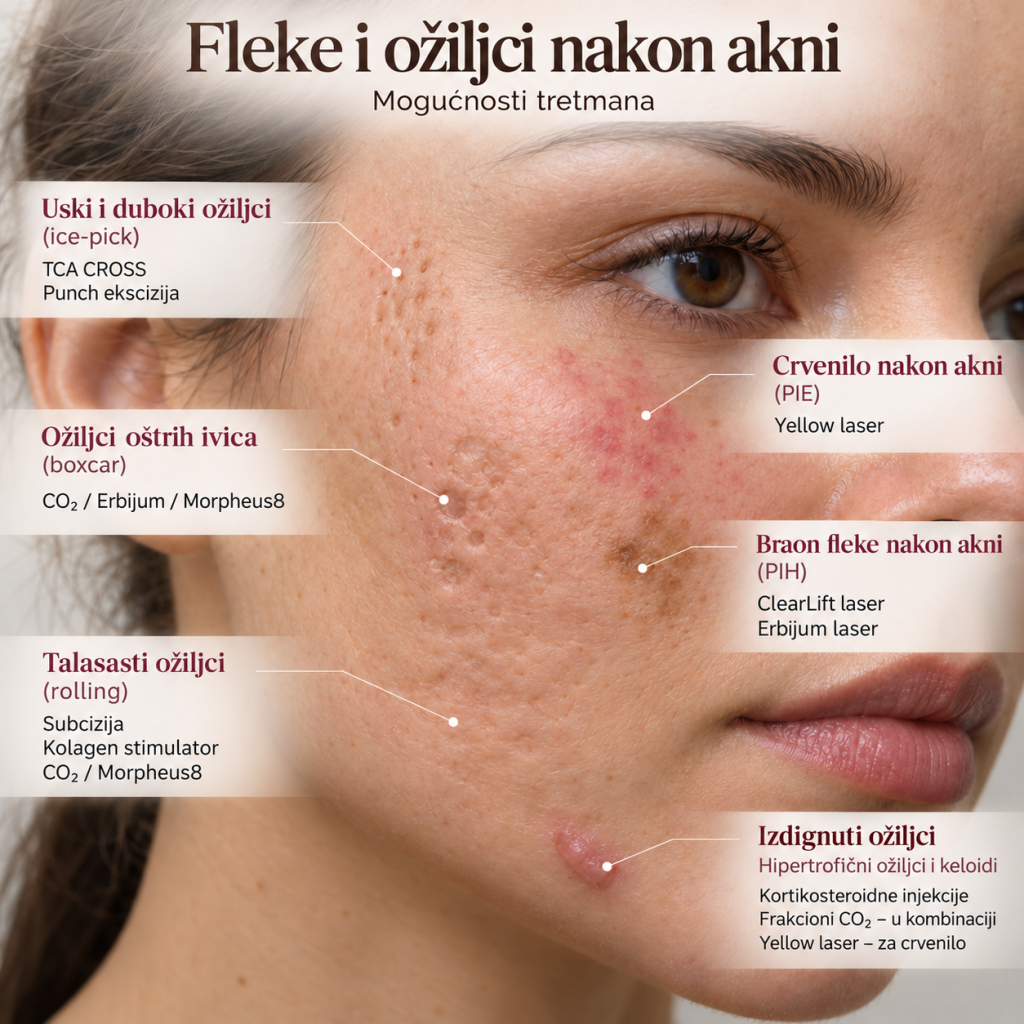
Ice pick – narrow and deep skin depressions, resembling a puncture, which taper towards the depth. They are among the more challenging scars to treat, as surface treatment often does not reach their base.
Boxcar – wider round or oval depressions with sharp, well-defined edges. They can be shallow or deep and most commonly occur on the cheeks and temples.
Rolling – wide depressions with soft edges, which make the skin look wavy. They occur when connective tissue bands beneath the skin pull the surface downwards and are more common on the lower cheeks and along the jawline.
Raised scars – hypertrophic scars remain within the borders of the original lesion and may partially regress over time, whereas keloids spread beyond the boundaries of the wound and do not regress on their own. They are more common on the chest, back, shoulders and along the jawline, and may be accompanied by itching or tenderness. Raised lesions require a different approach, and more about them can be found on the page keloids and hypertrophic scars.
On the same face, there is often a combination of multiple scar types, so a treatment plan is made for each region separately.
What does the examination and treatment selection process look like?
Treatment begins with an examination. The doctor assesses the type, depth and layout of the scarring, and checks for active acne or blemishes. Information on previous acne and scar treatments, a tendency towards pigmentation, wound healing and chronic illnesses is also important.
During the consultation, both expectations and the amount of time the patient can set aside for recovery are discussed, as this influences the choice of procedures and their sequence. Based on the findings, the doctor proposes a rough plan – which procedures, in what order and at what intervals – which is adjusted during treatment according to the skin's response. How expectations are set and therapy is planned is explained in more detail in the text how to properly start treating acne scars.
Which treatment suits which type of scar?
The choice of treatment depends on the type, depth and distribution of the scars, and multiple methods are often combined on the same face.
| Type of scar | Most common approach |
|---|---|
| Ice pick | Deep scars often require targeted procedures, such as the TCA CROSS method or punch excision; superficial treatment is not always sufficient. |
| Boxcar | The choice depends on the depth and edges of the scar – for shallower ones, fractional CO2 laser or microneedling are considered, and for deeper ones, targeted procedures as well. |
| Rolling | It is assessed whether tethering bands are pulling the skin; subcision is then considered, often in combination with collagen stimulators, fillers or a laser. |
| Mixed scars | Different regions and types of scars require different methods and sequences, so the procedures are combined. |
| Raised scars | They require a different approach from depressed scars, most commonly corticosteroid injections into the scar, along with an individual assessment. |
The table serves as a guide, and the final choice of procedures is decided by the dermatologist during the examination. Why multiple methods are most commonly combined is explained in the text acne scar treatments.
Procedures we apply
Fractional CO2 laser
Fractional CO2 laser It creates microscopic channels in the skin, leaving intact tissue between them. The skin regenerates in these areas, and the heat stimulates the production of new collagen, gradually evening out the skin texture. It is most commonly used for boxcar and shallower rolling scars and uneven texture, with the dermatologist adjusting the parameters based on the scar type, skin type and planned recovery. Redness, swelling and flaking are to be expected after the treatment. The recovery time depends on the intensity of the treatment, the size of the treated area and individual healing, usually lasting from a few days to about ten days. When multiple treatments are required, the interval between them is usually around two months.
Scar subcision
For certain depressed scars, primarily rolling and some boxcar scars, a dermatologist may recommend scar subcision, which releases the fibrous bands beneath the skin. Under local anaesthesia, a special needle is inserted beneath the scar and, with controlled movements, cuts the fibrous strands that pull the skin downwards, allowing it to rise to the surface. Minor bleeding under the skin, which occurs during the procedure, triggers healing and the creation of new collagen. In our practice, subcision is often combined with collagen stimulators or hyaluronic acid fillers to make the result more stable. After the treatment, swelling and bruising are possible, which subside in the following days.
TCA CROSS
TCA CROSS is a targeted method for narrow and deep scars, primarily ice pick and narrow boxcar scars. A trichloroacetic acid (TCA) solution is applied with a fine applicator only to the base of individual scars, rather than the entire region. Tissue regeneration and collagen production are triggered at the treated sites, so the depression gradually rises. The treatment is most often repeated several times, at intervals of a few weeks. The treated areas are darker for a few days and covered with tiny scabs, and sun protection is compulsory.
TCA chemical peel
TCA peeling, unlike the CROSS method, is applied to the entire region. It removes the superficial layers of the skin and evens out texture and complexion, so it is useful for shallower scars and lingering blemishes, while it does not resolve deep scars on its own. The strength of the peel is chosen according to the skin and scar type. After the treatment, the skin peels for a few days. With a darker complexion, there is a greater risk of pigmentation changes, which is why TCA peels are performed during the autumn and winter periods, with mandatory sun protection. More about peels can be found on the page chemical peels.
Microneedling (Dermapen)
Dermapen is a microneedling device with an attachment of many tiny needles, which create controlled micro-injuries in the skin. The skin responds to them by producing new collagen, so the texture gradually improves. Microneedling is suitable for shallower scars and uneven texture, with a low risk of skin discoloration and a short recovery time. Several treatments are usually required, and for deeper scars, microneedling is a supplement to other procedures rather than a standalone solution.
Morpheus8
Morpheus8 It combines microneedling and radiofrequency energy, which is delivered into the deeper layers of the skin. This stimulates collagen production and skin tightening, which is useful for rolling and shallower boxcar scars, especially when the skin is also a bit lax. It is most commonly performed as a series of treatments.
Punch excision
For individual deep ice pick or narrow boxcar scars, punch excision can be used. Under local anaesthesia, the scar is removed using a small round instrument, and the skin is closed with a suture. A tiny, flat scar remains at the site of the depression, which is further blended using a laser or another treatment if necessary.
Hyaluronic fillers
Hyaluronic fillers they fill in the depressions, so the scars immediately become less noticeable. They are suitable for wider, soft depressions, while they do not have a great effect on narrow and deep scars. The effect is temporary, so the treatment is repeated. As with any injection procedure, temporary swelling and bruising are possible, and less commonly other adverse reactions, which is why the filler is chosen and applied after an individual assessment.
Collagen stimulators
For atrophic scars, we also use Juvelook, collagen stimulator based on poly-D,L-lactic acid. It gradually restores tissue density beneath the depression, so the edges of the scar become softer and the shadow that makes it visible is reduced. It is most commonly planned as part of a combination treatment plan, alongside subcision or laser treatments.
Injections for raised scars
For hypertrophic scars and keloids, corticosteroid injections are applied directly into the scar, which reduce its height, redness and itching. Multiple treatments are usually required, at intervals of several weeks.
Before and after results
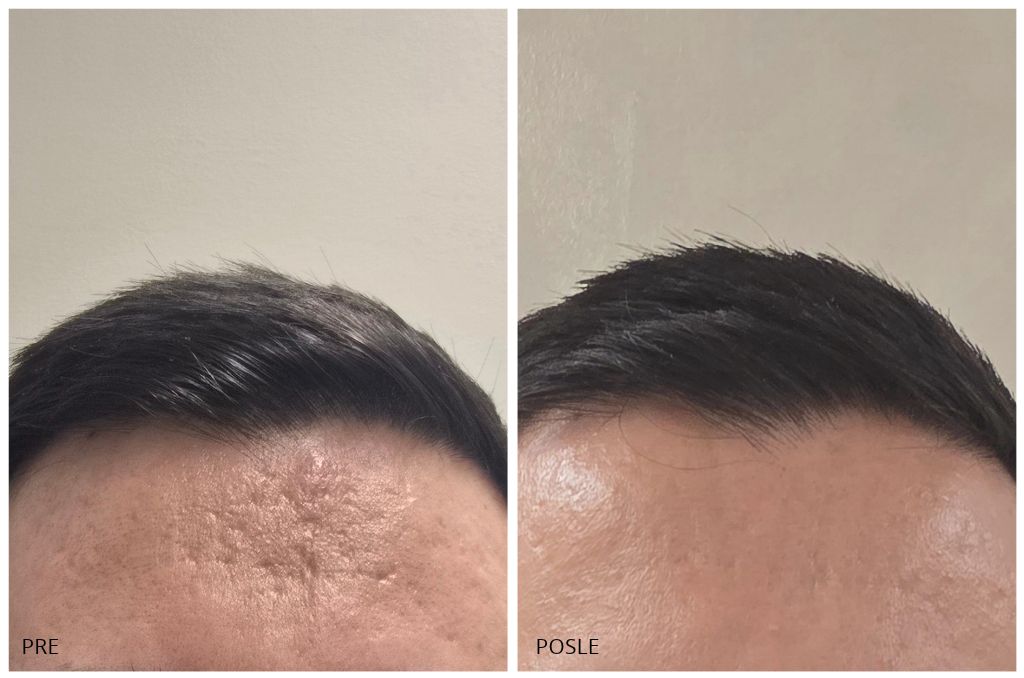
The photographs show the results of actual patients treated at Imedic. A combined plan was used: first subcision with a collagen stimulator, followed by fractional CO2 laser treatments. The result depends on the type and depth of the scars, the number of treatments, and skin healing, and varies from person to person.


Treatment plan
Most commonly a combination of multiple procedures
Treatments
CO2 laser, subcision, TCA CROSS, Morpheus8 and others
Results
Gradually, over several months
How many treatments are needed and when are results visible?
The number of treatments cannot be guaranteed in advance. A tentative plan is made at the consultation, which is adjusted according to how the skin responds. With shallower scars the path is usually shorter, while deeper and mixed scars require more procedures and several months of treatment.
The results develop gradually, as the skin needs time to produce new collagen, so the improvement is assessed several months after the treatment, rather than immediately upon recovery. During follow-up appointments, the dermatologist assesses the depth and appearance of the scars and decides whether the next treatment, a change of method or a break is needed. In the case of more severe scars, the achieved results can be maintained with occasional treatments.
Recovery and care
Recovery varies from procedure to procedure. After microneedling and milder peels, the skin is usually red for a short time, whereas after fractional CO2 laser, subcision or a stronger peel, you should expect a few days to around ten days of redness, swelling, bruising or peeling. Therefore, the timing of the treatment is planned in accordance with your commitments and important events.
After the treatment, the skin should be cared for using mild products recommended by the dermatologist, without exfoliants, acids and aggressive cosmetics, until it recovers. Scabs and flakes must not be removed. Sun protection is mandatory throughout the entire treatment, as exposure to the sun increases the risk of dark spots, making the period from autumn to spring the most suitable for most procedures.
Cost of acne scar treatment
The cost of acne scar treatment depends on the type and depth of the scars, the size of the area, and the chosen procedures. Multiple treatments are often combined, such as fractional CO2 laser, subcision, the TCA CROSS method, microneedling, or collagen stimulators, so there is no single price that applies to all patients. Following a dermatological examination, an approximate treatment plan and cost estimate are proposed. Prices for individual procedures can be found in price list for laser treatments and dermatology price list. For a preliminary assessment and rough price estimate, scar photographs can be sent via Viber or WhatsApp N/A 064 237 0707.
Our doctors
Who treats acne scars in Imedic?


Have you got a question?
Frequently asked questions about acne scars
When is the right time to start acne scar treatment?
If there are active acne breakouts, the plan usually involves getting them under control first. The dermatologist then assesses when the skin is ready for specific scar treatments – some can be started while the acne is still being treated, and others only once the lesions have settled.
Is it completely possible to smooth out skin after acne scars?
Completely smoothing out the skin is not always a realistic expectation. The aim of therapy is a significant improvement in texture, a reduction in scar depth, and a more even skin appearance, rather than perfect, “airbrushed” skin.
Can one treatment resolve all types of scars?
No. Different types of scars require different approaches. That is why treatment is often planned as a combination of procedures, tailored to the type, depth and layout of the scars.
How long does it take to see the final results of the treatment?
With most procedures, the results develop gradually, over a period of several weeks to several months, as the skin needs time to produce new collagen and regenerate.
Are scar treatments painful?
Before most treatments, an anaesthetic cream is applied, and for subcision and punch excision, local anaesthetic is given, so the procedures are tolerable. During the treatment, a stinging sensation or warmth may be felt, depending on the procedure.
Do the ages of scars affect the success of the treatment?
Yes. Fresher scars usually respond better to treatment, because the collagen remodelling process is more active. Older scars can be treated, but they often require a combination of multiple methods and a longer treatment plan.
Can acne scars get worse over time if left untreated?
Yes. Although the scar itself does not spread, the loss of collagen and skin elasticity with age can make depressions and unevenness more visible than before.
Does skin type affect the choice of scar treatment?
Yes. Skin type, its thickness, sensitivity, and propensity for pigmentation influence the choice of therapy and treatment parameters.
Is there a risk of new scars after the treatment?
With expert performance and proper care, the risk is small, but not non-existent. Prolonged redness, pigmentation changes, infection or, rarely, a new scar are possible. The risk is increased by sun exposure, picking at scabs and failing to follow post-treatment instructions.
Can home remedies remove acne scars?
I cannot remove existing scars, but I can contribute to better skin quality and the preservation of the results of professional treatments. Scar treatment requires medical procedures.
Can scar treatments be done during the summer?
Certain milder treatments can also be performed in the summer, but for fractional CO2 laser, TCA peels and TCA CROSS, a period with weaker sun is chosen, from autumn to spring. The dermatologist decides on the timing.
How important is aftercare for scar treatments?
Extremely important. Proper aftercare affects the speed of recovery, the quality of the results and the prevention of complications, such as dark spots or prolonged redness.
Book acne scar treatment in Belgrade
The Imedic Polyclinic is located at Kneza Miloša 23 street, 2nd floor, Belgrade. Opening hours: Monday–Sunday, 9:00–21:00.
Appointments are made by phone: 064 237 0707. If you contact us from abroad, we are also available via Viber and WhatsApp on the same number.

Author: Dr Ivica Jeremić
Doctor of Medical Sciences (Molecular Medicine and Immunology), subspecialist in rheumatology, dermatology resident.
Updated:
Expert sources
- American Academy of Dermatology Acne scars: Consultation and treatment.
- Lee JB, Chung WG, Kwahck H, Lee KH. Focal treatment of acne scars with trichloroacetic acid: chemical reconstruction of skin scars method. Dermatological Surgery, 2002. PMID: 12460296.
- Treatment of acne scarring with fractional CO2 laser. PubMed, PMID: 22671310.
- DermNet TCA CROSS.
Professional dermatological supervision and reliable information
The text on this page was written in accordance with the clinical practice of the Imedic Polyclinic and verified by a specialist in dermatovenereology. The professional sources are listed above. Acne scar treatment is led by a specialist doctor in dermatovenereology. The choice of procedures – fractional CO2 laser, subcision, TCA CROSS, chemical peels, microneedling or a combination of these – is made individually, based on an examination, the type and depth of the scars and the condition of the skin. A personal examination by a dermatologist is necessary for diagnosis and a treatment plan.


