
Thread vein removal on the face and legs in Belgrade
Visible capillaries can appear as individual red lines, a tiny branching network, or bluish blood vessels on the legs. The choice of treatment depends on the area, the appearance of the veins and the skin condition. At Imedic poliklinika in Belgrade, the Yellow laser and Dye-VL treatment are used for facial capillaries, and the Cooled LP Nd:YAG laser is used for suitable blood vessels on the legs. Examination allows the right method to be chosen and a treatment plan to be made.
Thread vein removal – summary
| Which areas are treated | Face and legs, following a doctor's assessment |
|---|---|
| What treatments are used | Yellow laser and Dye-VL for the face; Cooled LP Nd:YAG for the legs |
| How the method is chosen | Based on the appearance and depth of the blood vessels, the skin type and the findings |
| Anaesthesia | Not needed |
| Number of treatments | Individual, depending on the response to treatment |
| When the result is assessed | At the follow-up visit, once the veins have had time to fade |
| Season | During periods of lower UV radiation; not performed on tanned skin |
| Price | In the price list for laser and radiofrequency treatments |
Thread veins on the face and legs — what is the difference?
In everyday speech, “thread veins” or “broken capillaries” are small visible blood vessels in the skin. For choosing a treatment, a practical classification is more useful than a description of their structure.
Facial capillaries – fine red lines or a branched network, most commonly on the nose, cheeks and chin. They are located superficially, so they are treated with light of shorter wavelengths. If they are accompanied by persistent facial redness, the doctor assesses whether this is rosacea.
Small blood vessels on the legs – reddish to bluish lines and networks, most commonly below the knee. They are larger and deeper-seated than those on the face, so they require a different approach.
Varicose veins – raised, tortuous veins that can be seen and felt. They are not the same as tiny capillaries and are not treated in the same way; if symptoms are present alongside them, the condition of the venous circulation is assessed.
Small veins that cause no symptoms do not need to be removed. The decision is made according to the appearance, symptoms and the patient's preference, rather than out of medical necessity.
Nd:YAG laser for leg vein removal
At Imedic poliklinika, suitable visible blood vessels on the legs are treated with the Cooled LP Nd:YAG laser (wavelength 1064 nm). A long pulse and deeper penetration allow the treatment of vessels that require a different approach from superficial facial capillaries.
Laser energy heats the targeted blood vessel, which closes and stops carrying blood, and the body gradually breaks it down. Contact cooling protects the skin surface and eases any discomfort during the treatment.
During the examination, the arrangement, colour and thickness of the blood vessels, skin type and previous treatments are assessed, and based on that, the doctor determines whether Nd:YAG is a suitable option. The applicator is part of the Alma Harmony XL Pro platform; it is a long-pulsed vascular treatment, which differs from Nd:YAG skin rejuvenation treatments.
Is every visible blood vessel on the legs suitable for laser treatment?
No. Fine surface vessels and prominent varicose veins do not require the same approach. If, alongside the visible changes, there is swelling, pain or a feeling of heaviness in the legs, the doctor assesses whether additional examination of the venous circulation is necessary prior to aesthetic treatment.
A Doppler scan is not necessary for every person with a few small capillaries — the need for a blood vessel examination is determined according to symptoms and findings.
Nd:YAG or sclerotherapy?
Laser and sclerotherapy have different advantages and are chosen according to the type of lesions. Laser can be useful for certain tiny vessels, as well as when sclerotherapy is unsuitable or has not yielded the expected result.
At Imedic poliklinika, we do not perform sclerotherapy — for visible blood vessels on the legs, we use laser treatment. An assessment during the consultation will show whether laser treatment is the appropriate method for your condition.
Yellow laser and Dye-VL for facial capillaries
Yellow laser emits yellow light that is absorbed by haemoglobin in the blood vessel. The energy is converted into heat, the vessel closes, and over time the body breaks it down. It is used for individual visible capillaries and finer networks on the face.
Dye-VL is a light treatment based on IPL/AFT technology, rather than a conventional laser. It operates across a broader spectrum, so it is chosen when, alongside capillaries, there is also diffuse redness or an uneven complexion, and when they are treated together with pigmentation.
Both treatments target existing blood vessels. A successfully treated vessel generally does not return, but this does not prevent the formation of new capillaries — which is why sun protection and the avoidance of factors that dilate blood vessels are advised after the treatment.
Examination and choice of the appropriate method
During the examination, the doctor assesses the area, the appearance and depth of the blood vessels, the skin type and any persistent redness, as well as previous treatments and reactions to them. Based on this, the method is chosen and a plan is made.
The same person may have veins that require different treatments — for example, fine capillaries on the face and larger vessels on the legs. In such cases, each area is planned separately.
The number of treatments depends on the type, colour and density of the blood vessels and on the response to the first treatment. In the case of a dense network, more treatments are required, at intervals determined by the physician.
What the treatment involves
Preparation for the treatment
The area to be treated must not be tanned, so sunbathing and sunbeds are avoided prior to the appointment. The treatment is planned for a period of lower UV radiation.
You need to tell the doctor which medications you are taking, especially blood thinners, whether you have previously had a reaction to laser treatment, and whether you have had problems with healing. Also inform the doctor about pregnancy, breastfeeding, and any skin changes in the area being treated. Do not stop any prescribed medication on your own.
Course of treatment
Treatment begins with an examination and agreement on the area to be treated. During the procedure, protective eyewear is used, and pulses are directed at the selected blood vessels.
Heat, a stinging sensation or short-lived pain may be felt, and the intensity of this sensation varies from person to person and from area to area. Anaesthesia is not required. The duration depends on the size of the area and the extent of the veins.
Recovery and care
Following the treatment, redness, sensitivity or mild swelling may occur in the treated area. Pigmentation changes are also possible, and more rarely blisters or scarring; appropriate parameters and adherence to instructions reduce this risk.
The treated area must be protected from the sun. Instructions regarding aftercare, physical activity, sauna and any compression stocking are given after the treatment, as they differ for the face and legs.
When are the results visible?
Immediately after the treatment the appearance of the blood vessel may change, but that is not the final result. Certain vessels gradually fade, whilst some temporarily appear darker. The veins need time to fade, and sometimes repeat treatments are needed as well.
At the follow-up visit, the response and the need for further treatment are assessed. Treatment of existing blood vessels does not rule out the possibility of new ones appearing over time.
Thread vein removal: before and after
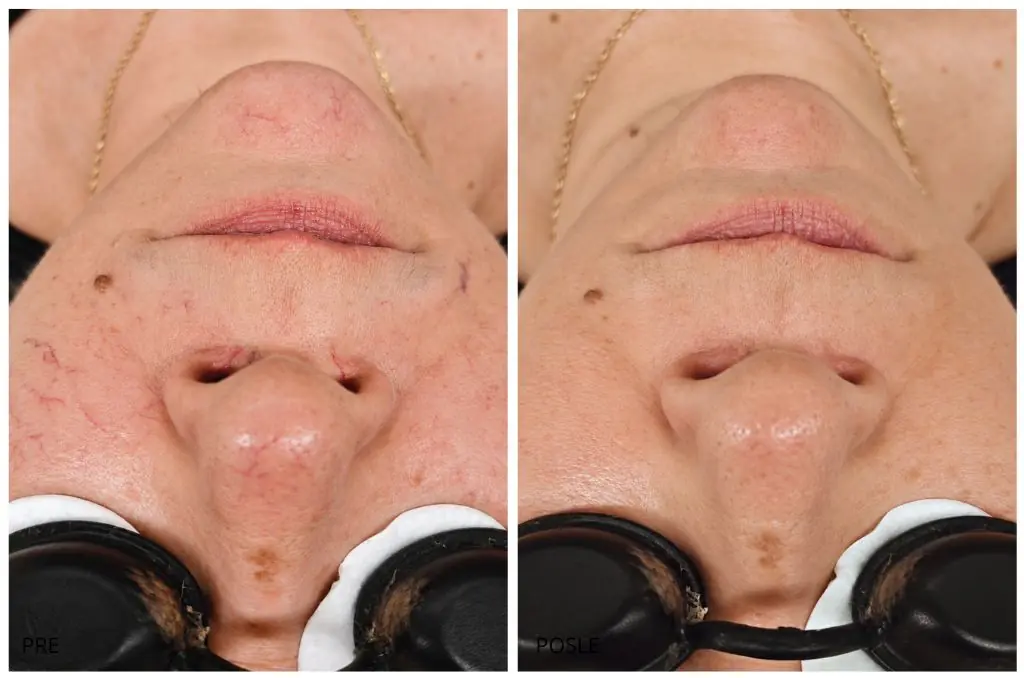
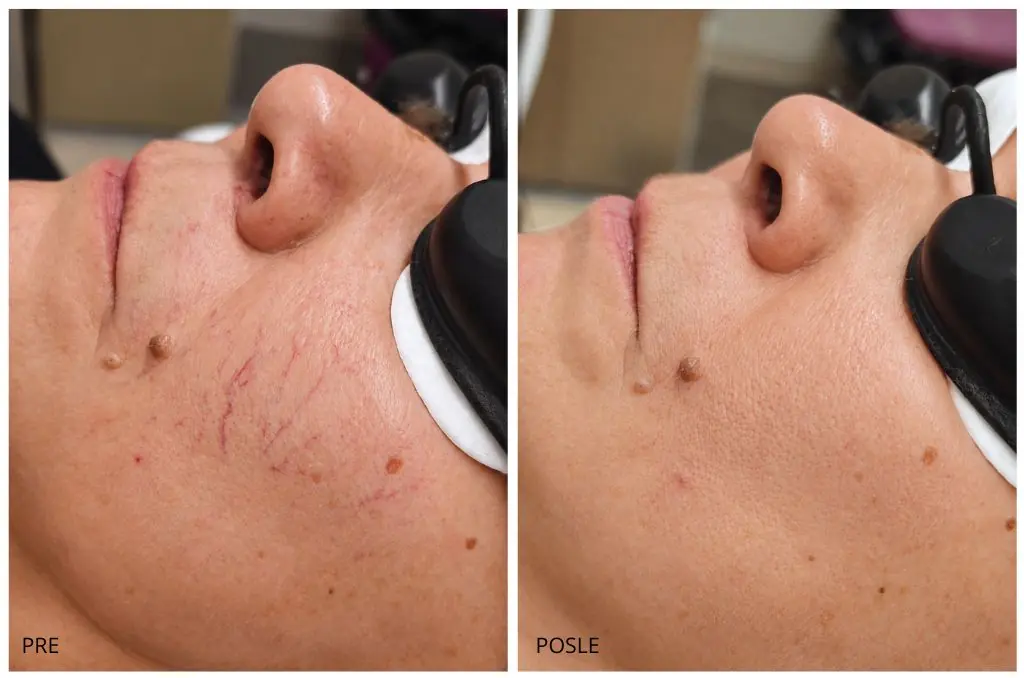
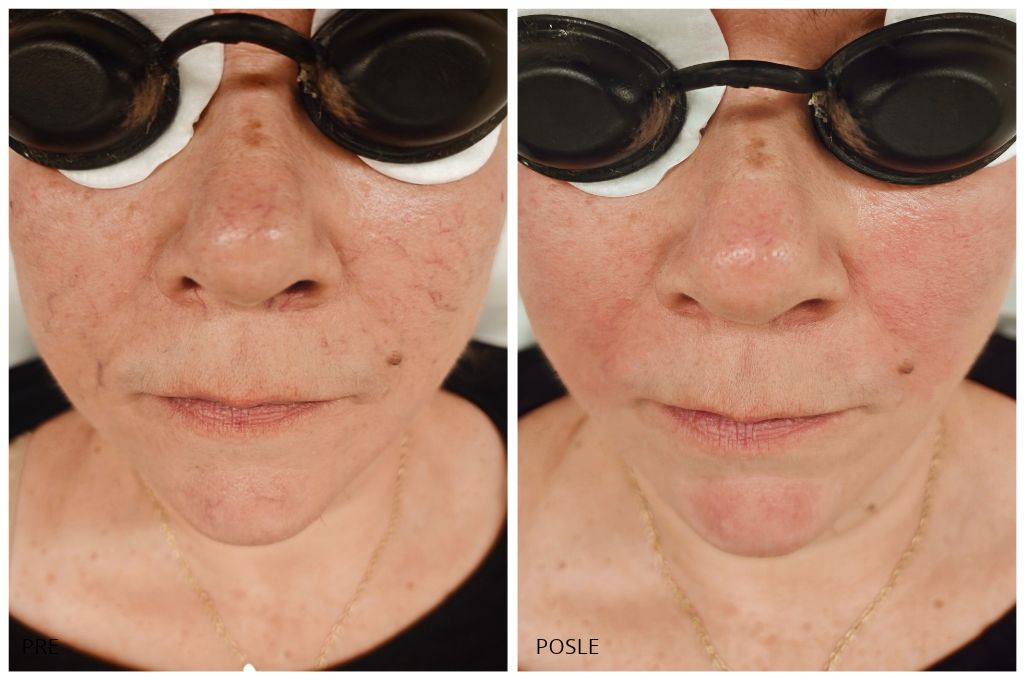
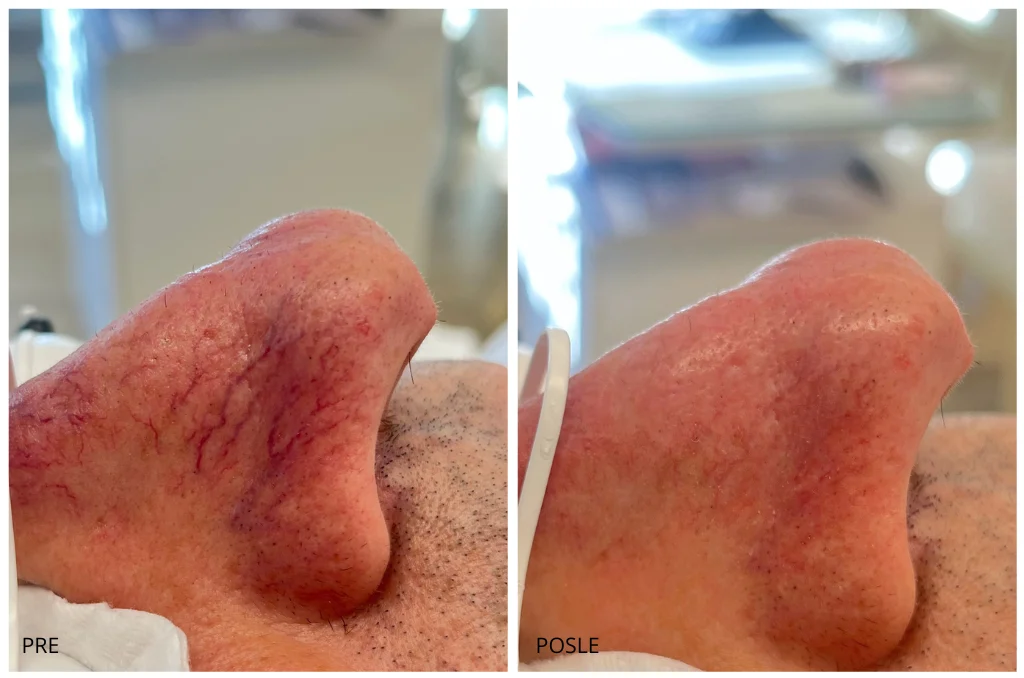
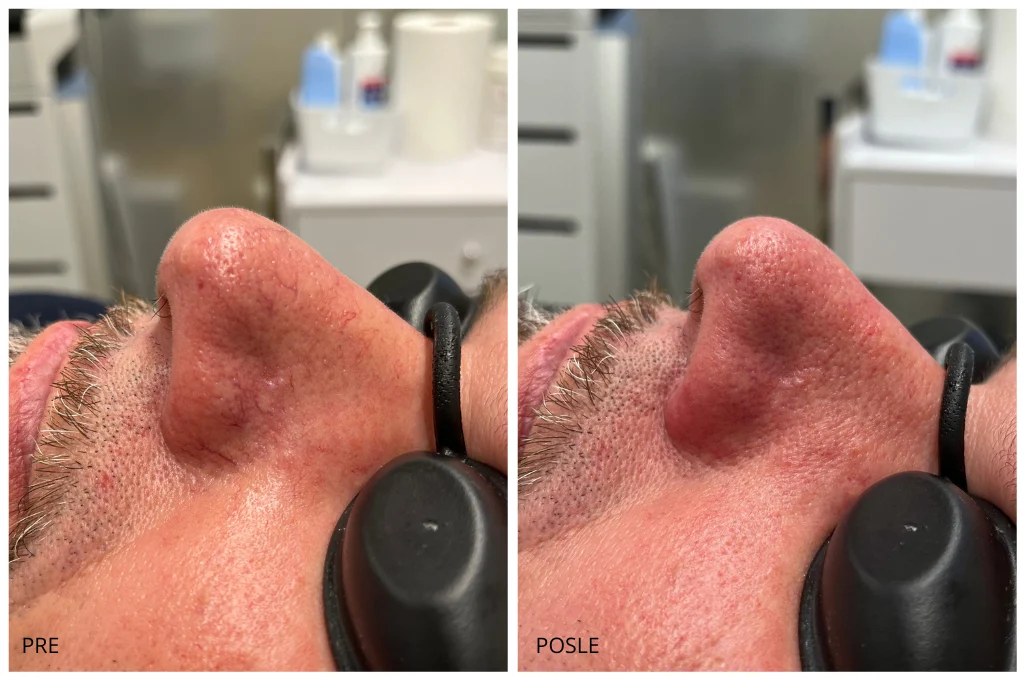
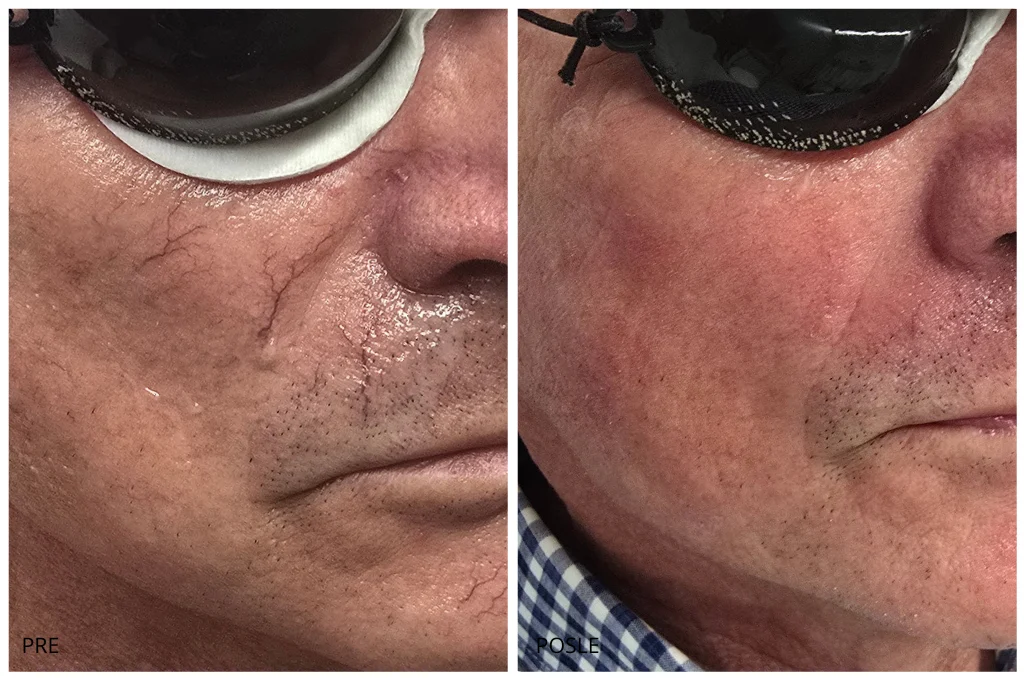
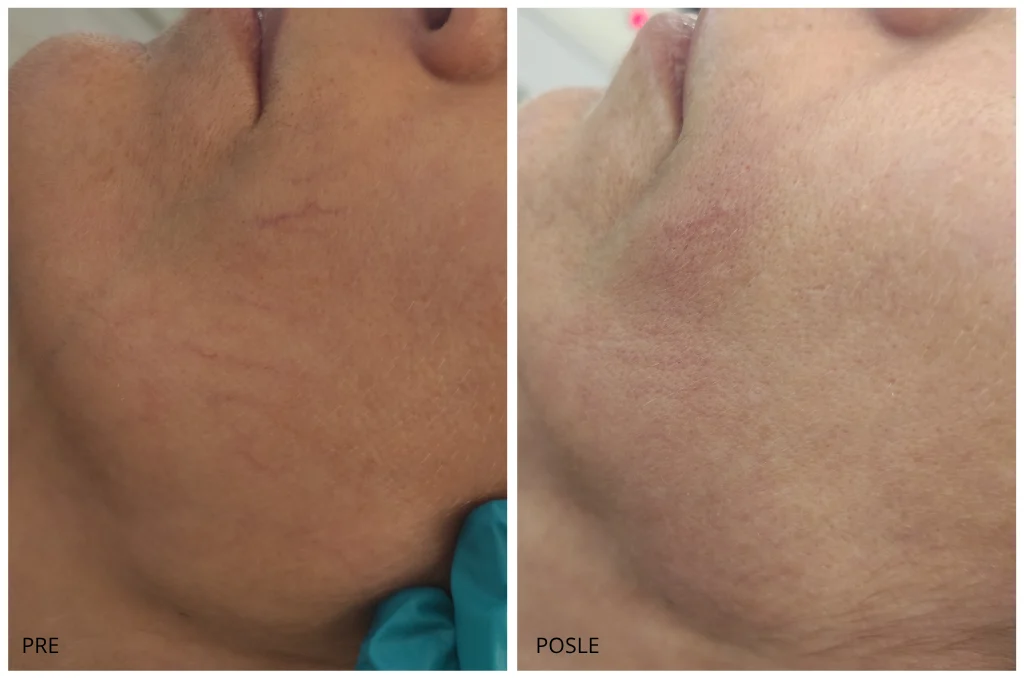
The photographs show the results of laser thread vein removal in specific patients. The result depends on the initial condition, area and number of treatments, so it varies from person to person.
Face
Yellow laser and Dye-VL
Legs
Cooled LP Nd:YAG
Anaesthesia
Not needed
Thread vein removal price
The price depends on the area, the extent of the veins and the chosen method. Current prices can be found in the laser and radiofrequency treatment price list.
The treatment plan and information on the total cost are determined after the examination.
Our doctors
Who carries out the assessment and treatment?


Have a question?
Frequently asked questions about thread vein removal
Does the treatment hurt?
Anaesthesia is not required. During each pulse, warmth and a prickling sensation are felt, and for some a brief pain, with the sensation depending on the region and pain threshold. Treatment on the legs is usually more sensitive than on the face, and contact cooling eases the discomfort.
How many treatments are needed?
It depends on the type, colour and density of the blood vessels and on the response to the first treatment. For single, tiny capillaries, fewer treatments are sometimes enough, whereas a dense network requires more. The plan is made during the examination and changed at the follow-up if necessary.
Do thread veins come back?
A successfully treated blood vessel generally does not come back, as the body breaks it down. That, however, does not prevent the formation of new capillaries — this is influenced by hereditary predisposition, sun exposure, hormonal changes, and strain on the legs.
What does the skin look like immediately after the treatment?
Redness and mild sensitivity, and sometimes mild swelling, are expected in the treated area. Individual blood vessels temporarily appear darker before fading. The doctor will advise when it is possible to use makeup and return to normal activities after the treatment.
Can the treatment be done in summer?
The treatment is not performed on sun-tanned skin, so it is planned for a period of lower UV radiation. If it is nevertheless performed during the warmer months, the treated area must be consistently protected from the sun before and after the treatment.
Do I need a vascular examination before the treatment?
It is not mandatory for everyone with a few small capillaries. If, along with visible changes in the legs, there is swelling, pain or a feeling of heaviness, the doctor assesses whether an examination of the venous circulation is necessary before the aesthetic treatment.
Do capillaries have to be removed?
They don't have to. Minor changes that do not cause symptoms can be monitored. The decision on treatment is made based on the appearance, symptoms and the patient's preference.
Is Dye-VL a laser?
Dye-VL is a light treatment based on IPL/AFT technology, so it is not a conventional laser, although in practice it is often called one. It operates across a broader spectrum of wavelengths, making it suitable when diffuse redness and pigmentation are treated alongside capillaries.
When the treatment is not carried out
The treatment is not performed on sun-tanned skin, nor in the presence of an active infection or skin damage in the area. It is postponed during pregnancy and breastfeeding, and in cases of therapy that affects blood clotting or skin sensitivity to light, the doctor assesses whether and when the treatment is possible.
Book thread vein removal in Belgrade
Imedic poliklinika is located at Kneza Miloša 23, 2nd floor, Belgrade. Opening hours: Monday–Sunday, 9:00–21:00.
Appointments can be booked by phone: 064 237 0707. If you contact us from abroad, we are also available via Viber and WhatsApp on the same number.

Author: Dr Ivica Jeremić
PhD in Medical Sciences (Molecular Medicine and Immunology), rheumatology subspecialist, dermatology resident.
Updated:
Expert sources
DermNet: Neodymium YAG laser treatment
DermNet: Facial red vein and vascular birthmark treatments
American Academy of Dermatology: Leg veins – why they appear and how dermatologists treat them
Professional dermatological supervision and reliable information
The text on this page is written according to the clinical practice of Imedic poliklinika and verified by a doctor. Expert sources are listed above. The choice of method – Yellow laser, Dye-VL or Cooled LP Nd:YAG – is made individually, based on the examination, the area and the appearance of the blood vessels. A personal examination by a doctor is essential for assessment and treatment planning.


