Facial biorevitalisation
Biorevitalisation is an injection treatment to improve skin hydration and quality. Here you can find out what the procedure looks like, who it is recommended for, what to expect during recovery and how facial, neck and décolletage treatments are planned.
Biorevitalisation – in brief
| What it treats | Dry and dehydrated skin of the face, neck and décolletage, loss of elasticity and fine lines |
|---|---|
| Who is it for | Dry, dehydrated, dull skin, fine lines and mild loss of elasticity, without pronounced sagging |
| Products | Non-cross-linked hyaluronic acid, skin boosters with amino acids (Jalupro) and stabilised products (Juvederm Volite); the choice is made at the consultation |
| Anaesthesia | Anaesthetic cream |
| Duration of treatment | About 45 minutes |
| Number of treatments | With non-cross-linked hyaluronic acid, a series of three treatments spaced about a month apart is needed; with stabilised products, fewer are required. |
| Result | Visible immediately, best after 5 to 7 days |
| Duration of results | It depends on the product: after a course of non-cross-linked hyaluronic acid, usually 4 to 6 months, with stabilised products up to 9 months |
What is facial biorevitalisation?
Biorevitalisation involves the application of a selected preparation into the skin, most commonly with hyaluronic acid, with the aim of improving hydration, texture and elasticity. The treatment begins with an examination: the skin, expectations, previous procedures and potential contraindications are assessed.
The names biorevitalisation and skin booster treatment often overlap. On this page, the focus is on the procedure, preparation and recovery. For an overview of the composition and differences between products, please see skin boosters and product selection.
How biorevitalisation improves facial skin firmness
Skin firmness is the skin's ability to return to its original shape after pressure or movement. When the skin loses water, it becomes thinner and flabbier to the touch, and fine lines become more visible.
Hyaluronic acid introduced into the skin binds water and stimulates fibroblasts, the cells that produce collagen and elastin. In clinical studies, the skin was more hydrated and measurably firmer after treatment.
The change is gradual and moderate. Biorevitalisation does not lift sagging areas of the face and does not replace fillers or skin tightening treatments. If sagging is the main problem, the doctor will suggest collagen stimulators or other treatments.
Facial biorevitalisation – how the treatment works
What the treatment looks like, step by step
- Examination and consultation, about 10 minutes: the doctor assesses the skin and chooses the product and plan.
- Cleansing and anaesthetic cream, about 20 minutes: the cream takes effect while you wait.
- Application, 15 to 20 minutes: The product is injected using a fine needle at multiple small points across the face, neck or décolletage.
- Finish, around 5 minutes: A soothing mask and gel are applied.
Injections feel like a brief stinging sensation. With anaesthetic cream, most patients describe the treatment as tolerable.
How does hyaluronic acid biorevitalise the skin?
As we age, the natural production of hyaluronic acid and collagen in the skin slows down. As a consequence, the skin becomes thinner, loses elasticity, and first fine lines and then deeper wrinkles begin to appear. When hyaluronic acid is applied directly into the skin, its deficiency is replenished in the layers where it is most needed, thereby restoring hydration and improving the quality of the skin's surface. The effect of freshness and firmness is often visible very quickly, while in the long term, regenerative processes within the skin itself are stimulated.
Most moisturising creams and serums contain hyaluronic acid, but in these products it acts mainly on the surface. The difference with biorevitalisation is that hyaluronic acid is introduced into the skin, where it acts where creams cannot penetrate. Hyaluronic acid binds a large amount of water, which is why it is one of the essential ingredients for skin hydration. By binding water within the tissue, fullness is restored to thin and dehydrated skin, texture is improved, and the face, neck and décolletage become smooth to the touch and visibly refreshed.
What are the effects of biorevitalisation?
Potential effects include better hydration, smoother texture and less noticeable fine lines. The time it takes for changes to appear and how long they last depend on the product and the condition of the skin. The immediate appearance after the injections is not the final result; an assessment is made once the initial reactions have subsided and according to the follow-up plan.
How is a biorevitalisation product chosen?
The product is chosen after a consultation, according to the area being treated, the degree of dehydration and the desired improvement in skin quality. Hyaluronic acid formulations, additional ingredients and application protocols differ.
A detailed review of Jalupro, Juvederm Volite, Profhilo and other formulations can be found on our page about Skin Boosters in Belgrade – Products and Differences. For a distinct treatment protocol, see also our page about Profhilo treatment.
What effect would you like to achieve?
Biorevitalisation is used for more intense hydration, a fresher complexion and the softening of fine lines. The products vary in composition and duration of effect. On our page about skin boosters, you can see which products we use and for which skin needs they are intended.
How long does the effect of biorevitalisation last?
For non-cross-linked hyaluronic acid, we recommend an initial series of treatments, followed by maintenance every three to four months. For cross-linked hyaluronic acid, we plan maintenance once every six months, depending on the product and the condition of the skin.
Preparation and aftercare
One week before:
- Tell your doctor which medicines and supplements you are taking, especially those that affect blood clotting. Do not stop taking any medication without consulting your doctor.
- Postpone facial peels and stronger skin products.
The day before:
- Do not drink alcohol.
- If you are prone to cold sores, tell your doctor.
The first 12 hours:
- No make-up.
- Do not touch or rub the treated areas.
The first 3 days:
- No sauna, steam room, swimming pool or intense exercise.
- No facial massage or strong skin products.
The first 7 days to 2 weeks:
- Avoid direct sunlight and sunbeds, and use sunscreen.
- Avoid extreme cold.
Bruises, if they appear, fade within a few days to a week.
Biorevitalisation or PRP?
Both treatments work on skin quality, but in different ways. With biorevitalisation, hyaluronic acid is introduced into the skin, which binds water and provides quicker hydration. With PRP, plasma from your blood is used, the growth factors of which gradually stimulate skin renewal.
In a randomised study, both treatments produced a moderate improvement, and the combination produced a more pronounced effect. Your doctor will assess which option is better for your skin at the consultation. Read more on our page about PRP facial treatment.
When is the right time for biorevitalisation?
Biorevitalisation is not linked to age. It is carried out when the skin becomes dry, thin or loses its radiance, and as a preventative measure in younger skin.
It is most commonly planned in autumn and winter, when the skin is exposed to heating and cold wind, and before summer, as skin preparation. In summer, it can be done with sun protection in the days following the treatment.
Biorevitalisation before and after
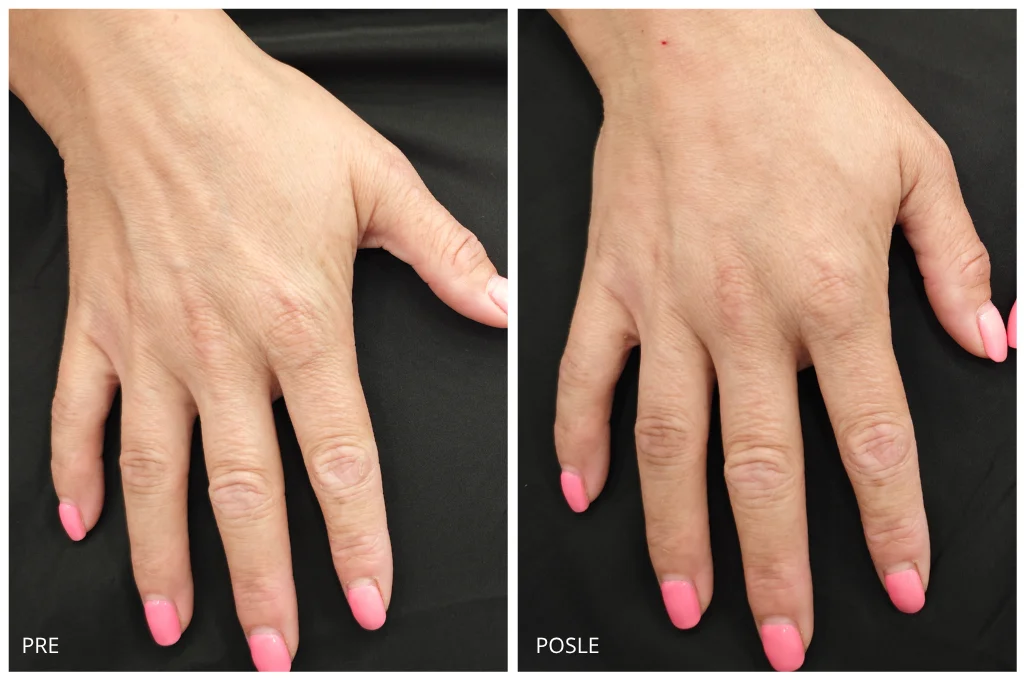
Result after a single skinbooster treatment for the hands. For other treatments for this area, see our page about hand rejuvenation.
Treatment plan
Usually a series of three treatments, about a month apart
Result
Visible immediately, best after 5 to 7 days
Duration of results
4 to 9 months, depending on the product
Price of biorevitalisation
Have a question?
Answers to frequently asked questions
What does a biorevitalisation treatment look like?
The treatment starts with an examination and the selection of the preparation, after which the skin is cleansed and an anaesthetic cream is applied. The entire procedure, step by step, is described in the section “What the treatment looks like, step by step”. The treatment takes about 45 minutes.
Who is biorevitalisation recommended for?
Biorevitalisation is one of the treatments regularly used to maintain the quality, health and beauty of the skin, and to prevent and slow down skin ageing. As skin ages differently in each of us, age is not the parameter by which we recommend treatments, but we do recommend the biorevitalisation treatment when:
- you have dry, dehydrated and thin skin
- there is photodamage to the skin
- the first signs of ageing appear, such as skin laxity, loss of firmness and the first wrinkles
Recovery
Following the treatment, the skin is slightly red, and tiny bumps can be seen at the injection sites. This is expected and subsides within a few hours.
Do not apply make-up for the first 12 hours. You can return to your daily routine immediately, but postpone saunas and intensive workouts for three days. Detailed instructions are in the “Preparation and aftercare” section.
How many treatments are needed for optimal results?
The number of required treatments depends on the type of preparation used, i.e. whether non-cross-linked or cross-linked hyaluronic acid is applied. With products containing non-cross-linked hyaluronic acid, which are used primarily for intensive skin hydration and biorevitalisation, a series of three treatments spaced about a month apart is recommended, as the active ingredients break down faster in the skin.
With products containing cross-linked hyaluronic acid, which are more stable and remain active in the tissue longer, the number of treatments can be smaller, and the intervals between applications longer. These preparations enable a more gradual, yet longer-lasting improvement in skin quality.
The final protocol is always determined individually, based on the skin condition, the area being treated and the goal of the therapy, following an examination and consultation with a doctor.
Difference between cross-linked and non-cross-linked hyaluronic acid
Non-cross-linked hyaluronic acid is used for intensive skin hydration and biorevitalisation, breaks down quickly and does not provide volume. Cross-linked hyaluronic acid is stabilised so that it remains in the skin longer and, depending on the formula, can improve skin quality and elasticity, without necessarily having a volumising effect.
The difference between mesotherapy and biorevitalisation
Although mesotherapy and biorevitalisation are performed using a similar technique, there is a fundamental difference between these two treatments in the composition of the products and the duration of the effect. Mesotherapy products most frequently contain low molecular weight hyaluronic acid, vitamins, minerals and other active substances that work quickly, but also break down relatively quickly in the skin. Because of this, multiple repeated treatments are needed to maintain the results.
Biorevitalisation products contain concentrated high molecular weight hyaluronic acid, often also stabilised (cross-linked), which remains in the skin significantly longer. In this way, longer-lasting hydration, improved skin elasticity and quality are achieved, with fewer treatments. With stabilised preparations, a change is often noticed after just the first treatment.
Biorevitalisation for neck and décolletage
Biorevitalisation is a treatment designed to improve skin quality and slow down the signs of ageing. Although it is most commonly applied to the face, it is also frequently used on the neck and décolletage. The skin in these areas is thinner, more sensitive and more prone to premature ageing, which is why many more invasive treatments are not recommended.
Biorevitalisation can be safely applied precisely to these sensitive areas. By injecting active substances into the skin, tissue regeneration is stimulated, hydration and elasticity are improved, and the skin gradually regains its plumpness. The skin becomes more hydrated and smoother, and fine lines less noticeable.
Potential side effects
The most common are redness, swelling, tenderness and tiny bumps at the injection sites, which subside within a few hours to a few days. Bruising is also possible, disappearing within a few days to a week.
Lumps rarely appear at the injection sites, and infection or allergic reaction is very rare. If you notice severe or increasing pain, skin discolouration or pus formation, contact a doctor immediately.
How long before an important event should I have biorevitalisation?
We recommend planning your injectable treatment at least two weeks before an important event. If a series of treatments is required, the plan should start earlier to allow enough time for the full effect to develop.
Contraindications
Biorevitalisation is safe when a doctor properly indicates and performs it, but there are conditions in which these procedures are not recommended or are postponed. Absolute contraindications include active infections or inflammatory processes on the skin in the area being treated, as well as systemic infections. Treatments are not performed on patients with autoimmune diseases in an active phase, malignant conditions, nor on individuals with a known hypersensitivity or allergy to any of the components of the preparation.
Relative contraindications are pregnancy and the breastfeeding period, when aesthetic injection treatments are not performed as a precaution. Caution is required in patients using anticoagulant therapy or having coagulation disorders, due to the increased risk of bruising and bleeding. Also, the treatment is postponed in cases of active herpes infections, severe acne, dermatitis or recent skin damage.
Before every procedure, an examination and consultation with a doctor are necessary in order to assess the patient's general state of health, skin condition and any potential risks, and to choose the approach that suits your skin.
Book facial biorevitalisation in Belgrade
Imedic poliklinika is located at Kneza Miloša 23, 2nd floor, Belgrade. Opening hours: Monday–Sunday, 9:00–21:00.
Appointments can be booked by phone: 064 237 0707. If you contact us from abroad, we are also available via Viber and WhatsApp on the same number.
Related topics

Author: Dr Ivica Jeremić
PhD in Medical Sciences (Molecular Medicine and Immunology), rheumatology subspecialist, dermatology resident.
Expert sources
- Landau i Fagien, 2015 — hijaluronska kiselina i odgovor fibroblasta
- Arora i saradnici, 2021 — biorevitalizacija kože skinbusterima
- Safa i saradnici, 2022 — uticaj stabilizovane hijaluronske kiseline na kvalitet kože
- Hersant i saradnici, 2021 — PRP i hijaluronska kiselina u podmlađivanju lica
- Goldie i saradnici, 2021 — konsenzus o kvalitetu kože


