Corn – pictures, causes, treatment and removal
A corn (lat. clavus) is a small, clearly defined thickening of the skin with a hard core in the centre. It develops in a place where the skin has long been subjected to pressure or friction, most commonly on the toes and the sole of the foot. It hurts when pressed, making walking and wearing shoes difficult.
It is not caused by a virus, so it is not contagious. It returns for as long as the pressure that caused it lasts. On the sole of the foot, it often resembles a viral wart, which is treated differently, so in the case of an unclear lesion, the first step is an examination.
What it looks like · Corn, callus or wart · Causes · December · When to see a doctor · Treatment · What you can do yourself · Plasters · Questions
| What it is | a localised thickening of the skin with a hard core, at a site of pressure or friction |
|---|---|
| Where does it occur | toes (most frequently the little toe), between the toes, sole of the foot; less commonly hands |
| Is it contagious | no; it is caused by pressure, not by a virus |
| What is it like | a callus and a plantar wart |
| What helps | footwear that does not pinch, foot relief, removal of hard skin by a doctor |
| Who should not treat it themselves | people with diabetes, poor circulation or impaired sensation in their feet |
| Appointment at Imedic | dermatological examination 5,000 RSD |
What does a corn look like
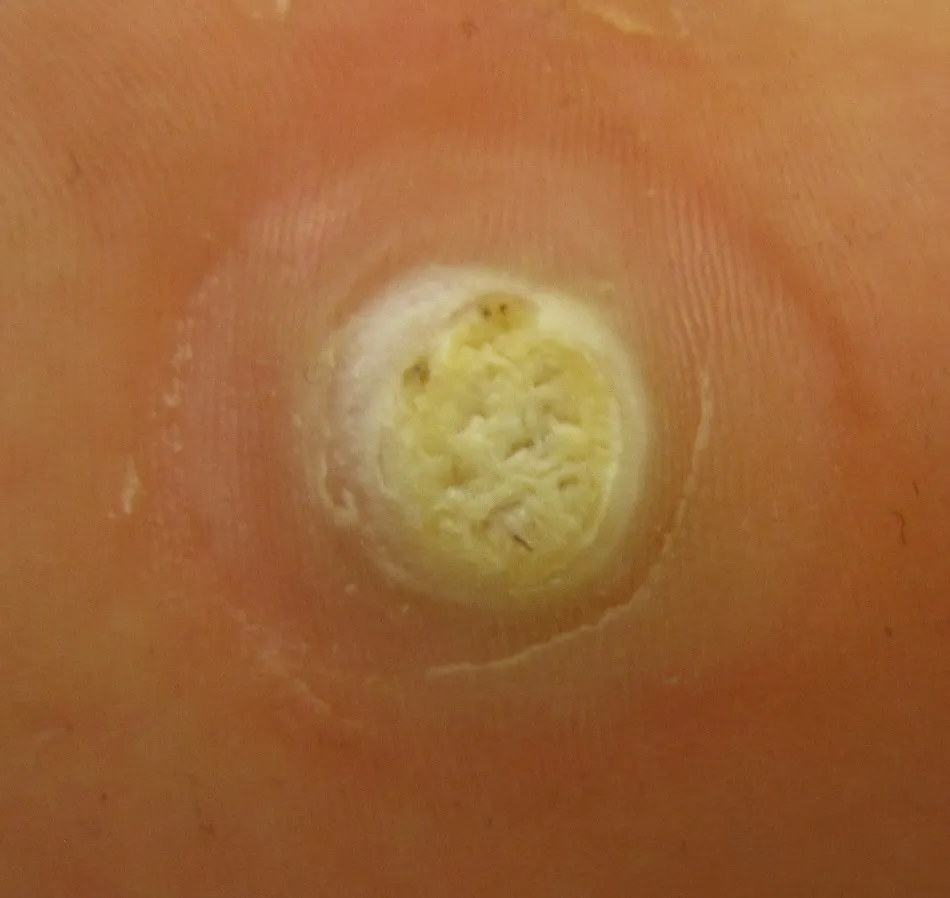
A corn is a round, hard and raised yellowish thickening of the skin. A clearly defined core, from which it gets its name, can usually be seen in the centre. It is the size of a pea or slightly larger, and the skin around it is often red. It hurts most in the centre, when standing and walking.
Hard and soft corn
Hard corn is most common. It is dry and horn-like, with a hard core. Typical locations are the outer side of the little toe and the upper side of the joints of the other smaller toes.
Soft corn it develops between the toes, most commonly between the fourth and fifth. The skin there is moist, so it is whitish and softer, and can be very painful.
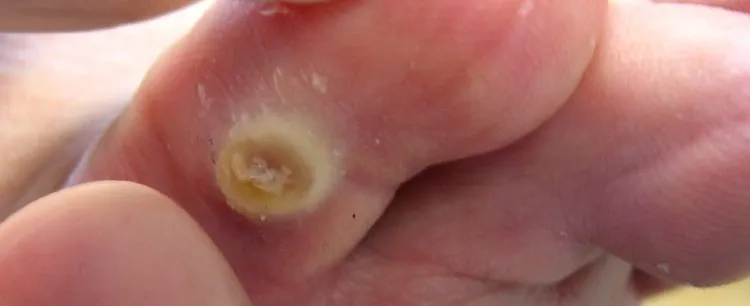
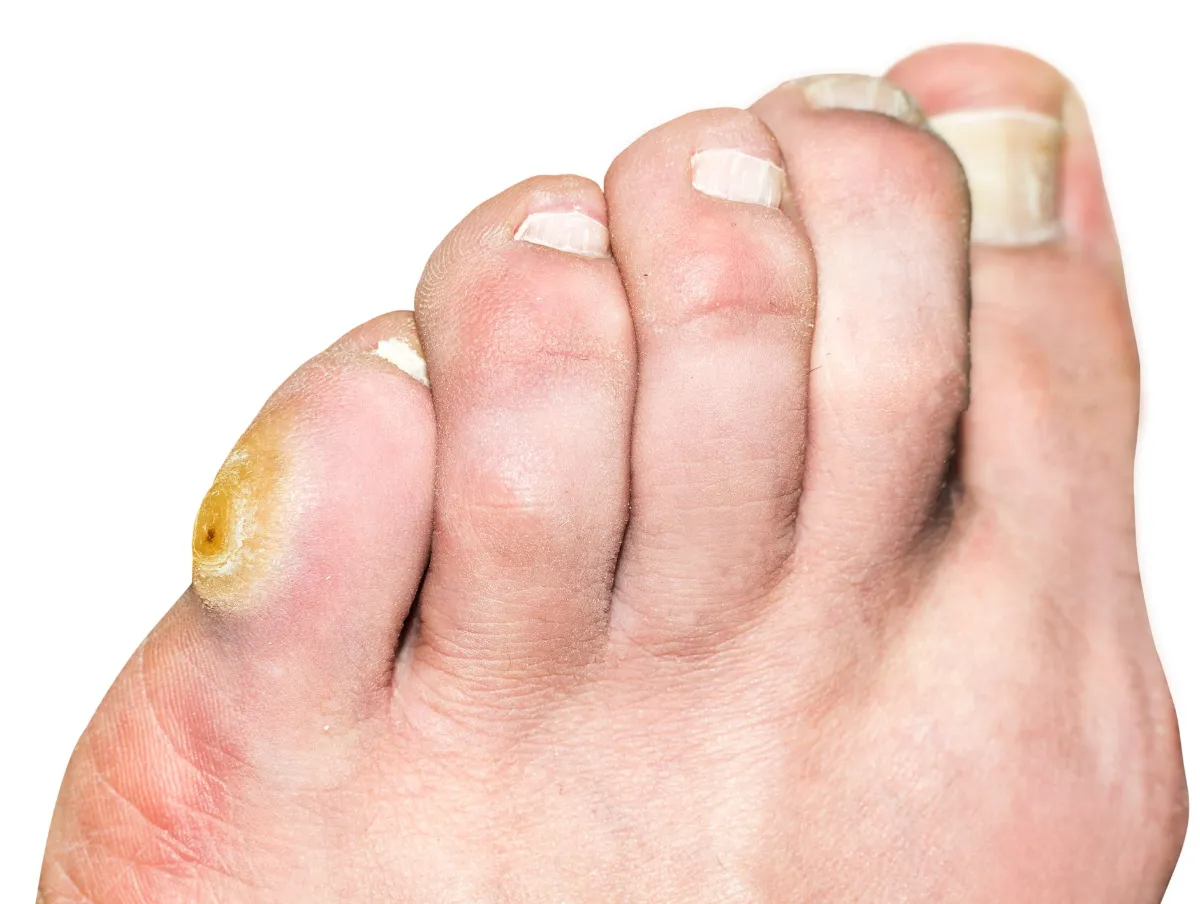
Illustrative photograph.
Corn on the foot (sole)
Thickened areas form on the sole beneath the forefoot, where pressure and friction are greatest. When such a thickening has a core in the centre, it is a corn on the sole.
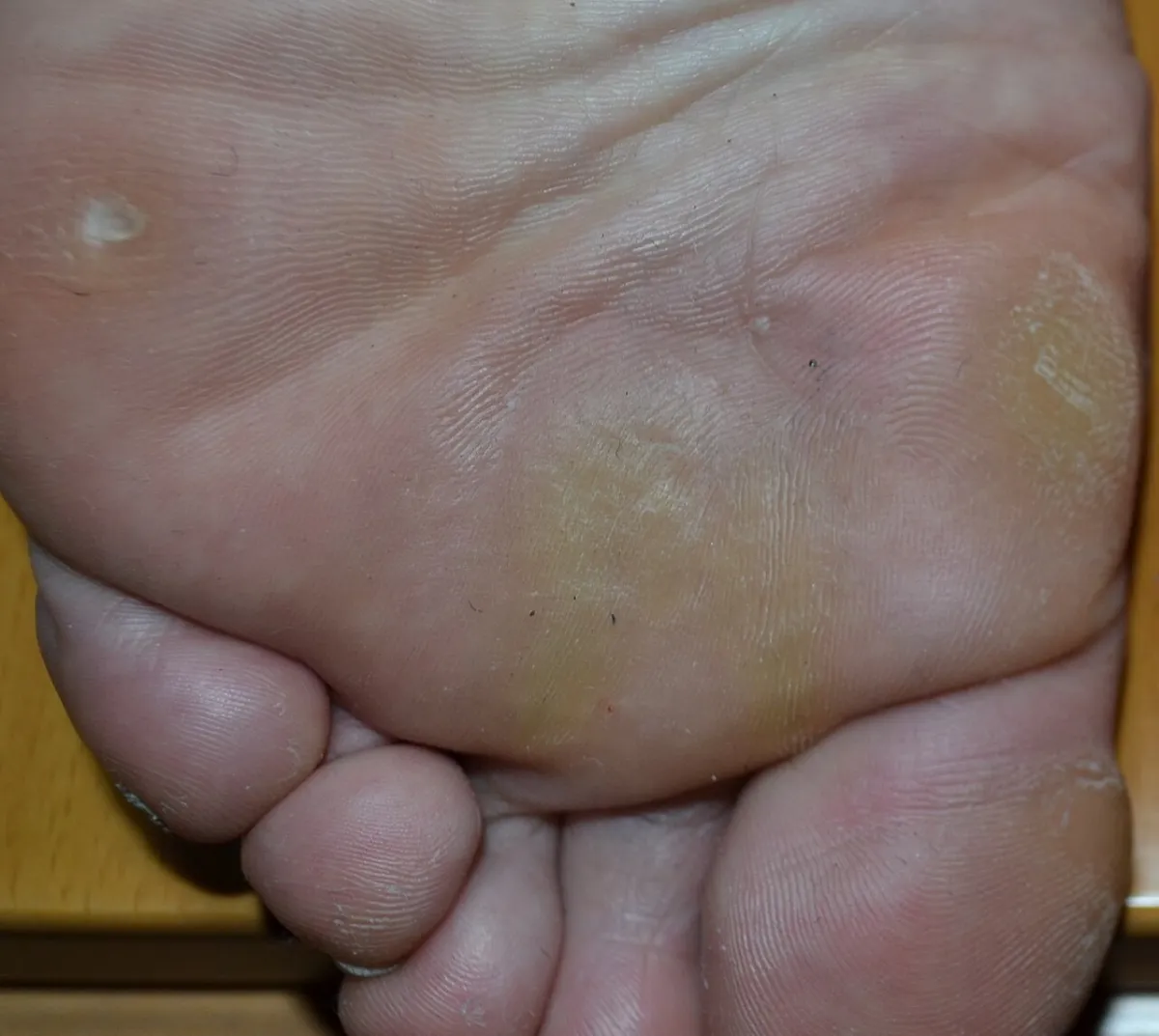
Photo: Węgrowski, Wikimedia Commons, CC BY-SA 4.0, cropped
The start of a corn
At first, it is just thickened, harder skin in a spot pressed by footwear, i.e. a callus. If the pressure does not stop, the thickening grows, a compact core forms in the middle which presses into the deeper layers of the skin and the spot begins to hurt.
What a corn looks like when it is removed
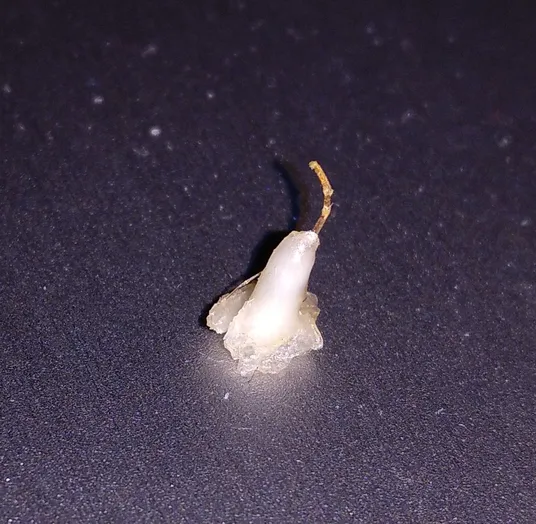
What is popularly called the „root“ is actually the core: a cone-shaped plug of compacted stratum corneum of the skin. This is not a root from which a corn grows, but the skin's protective response to pressure. When a doctor removes the thickening, a clearly defined, translucent core of a yellowish to brownish colour can be seen.
Corn, callus or wart
All three changes are hard and can hurt when walking, but they are treated differently. Corns and calluses are caused by pressure, while a wart is caused by a virus.
| Corn | Callus | Verruca on the foot | |
|---|---|---|---|
| Cause | pressure and friction | pressure and friction | virus (HPV) |
| Appearance | well-circumscribed, with a central core | wider, even thickening without a core, with indistinct margins | clearly defined, often with small black or red dots |
| Skin lines | well-preserved | well-preserved | cancelled |
| Pain | under direct pressure | it usually doesn't hurt | stronger when the change is squeezed from the sides |
| Location | places of pressure | places of pressure | stress van |
| When the surface is removed | transparent core, does not bleed | smooth, translucent skin | spotting |
To the naked eye the difference is not always clear, so a dermatologist checks it with a dermatoscope. In a study of 92 patients with a painful lesion on the sole of the foot, all corns had a translucent core in the centre, and 89% of warts had red dots. Skin lines were interrupted in all warts, and preserved in all corns and calluses.
Warts are removed by other methods, described on the page wart removal.
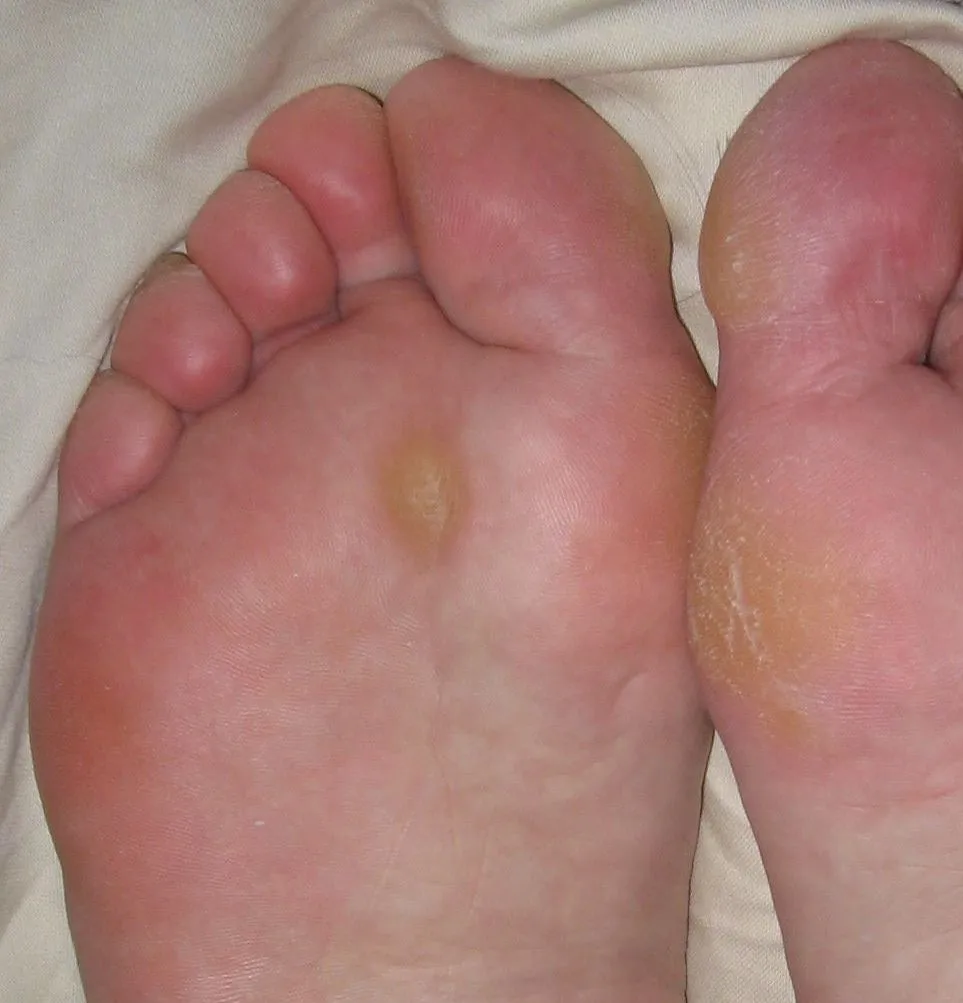
Thickened skin on the whole sole or palm is not a corn. It can accompany other skin conditions, for example eczema or psoriasis on the palms and soles. Small grain-sized thickenings on parts of the soles and palms that do not bear pressure can be hereditary.
What causes a corn
Skin defends itself against repeated pressure and friction by thickening. Corns are common: surveys show that between 14 and 48% of people have them, and they are more frequent among older adults. The most common causes are:
- footweartight or narrow in the toes, with a high heel or with an inner seam that rubs;
- shape of the foot and toeshammer toe, bone spur, joint diseases and deformities causing toes to rub against each other or footwear;
- wearing shoes without socks and dry skin;
- thin fatty tissue on the sole of the foot, which is lost with age;
- lots of walking and standing;
- on the hands: tools, sports equipment and musical instruments.
Once a corn has formed, it only increases the pressure in footwear, causing the thickening to grow further.
Corns in children
Verrucas are particularly common in school-age children, whereas corns are more frequent among older people. Therefore, a hard, painful lesion on a child's sole or toe should be examined by a dermatologist before a corn plaster is applied to it. In children, half of all verrucas clear up on their own within six months, and 90% within two years.
Imedica dermatologists also examine children.
When to see a doctor
Contact a doctor if:
- you have diabetes, poor circulation in your legs or a weakened immune system;
- the place bleeds or pus comes out of it;
- pain is severe or hinders you when walking and with daily tasks;
- no improvement after three weeks of home treatment;
- you are unsure whether it is a corn, a wart or something else.
Diabetes. People with nerve damage in their feet may not even feel a corn developing, so they should check their feet regularly. In their case, thickening should only be removed by a trained healthcare professional.
How is the diagnosis made?
The diagnosis is made by examination, based on the appearance and location of the lesion. When it is not clear whether it is a corn or a wart, the doctor examines the lesion with a dermatoscope or removes a thin surface layer with a scalpel. A skin sample for analysis is rarely needed.
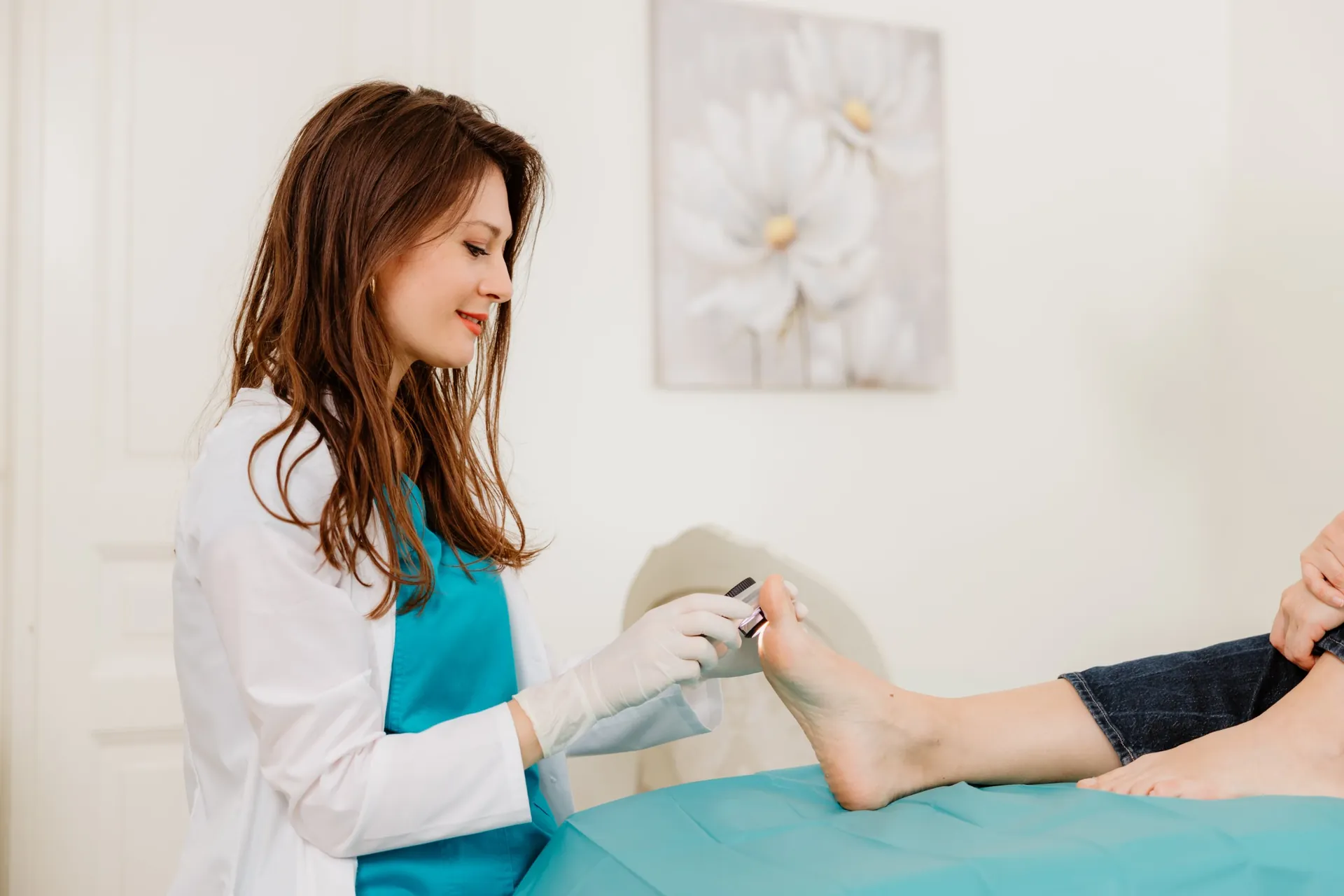
At Imedicus, the skin is examined by Dr Marina Ćirović and Dr Sanja Kekić, specialists in dermatovenereology. Dermatological examination It costs 5,000 RSD, a follow-up within a month is 3,000 RSD, and after more than a month it is 4,000 RSD.
Corn treatment
Treatment of a corn has two goals – to relieve pain when walking and to prevent the thickening from forming again. Removing the hard keratin plug often brings quick relief. For a more lasting result, it is important to determine why pressure and friction are occurring precisely at that spot.
Shoe change and foot relief
If the corn is on the top or outside of the toe, footwear with a sufficiently wide and deep front part often helps. In the case of a soft corn between two toes, a silicone separator can reduce friction. If the lesion is on the sole, beneath the forefoot, an appropriate insole or a correctly positioned metatarsal pad can redistribute pressure when walking.
Removal of calluses and salicylic acid
When a corn hurts on weight-bearing, a doctor can carefully remove the thickened skin and the central plug with a scalpel. This reduces the pressure on the sensitive tissue beneath the lesion.
Preparations with salicylic acid gradually soften the thickened layer of skin. In a study of 202 adults, after three months the corn completely cleared in 34% of patients treated with a 40% salicylic acid plaster under professional supervision, compared with 21% after scalpel debridement. After six months, the difference in complete clearance was no longer statistically significant.
If you have diabetes, poor circulation or a reduced sensation in your feet, consult a doctor before treatment. Self-treatment of calluses or the application of acid can lead to a wound.
When considering radio waves or a CO₂ laser
If a corn continues to hurt or returns despite pressure relief, a dermatologist may consider removal using radiowaves or a fully ablative CO₂ laser. Before the procedure, it is important to confirm the diagnosis because a plantar wart can resemble a corn.
Radiowave removal is a form of electrosurgery. Using a radiowave loop, the doctor can cut and remove the lesion. When choosing a procedure, it is important to take the healing time into account, especially if the corn is located on a part of the sole that bears your weight.
When is an orthopaedic appointment necessary
A recurrent corn in the same place, particularly between the fourth and fifth toes, may be caused by a bone spur or toe position. If changing footwear and using a spacer do not relieve the symptoms, an orthopaedist can assess whether surgical correction would reduce the pressure.
What you can do yourself
When pressure and friction stop, a corn will usually disappear on its own, but that takes patience. Along with footwear that does not pinch, the following helps at home.
- Protective pad. A ring-shaped cushion is placed around a corn to prevent the footwear from pressing on it.
- Thinning. Soak your foot in warm water for 5 to 10 minutes, then gently rub away the hard skin with a pumice stone or foot file. Do not remove too much skin, as this can cause bleeding and infection.
- Denial. Apply a cream containing urea, salicylic acid or lactic acid daily to gradually soften hard skin.
- Nails. Trim them regularly: a long nail pushes the toe against the footwear.
Do not cut a corn with a knife, razor or scissors, and do not try to pull it out: that is how wounds are caused.
Corn plasters, drops and creams
In pharmacies and drugstores there are two types of products. The first are protective pads and medicament-free plasters, which simply reduce pressure. The second contain salicylic acid, which dissolves the thickened stratum corneum. Plasters with 40% salicylic acid and a 17% salicylic acid solution in collodion are used, while the healthy skin around the corn is protected with petroleum jelly beforehand.
People with diabetes, poor circulation and nerve damage in their feet did not take part in the trial described in the treatment section, and the plaster was applied by a professional. Salicylic acid can also damage healthy skin around the corn.
Plasters and acid drops should not be used by yourself. people with diabetes, poor circulation, reduced sensation in the feet or a weakened immune system.
Natural remedies: iodine, houseleek and garlic
In the professional sources we reviewed for this text, there are no tests showing that iodine, houseleek, garlic or vinegar remove corns. Of home remedies, sources recommend a warm soak and a pumice stone, along with footwear that does not press. Without that, the corn comes back, whatever is put on it.
Does a corn come back
It returns if the cause remains, even after removal by a doctor. That is why changing footwear is just as important as the removal itself.
Frequently asked questions about corns
Is a corn contagious?
No. It is caused by pressure and friction, not a virus. A virus causes a wart, which on the sole of the foot can look like a corn.
Does a corn have a root?
It has no root from which it grows. In the centre, it has a core, a plug of compacted, cone-shaped horny skin.
Why does a corn hurt?
The core is pressed under pressure into the deeper layers of the skin and causes inflammation.
Can a corn go away on its own?
Sure, when the pressure and friction that caused it stop. That takes patience.
How do I know if it's a corn or a wart?
A wart often has black or red dots, disrupts skin lines and hurts more when squeezed from the side. A corn has a core in the middle and hurts on direct pressure. When you are not sure, a dermatoscope examination shows the difference.
Am I allowed to cut out or pull out a corn myself?
No. Cutting with a knife, razor blade or scissors can cause a wound and lead to infection.
What is the best corn plaster?
The medicament-free protective pad reduces pressure and can be used by anyone. The salicylic acid plaster dissolves the hardening, but is not suitable for people with diabetes, poor circulation or impaired sensation in their feet.
Can a corn develop on the hand or a finger?
Yes, at a site subject to repeated pressure from tools, sports equipment or a musical instrument.
I have diabetes and a corn. What should I do?
Do not treat it yourself, neither with plasters nor a file. See a doctor.
Should I go to the doctor about my corn?
Dermatologist. They determine whether the lesion is a corn, callus or wart and, when necessary, remove it. When the cause is a bony prominence or toe position, an orthopaedic surgeon will also examine you.
Does Canesten help with corns?
No. Canesten cream is an antifungal medicine, and corns are caused by pressure, not a fungal infection.
Dermatological examination at Imedic
Imedic Polyclinic, Kneza Miloša 23, Belgrade. Patients from all over Serbia attend for consultations. Appointments: 064 237 0707.
See also:
Expert sources
- Oakley A. Corns and calluses (heloma, tyloma). DermNet; modified 23 May 2024.
- Dinulos JGH. Calluses and Corns. MSD Manual, Professional Edition; February 2025.
- Freeman DB. Corns and calluses resulting from mechanical hyperkeratosis. Am Fam Physician. 2002;65(11):2277–2280.
- IQWiG. Overview: Corns. InformedHealth.org; updated 19 March 2025.
- NHS. Corns and calluses; reviewed 28. 7. 2026.
- American Academy of Dermatology. How to treat corns and calluses.
- Farndon LJ, Vernon W, Walters SJ et al. The effectiveness of salicylic acid plasters compared with ‘usual’ scalpel debridement of corns: a randomised controlled trial. J Foot Ankle Res. 2013;6:40.
- Ankad BS, Koti VR, Nikam BP, Rangappa M. Plantar papules and plaques: a dermoscopic-histopathological correlation. J Skin Stem Cell. 2021;8(1):e116806.
- Oakley A, Gomez J. Viral wart. DermNet; updated 2021, minor amendment November 2025.
- Bus SA, Sacco ICN, Monteiro-Soares M et al. Guidelines on the prevention of foot ulcers in persons with diabetes (IWGDF 2023 update). Diabetes Metab Res Rev. 2024;40(3):e3651.
- Stanway A. Palmoplantar keratoderma. DermNet; modified 3 June 2026.
- Clinical guideline „Corns and Calluses“, Ministry of Health of the Russian Federation; section 3.2 Surgical treatment.
- Bevans JS, Bosson G. A comparison of electrosurgery and sharp debridement in the treatment of chronic neurovascular, neurofibrous and hard corns. A pragmatic randomised controlled trial. Foot (Edinb). 2010;20(1):12–17.
- Babaev OG, Bashilov VP, Zakharov AK. Methods and effectiveness of surgical treatment of limited hyperkeratoses with CO2 laser. Khirurgiia (Mosk). 1993;(4):74–79.
- Marti-Martinez LM, Lorca-Gutierrez R, Sánchez-Pérez SP et al. Efficacy and safety of condylectomy with minimally invasive surgery in the treatment of interdigital corns of the lesser toes compared to conservative treatment. J Foot Ankle Res. 2021;14:20.

Author: Ivica Jeremić, MD, PhD
Specialist in internal medicine, subspecialist in rheumatology, resident in dermatology and venereology.
Updated:
Clinically reviewed by Dr Sanja Kekić, specialist in dermatology, on 23 November 2026.