Removal of condylomas in Belgrade
Genital warts are growths caused by HPV and are sexually transmitted. At the Imedic polyclinic, we remove warts using radiowaves or a CO2 laser under local anaesthesia, or with liquid nitrogen without anaesthesia; when the lesions are widespread, we combine removal with local therapy that you apply at home. The examination, choice of method and follow-up are managed by a specialist in dermatovenereology.
Removal of genital warts – in brief
Condyloma removal takes 15 to 30 minutes; allow 45 to 60 minutes for the whole appointment. We remove genital warts using radiowaves or a CO2 laser under local anaesthetic, or liquid nitrogen without anaesthesia, based on the findings of a specialist in dermatovenerology. When lesions are numerous or widespread, we combine the procedure with topical treatment that you apply at home. The table shows the methods, duration, recovery and how the price is calculated.
| What are we removing | Condylomas are genital warts caused by HPV, most commonly types 6 and 11; we remove them in women and men on the skin of the genitals, groin and around the anus. |
|---|---|
| Methods | Radio waves are the first choice for single and raised lesions; CO2 laser for smaller lesions; liquid nitrogen in series for small and numerous ones; home topical therapy (imiquimod or podophyllotoxin) for widespread lesions or alongside a procedure. |
| Duration and anaesthesia | The procedure takes 15 to 30 minutes. The entire visit, including the consultation and the effect of the anaesthetic cream (20 to 30 minutes), takes 45 to 60 minutes; the removal of just one lesion takes about half a minute. |
| Recovery | Scabs fall off in 7 to 14 days; sexual intercourse is postponed until the skin has healed, usually 2 to 3 weeks. |
| Control | Check-up in 4 weeks; condylomas can recur after any method, most commonly in the first 3 months, at which point removal is repeated or home treatment is added. |
| Price | The price is calculated based on the number of lesions and the region – the amounts are in the price list. The examination is not charged when the lesion is removed by radiowaves or laser, whereas for liquid nitrogen it is charged separately. |
What are condylomas?
Genital warts (condylomata acuminata) are soft growths on the skin and mucous membranes of the genital and anal regions caused by the human papillomavirus (HPV) – in about 90% of cases by types 6 and 11, which are not among the types associated with cervical cancer. [1] They are transmitted through skin-to-skin contact during sexual intercourse, and a condom reduces, but does not eliminate, the risk. In half of women, the first changes appear within about 3 months of infection, while in half of men they appear within about 11 months; in the rest, it takes longer, sometimes even years. [2]
They look like pink, skin-coloured or brown growths ranging from 1 to several millimetres in size, flat, raised or on a stalk, with an uneven cauliflower-like surface; they can appear individually or merge into larger clusters. In women, they occur on the labia, the entrance to the vagina and around the anus, while in men they occur on the glans, foreskin, shaft of the penis, scrotum and around the anus. [3] Pain is rare, but itching, burning, bleeding during intercourse or a feeling of discomfort do occur. Condylomas differ from viral warts on hands and feet, which are caused by other types of HPV. How genital warts are recognised in the initial stage and what changes resemble them, we describe in guide to genital warts.
Which method for which changes: radiofrequency, laser, nitrogen or topical therapy
We choose the method according to the number, size and location of the lesions, rather than following a one-size-fits-all rule. Radiowaves remove single and raised genital warts in a single visit; for tiny and numerous lesions we use liquid nitrogen in series; a CO2 laser is used for smaller lesions in sensitive areas; when lesions are widespread, removal is combined with local treatment at home. [2] The table shows how this looks in practice.
| Changes | Method | What to expect |
|---|---|---|
| Single, raised or on a stalk, 1 to 3 lesions | Removal of condylomas using radiowaves (radiowave knife), local anaesthesia | One visit; the lesion is removed in its entirety, without sutures; the scab falls off in 7 to 14 days |
| Minor changes, sensitive areas (glans, labia) | Laser removal of condylomas (CO2 laser) under local anaesthetic | One visit; precise layer-by-layer removal; healing 1 to 2 weeks |
| Minor and numerous, flat changes | Liquid nitrogen (cryotherapy) | A course of 2 to 4 treatments every 1 to 3 weeks, without anaesthesia; blister and scab for 7 to 10 days |
| Widespread changes, multi-regional, relapses | Home-based topical therapy (imiquimod or podootoxin) alongside the removal of larger lesions | Treatment lasts for weeks with follow-up appointments; redness and stinging at the application site are expected. |
| Changes in the vagina, on the cervix, and in the urinary and anal tracts | Gynaecologist, urologist or proctologist | We do not remove them at the polyclinic – we refer you to the appropriate specialist; external lesions of the genitalia, groin and around the anus are removed by us. |
Laser removal of genital warts
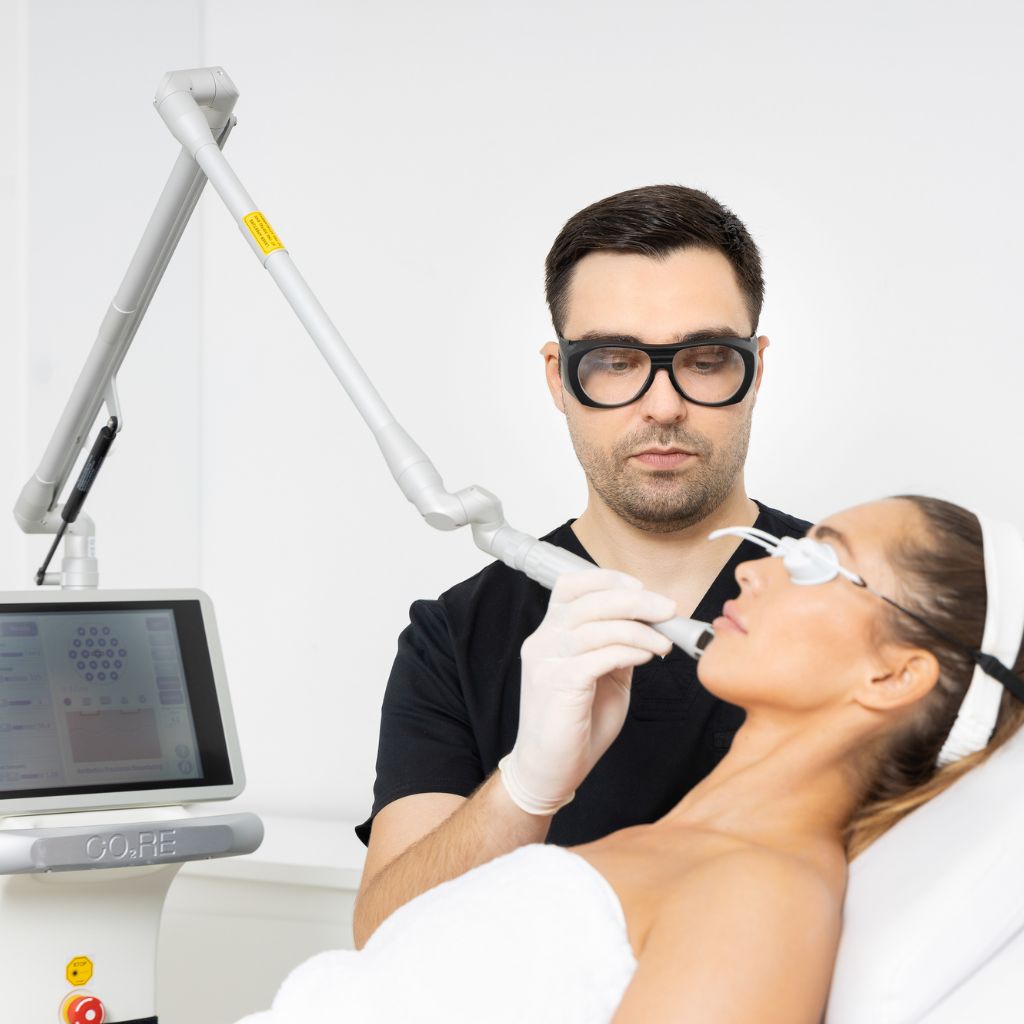
We choose the CO2 laser for smaller warts on sensitive areas, such as the glans and labia, because it removes the lesion precisely, layer by layer. The procedure is performed under local anaesthesia, using an anaesthetic cream or, for larger and deeper lesions, an injection of local anaesthetic; it takes 15 to 30 minutes, and the skin heals in 1 to 2 weeks. Laser removal of warts costs the same as removal by radiowaves: 7,000 RSD for 1 to 3 lesions, or 14,000 RSD per region when there are more lesions, as stated in the section Price of wart removal.
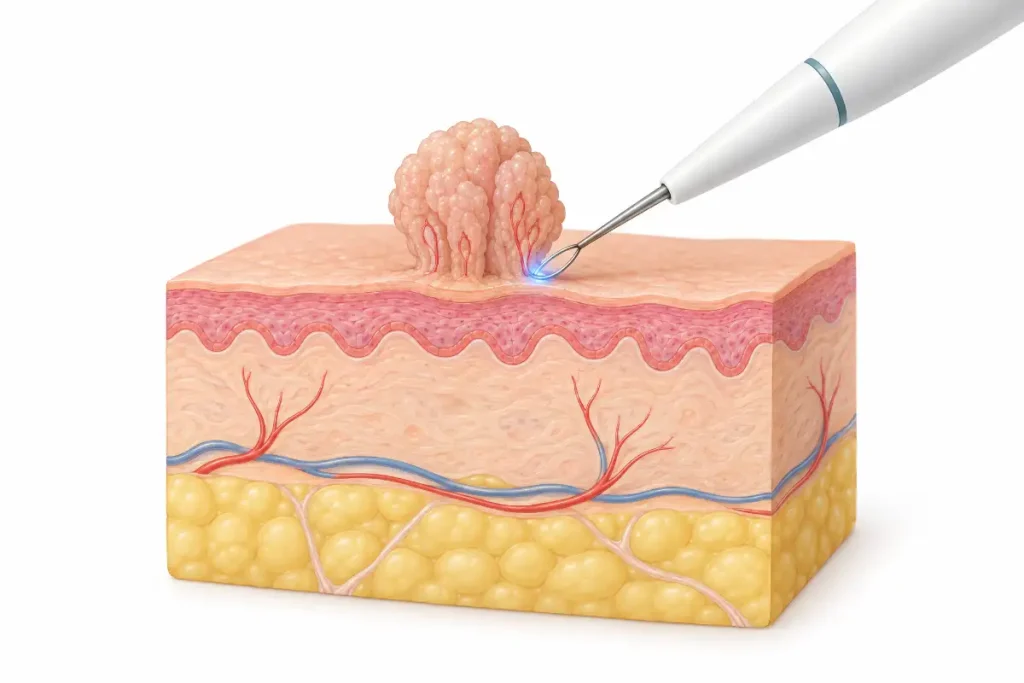
In studies, radiowaves and electrosurgery removed lesions in 94 to 100% of patients, the CO2 laser in almost all, liquid nitrogen in 44 to 87%, and topical therapy in 35 to 83%; no method eliminates the virus, so condylomas can recur in approximately one in five to one in three patients, most often in the first 3 months, and in studies with a one-year follow-up in more than half. [2]
What removal looks like – a practical example
Patient, aged 32, three raised condylomas on the shaft of the penis, present for about 2 months. Following examination and dermoscopy, the lesions were removed using radiowaves under local anaesthesia in a single 45-minute visit; the scabs fell off within 10 days, at the follow-up after 4 weeks there were no new lesions, and the female partner was referred for an examination.
Price of wart removal
The cost of removing condylomas by radiowaves or laser depends on the number of lesions and the number of regions being treated, rather than the method. Liquid nitrogen is most commonly done in a series and is paid for per treatment. The amounts from our price list are in the table.
| Service | Price |
|---|---|
| Removal of warts, 1–3 lesions | 7,000 RSD |
| Removal of condylomas, multiple lesions, per region | RSD 14,000 |
| Liquid nitrogen therapy, per treatment | 2,000–12,000 RSD |
When a lesion is removed by radiowaves or laser, the dermatological examination is not charged. With liquid nitrogen, the examination is charged separately, according to the price list. The examination is charged according to the price list when therapy is prescribed or follow-up is arranged during it, and it is not charged if it is determined that a different specialist is responsible for your lesions.
What does the total price depend on?
Depending on the number of lesions (up to 3 or more), the number of regions (for example, the genitals and groin separately), the need for a series of liquid nitrogen treatments, and potential histopathological analysis when a lesion appears atypical. Home topical treatment is bought at the pharmacy with a prescription and is not included in the price of the procedure. All prices are in dermatology price list.
How is a diagnosis made and what tests are needed?
The diagnosis is made dermatological examination – an experienced dermatovenerologist can recognise genital warts with the naked eye and a dermatoscope, and an HPV test or viral genotyping is not required for either diagnosis or the choice of treatment. [1] During the examination, we distinguish genital warts from lesions that resemble them but are harmless: pearly penile papules on the glans, vestibular papules in women, Fordyce spots, soft fibromas and seborrhoeic keratoses – these are the so-called „false genital warts“, which are not removed because of HPV. [3]
- Testing for other sexually transmitted infections we recommend this to everyone with genital warts; tests are carried out in the laboratory, and you bring the results to your follow-up appointment.
- To the partner We advise examination and testing; an HPV test for the partner is not necessary, as the result does not alter treatment. [1]
- To women We advise regular gynaecological examination and cervical screening according to the national programme – no more frequently than usual, as types 6 and 11 do not cause cervical cancer. [1]
- Histopathological (HP) analysis tissue removal is performed when the lesion is pigmented, hard, fixed to the underlying tissue, bleeds, ulcerates, does not respond to treatment, or in individuals with a compromised immune system. [1]
Our dermatologists
Who removes condylomas and which regions do we treat?
The removal of genital warts in Belgrade, at the Imedic polyclinic, is performed by dermatology and venereology specialists Dr Marina Ćirović and Dr Sanja Kekić, who also lead the consultation, selection of the method and follow-ups. We treat external lesions in women and men: the skin of the labia and vaginal entrance, penis, scrotum, groin, pubic region and the skin around the anus. Around the anus, besides external lesions, lesions are often present in the anal canal as well, so along with the removal of external ones, we also recommend a proctologist examination. Internal lesions – in the vagina, on the cervix, in the urinary or anal canal – are not removed by us; a gynaecologist, urologist or proctologist is in charge of those, so we refer you for such examinations. Patients come to us from all over Serbia, and the first consultation and removal can be done in the same visit when there are no obstacles to doing so.

Do warts go away on their own and when do we remove them?
Sometimes. Without treatment, genital warts go away on their own in some people, stay the same in others, and in some they grow larger or increase in number. [1] That is why, after the examination, we decide together whether it makes sense to monitor them or remove them. The procedure removes the visible changes, but not the virus: HPV can still be transmitted even after the skin heals following the procedure, and it has not been established whether removal reduces transmission to a partner. [1] That is why follow-up appointments and condoms are important; condoms reduce the risk, but do not eliminate it. In people with weakened immune systems and in smokers, genital warts are more persistent and return more frequently.
How to prepare and when to postpone the treatment?
No special preparation is needed: come showered, without cream on the area, in comfortable clothes; the hair in the area should not be shaved for 2 days before the procedure, so that the skin is not irritated. If you are taking blood-thinning medication or immunosuppressants, or if you are allergic to local anaesthetics, mention this at the consultation – the procedure is planned differently, not cancelled. We postpone the treatment when there is:
- active infection in the region (herpes, fungal or bacterial infection) – it must be treated first;
- menstruation, when there are changes to the labia or the vaginal entrance;
- pregnancy – local treatment (imiquimod, podophyllotoxin) is not used; radiowaves, laser and nitrogen are possible in agreement with the gynaecologist, and delivery is often awaited, as some of the lesions then regress; [2]
- uncontrolled diabetes mellitus or a clotting disorder – until stabilised.
What do the treatment and recovery look like?
- 01 Overview and plan. A dermatovenerologist examines the entire genital region, groin and skin around the anus, uses a dermatoscope to distinguish condylomas from similar lesions, counts them and, together with you, chooses the method. You receive a recommendation for laboratory tests and a partner check-up.
- 02 Anaesthesia. An anaesthetic cream is applied to the lesions which takes effect after 20 to 30 minutes; for larger or deeper lesions, a local anaesthetic injection is given, so the procedure itself is painless.
- 03 Removal. Using a radiofrequency probe, the lesion is removed entirely in 20 to 30 seconds, without stitches; the laser removes the lesion layer by layer; the nitrogen is applied in short cycles. The entire procedure takes 15 to 30 minutes.
- 04 After the procedure. You receive care instructions, a prescription for topical treatment if necessary, and a follow-up appointment in 4 weeks. You go home immediately, and back to work the same or the next day.
Recovery
- First 1 to 3 days: mild stinging, redness and swelling; wash the area with lukewarm water and a mild soap, without rubbing, and keep it dry.
- Scabs fall off in 7 to 14 days; do not pick at them; wear cotton underwear, avoid tight trousers, swimming pools, saunas and heavy sweating until the skin has healed.
- Sexual intercourse is postponed until the skin has completely healed, usually 2 to 3 weeks, and then a condom is used until the follow-up appointment.
- Follow-up after 4 weeks: healing is checked and whether there are any new lesions; if necessary, removal is repeated or home treatment is introduced.
What is expected after the treatment, and when should you contact a doctor?
It is normal to experience mild pain, slight bleeding as the scabs fall off, and temporarily lighter or darker skin at the removal site in the first few days, which will even out within a few months. Contact your doctor if severe pain that worsens, pus, an unpleasant odour, a raised temperature, bleeding that does not stop with pressure, or new changes appear in the first 4 weeks – do not wait for your scheduled follow-up appointment. Call us on the number in the „Book condyloma removal in Belgrade“ section at the bottom of the page.
Cream for condylomas and local home treatment
We prescribe topical therapy when the lesions are widespread, flat or numerous, when they return after removal, or when the patient does not wish to undergo a procedure; it is used either alone or following the removal of larger lesions. [1] Imiquimod 5% is a cream that stimulates the local immune response, while podophyllotoxin is a solution or cream that destroys the wart tissue. [1] Both treatments are available from a pharmacy on prescription, redness and a stinging sensation at the application site are expected, and they are not to be used during pregnancy. The preparation, method of application and duration of treatment are prescribed by a doctor during the consultation.
HPV vaccine after genital warts
The HPV vaccine does not treat existing genital warts, but it protects against HPV types you have not been in contact with – the nine-valent vaccine covers types 6 and 11, as well as the types responsible for cervical cancer. [1] According to professional-methodological guideline of the Batut Institute for 2026, the vaccine is recommended for children aged 9 to 19, from 19 to 26 years it is given in accordance with available vaccine quantities, and from 27 to 45 years when an indication is established by a specialist in the appropriate branch of medicine; adults are vaccinated at the public health institute, the student health care service, or by their chosen general practitioner. [4] According to Batut's announcement, immunization is free of charge for all these age groups. [5] You can obtain a recommendation for vaccination during an examination with our dermatovenerologist. Whether the vaccine reduces the recurrence of condyloma after treatment has not yet been proven. [2]
Possible side effects of wart removal
They are rare and mostly temporary: more severe swelling or pain in the first days, wound infection, slower healing in moist areas, skin discolouration where the lesion was removed and, in the case of larger lesions, a small scar. When removed near the urinary tract, there may be temporary stinging when urinating. The most common „complication“ is not a complication of the procedure, but the return of genital warts – which is why a follow-up is scheduled in 4 weeks and, if necessary, a second treatment or home therapy.
Have a question?
Frequently asked questions about genital warts
Is the removal of warts painful?
No – removal using radiowaves or a laser is performed under local anaesthesia (cream or injection), so only pressure is felt. Liquid nitrogen is applied without anaesthesia, in which case a stinging sensation is felt. For the first day or two after the procedure, a stinging sensation is possible, which subsides with a standard painkiller.
How long does the removal take and when can I go to work?
The procedure itself takes 15 to 30 minutes, and with the examination and anaesthesia you will be at the polyclinic for 45 to 60 minutes; you can return to work the same or the next day. The only things that are postponed are sexual intercourse, sports involving sweating and swimming pools until the skin heals.
When can I have sexual intercourse after the removal?
When the skin is completely healed, usually after 2 to 3 weeks, and until the check-up use a condom, because the virus can remain in the skin even without visible changes.
Do genital warts come back?
It is possible, after any method – in roughly one in three to five patients, mostly during the first three months. That is why we schedule a follow-up for 4 weeks and, if new lesions appear, we repeat the removal or introduce local therapy.
Does the partner need to go for a check-up?
Yes, we advise examination and testing of the partner for sexually transmitted infections. An HPV test for the partner is not necessary, as it does not change the treatment.
Is the HPV test or genotyping performed?
No – the diagnosis is made by examination, and the virus type does not change the treatment. We test for other sexually transmitted infections, and we advise women to have regular cervical screening.
What is the difference between condylomas, papillomas and pseudocondylomas?
Condylomas are HPV warts in the genital region; papillomas They are soft growths on the neck, armpits and groin that are not sexually transmitted; „false condylomas“ are normal skin structures, for example pearly penile papules on the glans or vestibular papules in women, which are not removed. The difference is shown during examination by dermoscopy.
Can I remove genital warts myself, using a cream from the pharmacy?
Local treatment exists, but it is prescribed by a doctor after an examination, as they must first confirm that the condition involves condylomas rather than harmless growths similar to them; moreover, preparations are not suitable for all regions or for pregnancy. Preparations for common warts and folk remedies cause burns on the mucous membranes.
Can I remove condylomas during pregnancy?
Warts creams are not used during pregnancy. A procedure is possible, but we plan it together with the gynaecologist, and it is often better to wait until after delivery, following which some of the lesions disappear on their own.
How much does it cost to remove genital warts?
Removal of condylomas using radiowaves or a laser is charged according to the number of lesions and regions; the amounts are in the table above, and the examination is not charged in that case. Liquid nitrogen is charged per treatment, with a separate examination.
Should I get the HPV vaccine if I have had genital warts?
It is worth considering: existing changes will not be cured, but it protects you from other types of HPV, including those linked to cancer. According to the Batut Institute, the vaccine is recommended from 9 to 19 years of age, from 19 to 26 it is given depending on available quantities, and from 27 to 45 with a specialist's indication, which you can obtain during an examination. Vaccination at these ages is free of charge.
Book wart removal in Belgrade
Imedic poliklinika is located at Kneza Miloša 23, 2nd floor, Belgrade. Opening hours: Monday–Sunday, 9:00–21:00.
Appointments can be booked by phone: 064 237 0707. If it is easier for you, you can also write to us at Viber or WhatsApp, to the same number.

Author: Dr Miloš Živković
Doctor in specialist studies of aesthetic, plastic and reconstructive surgery at the Faculty of Medicine, University of Belgrade; in practice she applies radiowave surgery and fractional CO2 laser.
Updated:

Author: Dr Marina Ćirović
Specialist in dermatovenereology; she graduated from the Faculty of Medicine, University of Belgrade in 2015.
Updated:
Expert sources
- Centres for Disease Control and Prevention. Sexually Transmitted Infections Treatment Guidelines, 2021 – Anogenital Warts. https://www.cdc.gov/std/treatment-guidelines/anogenital-warts.htm
- Gilson R, Nugent D, Werner RN, Ballesteros J, Ross J. 2019 IUSTI-Europe guideline for the management of anogenital warts. J Eur Acad Dermatol Venereol. 2020;34(8):1644–1653. https://doi.org/10.1111/jdv.16522
- Oakley A. Anogenital warts. DermNet NZ, revised 2021, updated 2024. https://dermnetnz.org/topics/anogenital-warts
- Institute of Public Health of Serbia „Dr Milan Jovanović Batut“. Professional and methodological instructions for the implementation of mandatory and recommended immunization of the population for 2026, section 6.2, pp. 38–39; updated 9 February 2026. https://www.batut.org.rs/index.php?content=3157
- Institute of Public Health of Serbia „Dr Milan Jovanović Batut“. Statement on HPV immunisation (aged 19–26 and 27–45 years), reported by Tanjug, 6 May 2026. https://www.tanjug.rs/srbija/drustvo/250040/batut-od-januara-do-kraja-aprila-335-osoba-uzrasta-27-45-godina-primilo-hpv-vakcinu/vest
Professional dermatological supervision and reliable information
The text on this page was written by Dr Miloš Živković and Dr Marina Ćirović, specialist in dermatovenereology, in accordance with the clinical practice of Imedic polyclinic. The professional sources are listed above. Genital warts are removed by a specialist in dermatovenereology, following an examination that confirms the diagnosis and rules out similar conditions. A personal examination by a dermatologist is essential for the diagnosis and treatment plan.