Removal of hyperpigmentation and melasma in Belgrade

Dark spots on the face can have various causes, so the choice of therapy begins with a skin assessment. At the Imedic Polyclinic in Belgrade, a dermatologist assesses whether it is melasma, sun spots or post-inflammatory pigmentation and proposes an individual plan for spot removal. The plan may include topical therapy, skincare, sun protection and appropriate procedures - chemical peels and laser treatments. The goal is a more even complexion, gradual fading of spots and long-term maintenance of results.

Hyperpigmentation and melasma – in brief

TypesMelasma, sun spots (age spots) and spots after acne or irritation
ExaminationAssessment of pigment type and depth, skin type and previous treatments
RemovalTopical therapy, skincare and everyday sun protection, chemical peels or laser treatments where necessary
Treatments we offerMelanostop and TCA chemical peel, ClearLift, Yellow, Erbium and CO2 laser, microneedling (SkinPen, Dermapen)
SeasonCO2 and Erbium lasers and TCA peel from October to the end of March; in summer, microneedling
MaintenanceSun protection and home care according to a dermatologist's advice

What are hyperpigmentations?

Hyperpigmentation consists of pigmentary changes in the skin that occur due to the increased production of melanin – the natural pigment responsible for skin colour. When a disturbance in the functioning of melanocytes occurs, darker regions are formed that differ from the rest of the complexion. They most commonly manifest as brown to dark brown spots, patches or freckles. They can be superficial (epidermal) or deeper (dermal), which is important for choosing the appropriate therapy. Although they do not represent a disease in themselves, hyperpigmentation often requires a dermatologist's professional assessment in order to determine their cause and the optimal method of treatment.

What types of spots are there?

Melasma – symmetrical dark patches on the cheeks, forehead, nose and above the upper lip. It is more common in women and often occurs or worsens during pregnancy, with hormonal contraception or after exposure to the sun and heat. This does not mean that there is a hormonal disorder, but melasma is prone to recurrence, so it requires maintenance.

Sun spots and age spots (solar lentigines) – two names for the same type of change: clearly defined brown spots that appear after years of sun exposure, most commonly on the face, hands, décolletage and shoulders. As the years go by, there are more and more of them, which is why they are also called age spots.

Blemishes after acne or irritation (post-inflammatory hyperpigmentation) – they occur at the site of inflammation, after acne, eczema, a burn or an aggressive treatment, and are more common in darker skin. It is important to calm the underlying problem, because every new inflammation creates new blemishes, so in the case of blemishes after acne, the plan is adjusted to acne treatment.

Blemishes and acne scars – blemishes are flat skin discolourations and most commonly fade over time, whereas scars are textural changes, depressions or elevations, which do not disappear on their own. More information about their treatment can be found on the page acne scars.

Depending on the depth of the pigment, the changes can be superficial (epidermal), deeper (dermal) or a combination of both. Superficial pigment usually responds more quickly to treatment, whereas deeper pigment requires longer treatments.
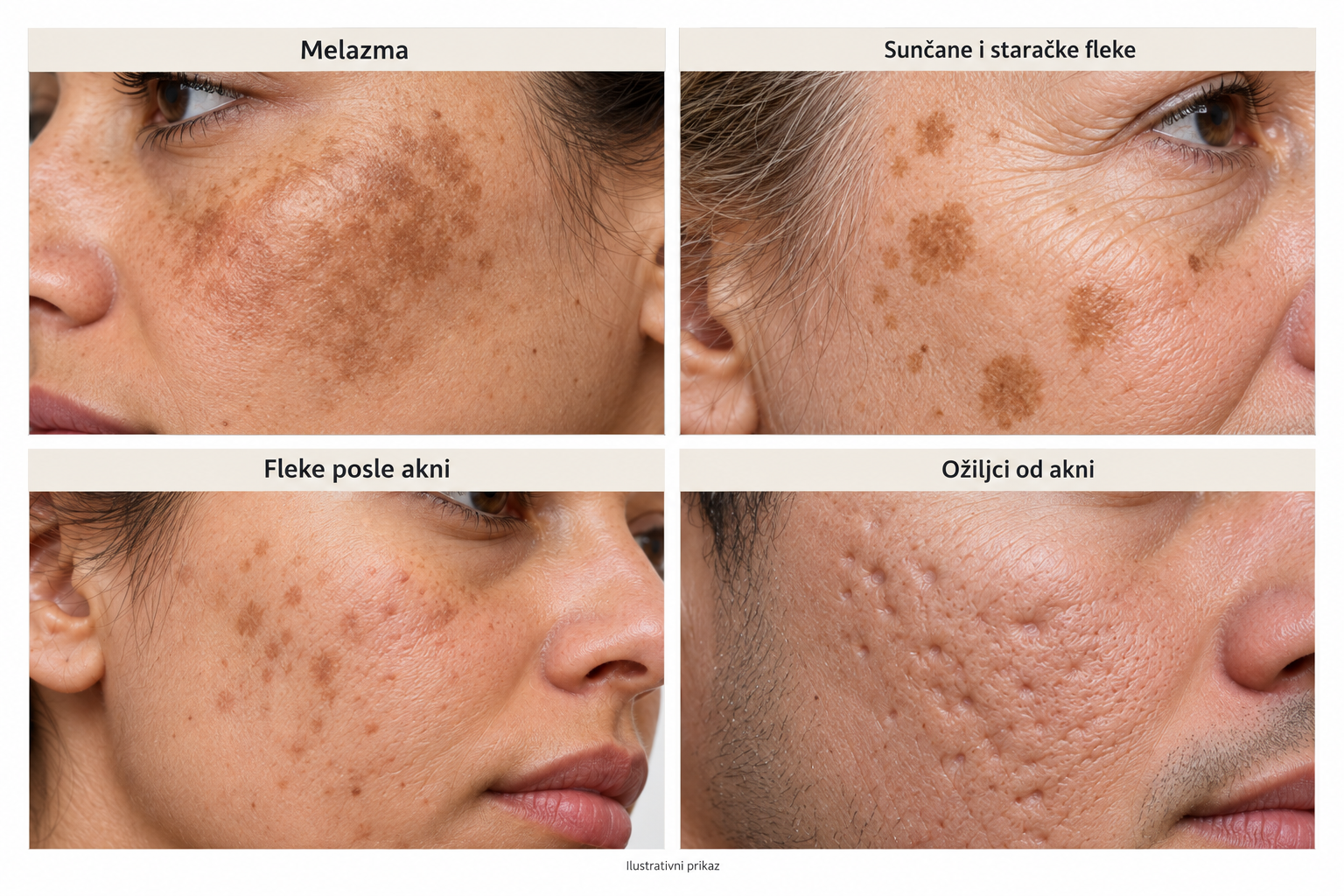
 

types of hyperpigmentation spots

What does a dermatological examination look like?

The first step is dermatological examination. The dermatologist discusses when the blemishes appeared, whether they change throughout the year and what makes them worse – the sun, pregnancy, hormonal contraception or skin inflammation. Information on previous treatments and skin reactions is also important, as well as on the products and therapies currently being used.

Then the skin is examined and the type of pigmentation, its depth and skin type are assessed. Further tests are recommended only when there is a reason for them. At the end of the examination, a plan is agreed upon: therapy, skincare, sun protection, any potential procedures and a follow-up appointment.

Melasma removal

Melasma removal begins with an assessment of the skin, previous treatments and potential triggers. A dermatologist creates an individual plan which most commonly includes topical therapy, appropriate care and daily sun protection. Chemical peels or laser treatment are included when there is an appropriate indication for them. For melasma, gentle, controlled procedures are chosen, such as Melanostop peel or of non-ablative lasers, as strong irritation can increase pigmentation.

Melasma is prone to returning, especially in summer and after exposure to heat. Therefore, the goal is not one-off removal, but gradual fading of the blemishes and long-term maintenance of the results. Sun protection is needed throughout the year, and a dermatologist may recommend tinted protection with iron oxides, which also protects against visible light.

Removal of sun spots and post-acne pigmentation

Sun and age spots are clearly limited and mostly superficial, so they respond well to targeted procedures. Depending on the size and number of blemishes and the skin type, ClearLift, Yellow, Erbium or CO2 lasers are used, as well as TCA chemical peels. After ablative lasers, recovery takes a few days, so these treatments are planned from October to the end of March.

Blemishes after acne or irritation It is treated when the inflammation is under control. Local therapy, mild peels and non-ablative treatments are used, and the procedure is chosen carefully, because additional irritation can increase pigmentation. Many post-inflammatory blemishes fade on their own over time, and therapy and sun protection accelerate that process.

When are lasers and chemical peels used?

ClearLift It is a non-ablative laser that works in the deeper layers of the skin without damaging the surface. It is used for mild to moderately pronounced pigmentation and for individuals who are not candidates for ablative procedures. During the treatment, a sensation of warmth or slight stinging is felt, and afterwards the skin may briefly be mildly red, without peeling or interruption to daily activities. When combined with a chemical peel, recovery takes about 5 days. Results are achieved gradually, through a series of treatments, and the appointment is chosen according to skin type and sun exposure.
Yellow laser It is a non-ablative laser whose light is absorbed by melanin and haemoglobin, so it acts on surface pigment and redness. It is used for sun spots, early age spots and pigmentations accompanied by redness, and for melasma as part of combination therapy, according to a doctor's assessment. The skin does not peel and daily activities are resumed immediately.
Erbium fractional laser is an ablative laser that controlledly removes the surface layer of skin with excess pigment. It is used for more pronounced sunspots and post-acne pigmentation, especially when it is also necessary to improve skin texture. After the treatment, redness and peeling occur, and recovery takes 5–7 days. The treatment is performed from October to the end of March.
CO2 laser is an ablative laser used for significant photodamage and clearly defined age spots, when, alongside the removal of blemishes, it is also necessary to improve skin texture and soften fine lines. Following the procedure, redness and flaking occur, and recovery takes 5–7 days. It is performed from October to the end of March, while for melasma, other, gentler methods are chosen.
Melanostop It is a chemical peel designed for melasma, mild to moderate hyperpigmentation, sun spots and post-inflammatory pigmentation. The combination of azelaic, phytic and tranexamic acid reduces melanin production and gradually lightens spots. A series of 3 to 6 treatments is usually performed, at intervals of about 15 days, with mandatory sun protection.

TCA peel (trichloroacetic acid) controlledly removes the superficial layer of the skin and stimulates its renewal. It is used for sun spots, post-acne pigmentation and milder signs of photodamage, on the face, neck, décolletage and hands. For hyperpigmentation, concentrations of 10–15% are most commonly used, and for more pronounced sun spots around 20%. After the treatment, the skin peels, and recovery takes 5–7 days, while the peel is performed from October to the end of March. More about peels can be found on the page chemical peels.

Microneedling is a treatment where tiny needles create controlled micro-injuries in the skin, which stimulate skin renewal and collagen production, and help even out complexion. For hyperpigmentation, it is used as a milder procedure. In Imedic it is performed using devices SkinPen and Dermapen. Recovery takes about 2 days, so microneedling can also be done during the summer, with mandatory sun protection and on skin that is not tanned. It is most commonly performed in a series of treatments.

For melasma and post-inflammatory pigmentation, the pigment is often distributed across multiple layers of the skin and can be accompanied by redness. Procedures can then be combined – for example, the Yellow laser, which targets surface pigment and redness, and ClearLift, which works in the deeper layers. The combination is always planned individually, based on an examination.

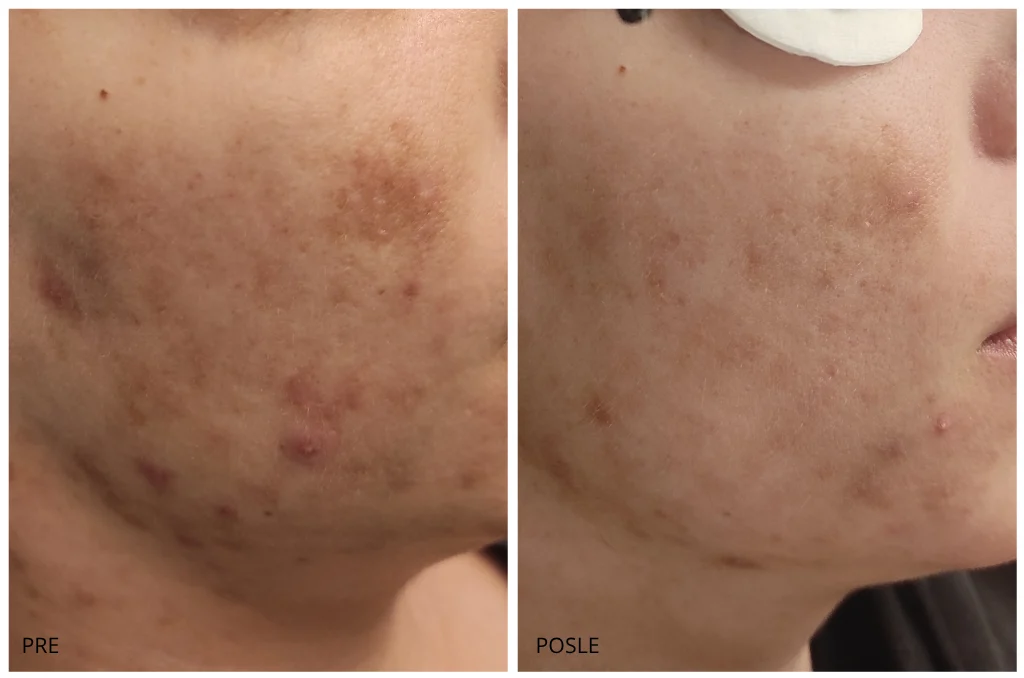
Treatment results

An individual result is shown after a single ClearLift laser treatment and chemical peel. The number of treatments needed and the result vary from person to person.

Recovery after treatment

Recovery depends on the type and intensity of the treatment:

CO2 laser, Erbium laser and TCA peel – recovery takes 5–7 days, with redness and skin flaking.

ClearLift laser – on its own it does not require recovery time. When combined with a chemical peel, the recovery takes about 5 days.

MicroneedlingSkinPen or Dermapen) – recovery takes about 2 days, so it can be done during the summer as well.

CO2 laser, Erbium laser, TCA peel and ClearLift in combination with a peel are not performed during the summer, but from October to the end of March. Treatments are not performed on sun-tanned skin, and during and after recovery, sun protection is mandatory.

Aftercare and maintenance of results

Hyper-pigmentation removal does not end with the treatment. Daily broad-spectrum sun protection, both in winter and on cloudy days, is the most important step in maintaining the results. The skin should be cleansed gently and hydrated regularly, and harsh products and acids should not be combined on one's own initiative, as irritation can worsen pigmentation. Home therapy is applied according to a plan determined by a dermatologist, and follow-up appointments assess the skin's response and adjust the plan if necessary.

In the video, Dr Miloš Živković and Dr Ivica Jeremić explain which active ingredients to look for in products for hyperpigmentation-prone skin and the most common mistakes made in daily skincare.

Cost of hyperpigmentation and melasma removal

The price depends on the type of pigmentation, its depth, the area being treated and whether a combination of treatments is required. The prices for consultations can be found in dermatology price list, prices of laser treatments in price list for laser treatments, and the prices of peeling in price list of aesthetic treatments. For a preliminary assessment and estimated price, photographs of the spots can be sent via Viber or WhatsApp N/A 064 237 0707, and the exact price is defined after inspection.

Have you got a question?

Frequently asked questions about hyperpigmentation

There is no single most effective treatment for all blemishes. The choice depends on the type and depth of pigmentation and the skin type, and most commonly, a combination of topical therapy, sun protection, chemical peels, and laser treatments is used.

Sun spots can often be significantly lightened or removed. Melasma and pigmentation related to hormones and the sun can be alleviated, but they are prone to returning, so maintenance is required.

The number of treatments depends on the type of pigmentation, its depth and individual skin response. Sometimes a single treatment is enough, while in other cases a series of treatments is required.

Many fade away on their own over time, but this can take months. Therapy, mild treatments and sun protection accelerate the lightening process, and treating acne is also important to prevent new blemishes from forming.

Products recommended by a dermatologist can gradually lighten surface blemishes and are important for maintaining results. The self-initiated use of strong products can irritate the skin and increase pigmentation.

Yes. Sun exposure is the main factor that worsens hyperpigmentation and leads to its return. That is why sun protection is a key part of treatment and prevention.

Prevention includes the regular use of SPF protection products, avoiding direct sunlight, proper skincare and the timely treatment of inflammatory skin conditions.

Not with all treatments. CO2 lasers, Erbium lasers, and TCA peels, as well as ClearLift in combination with a peel, are not performed during the summer, but rather from October to the end of March, because exposure to the sun during the recovery period increases the risk of new dark spots. Microneedling can be done during the summer (SkinPen or Dermapen), with a recovery time of about 2 days, and local therapy, skincare and strict sun protection are also continued.

No. Laser treatments, peels and microneedling are not performed on sun-exposed or tanned skin, as the risk of irritation and new dark spots is higher at that time. Before the treatment, it is necessary to avoid the sun and sunbeds, and the doctor evaluates when the skin is ready for the treatment during a consultation.

Book hyperpigmentation removal in Belgrade

The Imedic Polyclinic is located at Kneza Miloša 23 street, 2nd floor, Belgrade. Opening hours: Monday–Sunday, 9:00–21:00.

Appointments are made by phone: 064 237 0707. If you contact us from abroad, we are also available via Viber and WhatsApp on the same number.

Author: Dr Ivica Jeremić

Author: Dr Ivica Jeremić

Doctor of Medical Sciences (Molecular Medicine and Immunology), subspecialist in rheumatology, dermatology resident.

Updated:

Expert sources

OCTOBER OFFER · UNTIL 31.10.

Autumn for your skin

ULTRAFORMER III + JUVELOOK
from 35,000

CLEARLIFT + POLYNUCLEOTIDES / PROFHILO
35.000

JALUPRO
20% discount

Imedic Polyclinic
Privacy Overview

This website uses cookies so that we can provide you with the best user experience possible. Cookie information is stored in your browser and performs functions such as recognising you when you return to our website and helping our team to understand which sections of the website you find most interesting and useful.