Hives (urticaria) – pictures, causes and treatment
Nettle rash (urticaria) is a rash that looks as though you have brushed against a stinging nettle: raised, very itchy spots suddenly appear on the skin and then fade without a trace. In medical terms, they are called wheals. They occur when cells in the skin, known as mast cells, release histamine. Alongside wheals, a deeper swelling, known as angioedema, may also occur.
Hives are common: roughly one in five people experience at least one episode during their lifetime. For the majority, it passes in a few days. For a smaller number of people, it returns for weeks and months, and in those cases a treatment plan with a dermatologist is necessary.
What it looks like · Types · From stress · In children · When urgently · Treatment
Hives themselves are usually not dangerous. It is dangerous when, along with the rash, the lips, tongue or throat swell up or when breathing is difficult: in that case, an ambulance must be called immediately (194).
| What it is | rash with raised itchy bumps (hives) that move around the body |
|---|---|
| How long does one shift last? | from a few minutes up to a maximum of 24 hours |
| Acute and chronic | acute lasts for less than six weeks, chronic for six weeks or longer |
| Is it contagious | No |
| Who cures | dermatologist; when allergy testing is needed, and allergist |
| Appointment at Imedic | dermatological examination 5,000 RSD |
| When urgently | swelling of the lips, tongue or throat, difficulty breathing, fainting |
What does hives look like
Urticas are raised, well-demarcated lesions that are pale or skin-coloured in the centre, with redness around them. They can be a few millimetres or a few centimetres in size, round, annular or map-like in shape, and often merge into larger plaques. As well as itching, they can sting and burn. On darker skin, the redness is less visible.
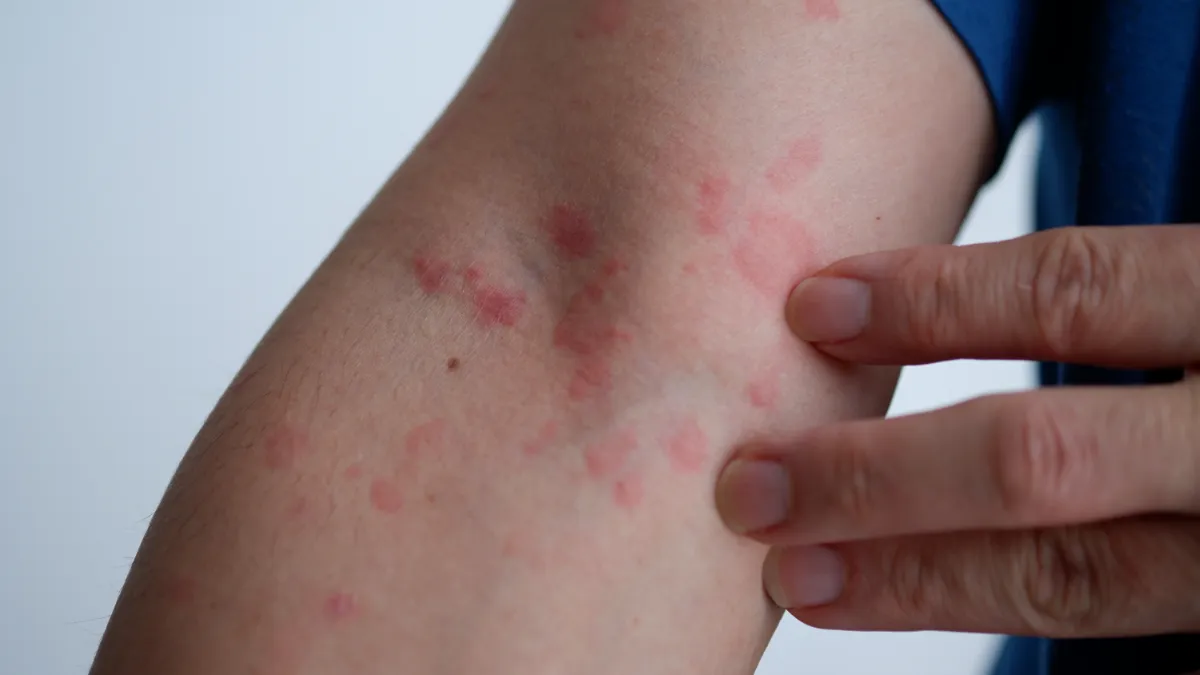
Illustrative photograph.
The most important feature of urticaria is that the lesions move around. A single wheal lasts from a few minutes to a few hours and disappears within 24 hours at the most, while new ones appear elsewhere. Therefore, it often happens that there is nothing on the skin by the time of the examination. Photograph the rash with your phone while it is active and show the pictures to the doctor.
Hives can appear anywhere on the body, in one place or all over the skin.
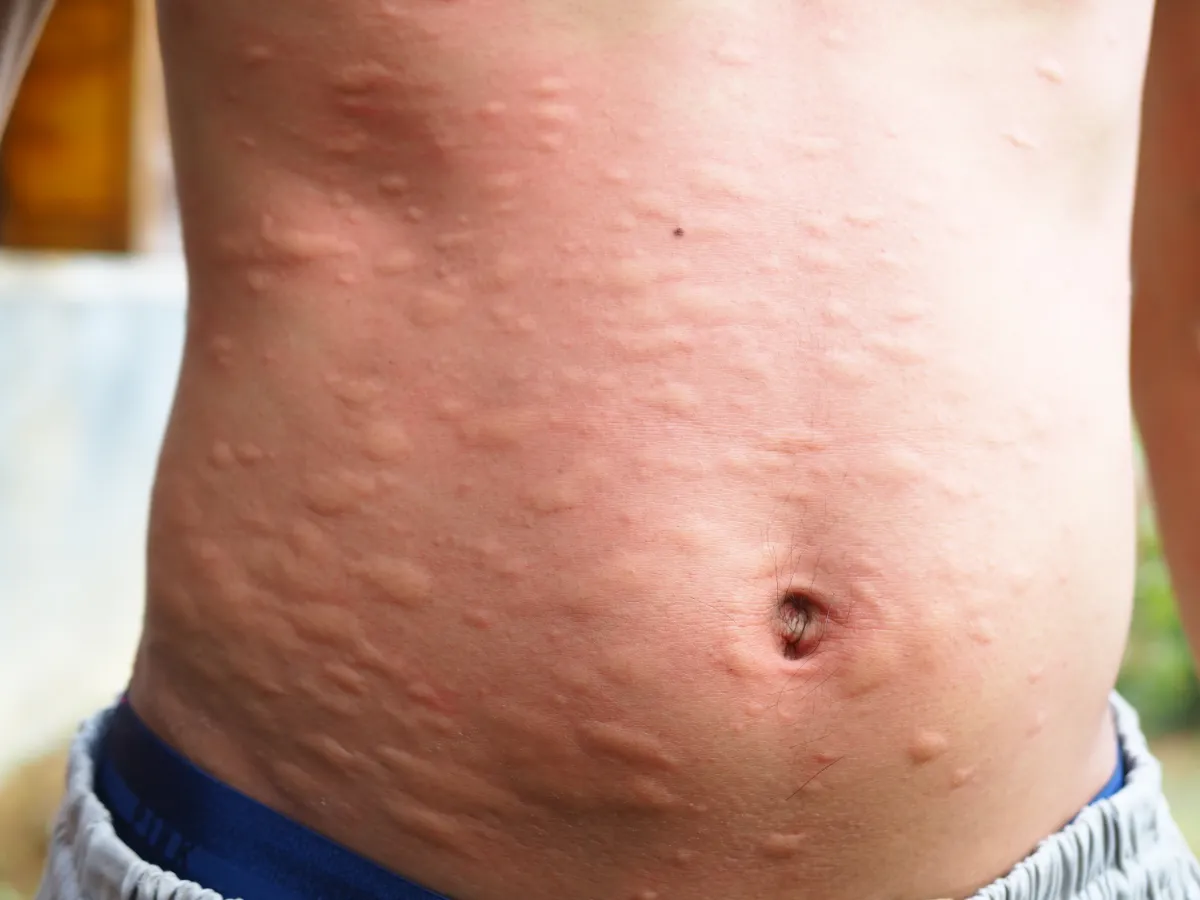
Illustrative photograph.
Hives on the face and swelling of the lips and eyelids (angioedema)
Angioedema is swelling of the deeper layers of the skin and mucous membranes. It most commonly affects the eyelids and lips, followed by the hands, feet and genitals, and can also affect the tongue and throat. It occurs either together with hives or on its own. In children with acute hives, it accompanies them in about 40% of cases.
Swelling without hives can be caused by blood pressure medication from the ACE inhibitor group, and there is also hereditary angioedema, which is a distinct disease and is treated differently. Swelling of the tongue or throat is an emergency.
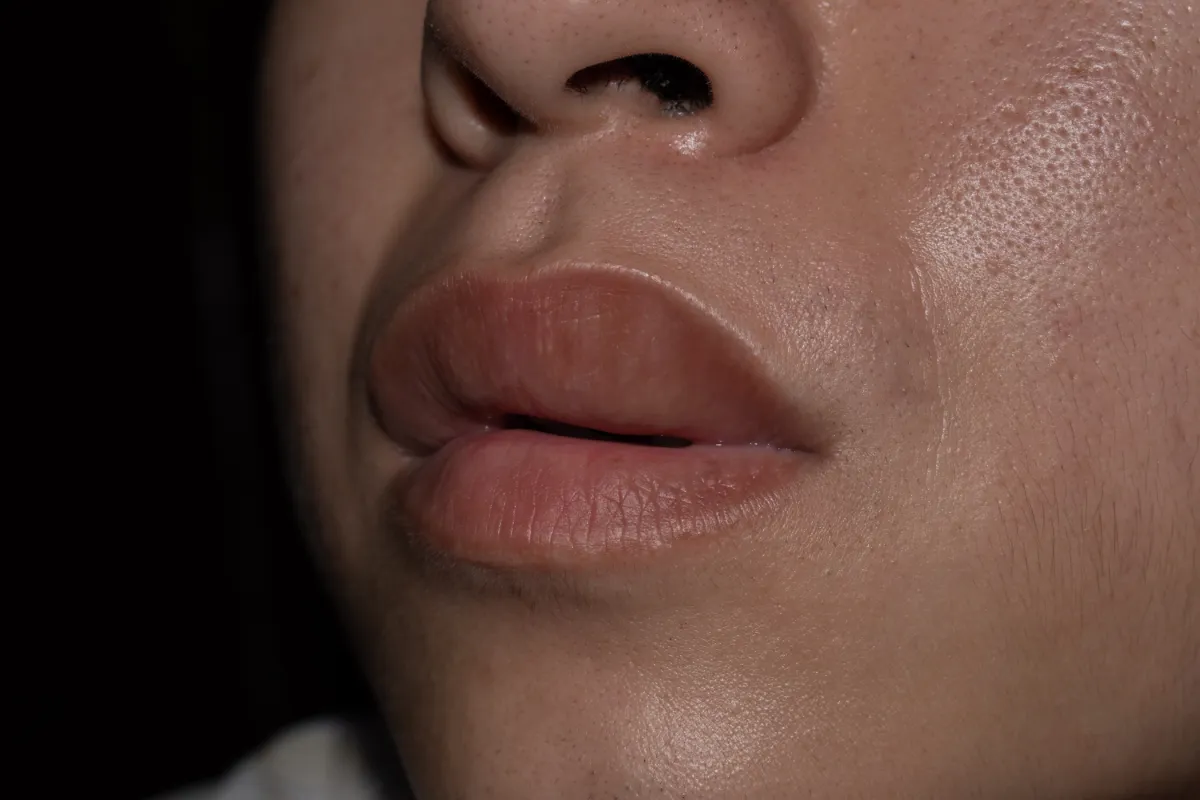
Illustrative photograph, posed by model.
What causes hives
A trigger causes mast cells in the skin to release histamine and other substances. Tiny blood vessels then leak fluid into the surrounding tissue, resulting in an itchy swelling.
In acute urticaria, the most common triggers are infections, primarily viral, followed by food (milk, eggs, peanuts, shellfish and crustaceans), medicines (antibiotics, aspirin and other painkillers), insect stings and latex. Food usually causes a rash within an hour of eating. In approximately half of the cases of acute urticaria, no trigger is found.
With chronic spontaneous urticaria, an external cause is usually not found. The likely mechanism is autoimmune: the body produces antibodies that activate mast cells themselves. It is more common in people with autoimmune diseases, for example thyroid disorders. Around half of people with chronic urticaria never find out what triggers it, but treatment works even then.
Acute and chronic urticaria: how long it lasts
Acute urticaria lasts for less than six weeks, and most commonly clears up within a few hours or days. It may recur.
We speak of chronic urticaria when hives occur every or almost every day for six weeks or longer. It is divided into spontaneous, for which a cause is most commonly not found (idiopathic urticaria), and inducible, which is triggered by a specific physical stimulus. Between 0.5 and 2% of people suffer from chronic spontaneous urticaria.
Chronic hives do not last forever. In approximately half of sufferers, they clear up within 6 to 12 months, and after two years, around 15% of people still have hives at least twice a week. During this time, it disrupts everyday life, work and school, so the aim of treatment is to keep the skin calm until the condition passes.
Types of urticaria with a known trigger
In some people, hives are triggered by a very specific stimulus: scratching, cold, sweating, pressure or sunlight. This is inducible urticaria.
| Type | What causes it? | Important for you to know |
|---|---|---|
| Dermographism (skin writing) | scratching and rubbing the skin, tight clothing, drying with a towel after showering | hives follow the line along which the skin was scratched |
| Cold urticaria cold urticaria | cold air, cold water, ice | it appears 2 to 5 minutes after exposure and lasts an hour or two; swimming in cold water is the most common cause of severe reactions |
| Cholinergic urticaria | sweating during exertion, excitement and emotional stress, hot shower | it comes on quickly and lasts 30 to 60 minutes |
| Pressure urticaria | long-term pressure: heavy bag, car seatbelt | the man only replies after several hours |
| Solar urticaria solar urticaria | sun, most commonly on skin that is usually covered | it can look like sunburn |
| Contact urticaria | contact with nettles, latex, food or cosmetics | changes are only at the point of contact |
| Thermal, aquagenic and vibrational | heat, water of any temperature, vibrations | aquagenic and vibratory are very rare |
With these types of wheals, they usually appear about five minutes after the trigger and last from a few minutes to an hour. They affect about 0.5% of people and can occur alongside spontaneous urticaria.
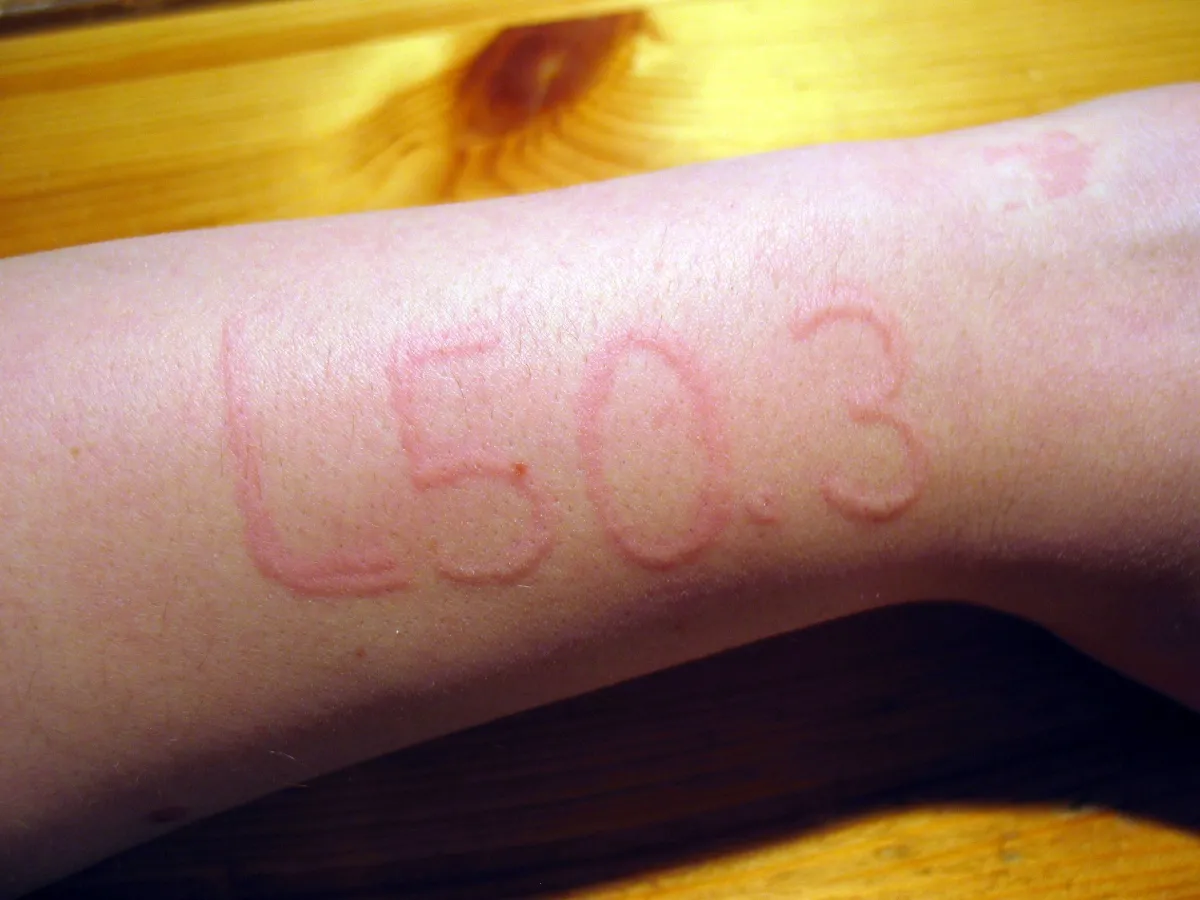
Photo: Mysid, Wikimedia Commons, public domain
The diagnosis is confirmed by triggering a reaction: in dermographism by scratching the skin, and in cold urticaria by an ice cube held on the forearm for up to five minutes. Anyone with cold urticaria should not swim unsupervised.
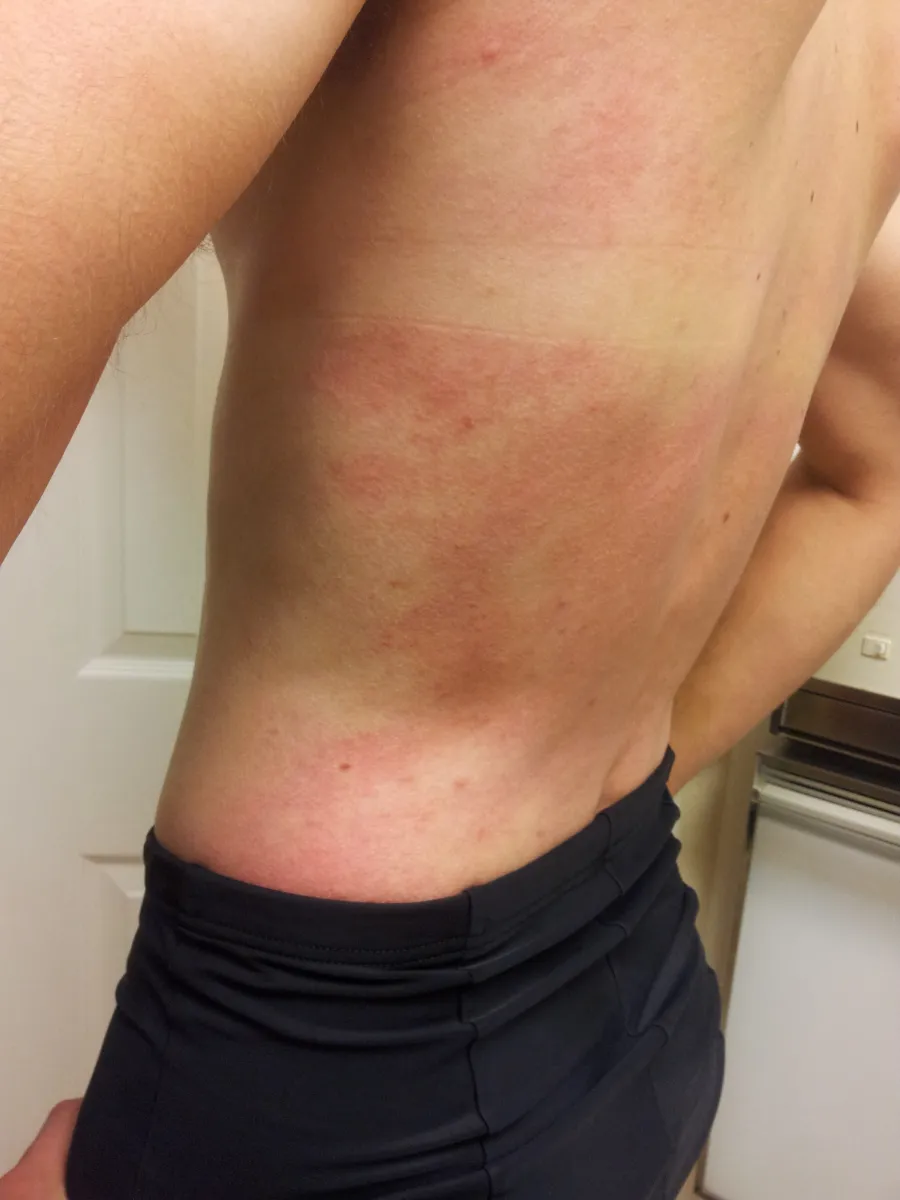
Stress hives
Stress can trigger hives. The British health service lists emotional stress among the triggers, along with heat and exertion-induced sweating. A typical example is cholinergic urticaria, where hives appear when the body warms up and sweats, whether from working out or from excitement.
The connection goes the other way too: chronic hives disrupt sleep and can lead to anxiety and depression.
What people call a „stress rash“ isn't always hives. If the changes stay in the same place for days, peel or weep, it's more likely to be eczema or atopic eczema, and that shows up differently on the examination.
It helps to treat the hives themselves and anything that reduces your tension. The American Academy of Dermatology mentions physical activity, meditation and mindfulness exercises.
Hives in children and babies
Nettle rash is common in children: around 15% of children under the age of ten experience at least one episode. It is almost always acute, whilst chronic cases are rare in children. It also occurs in newborns and infants, though less frequently.
The most commonly recognised trigger is a viral infection, for example a cold, in around 40% of cases. These are followed by food (eggs, milk, soya, peanuts, wheat), medicines (antibiotics and painkillers and fever reducers) and bee and wasp stings.
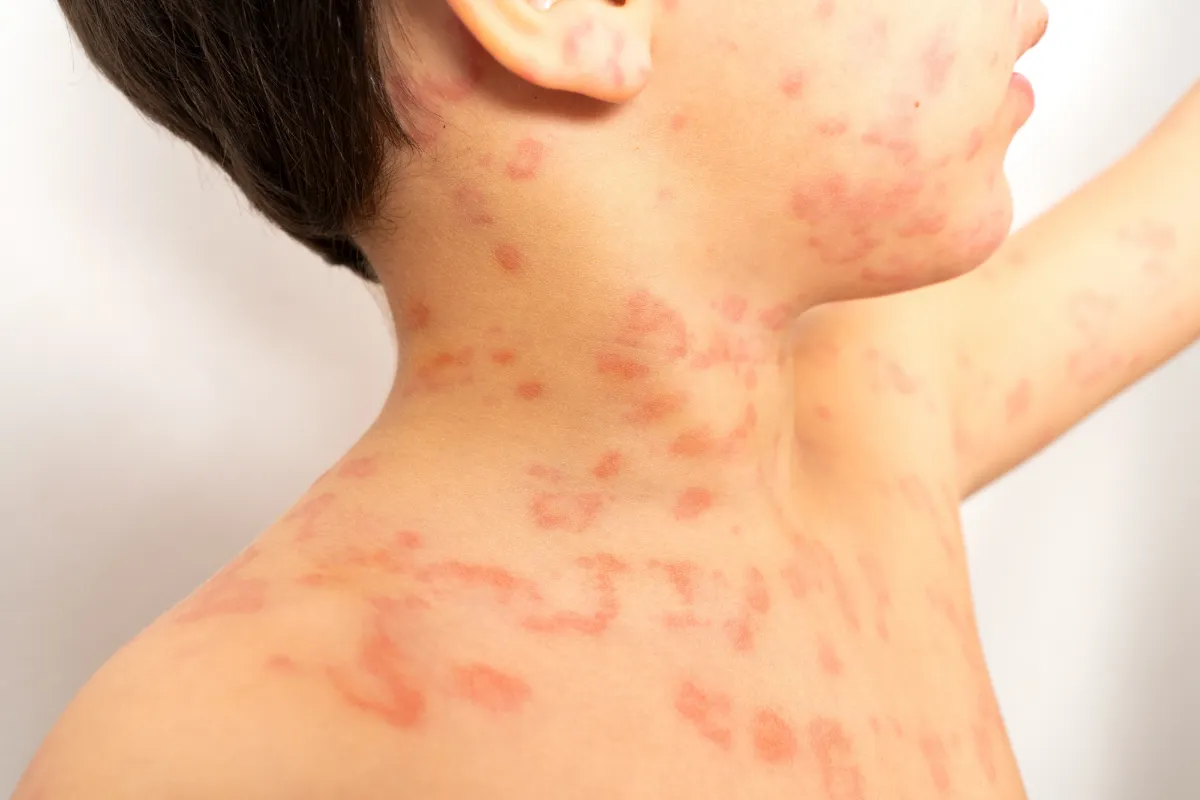
Illustrative photograph, posed by model.
Treatment is the same as for adults: a non-drowsy antihistamine, at a dose determined by the doctor according to the child's age and weight. Antihistamines are not always suitable for young children, so do not give the medicine without advice from a doctor or pharmacist. Hives in children usually clear up on their own, within a few hours or days, and leave no lasting effects.
Take the child to A&E immediately if they are having difficulty breathing, wheezing, if their lips or tongue are swelling, or if they are limp and not responding as usual. At Imedic, dermatologists examine both babies and children.
Is urticaria dangerous and when to call an ambulance immediately
Hives on their own are usually not dangerous and in most people pass without consequence. They are dangerous when they are part of a severe allergic reaction (anaphylaxis) or when the swelling affects the tongue and throat.
Immediately call an ambulance (194) if:
- sudden swelling of the lips, mouth, tongue or throat
- you have difficulty breathing, a wheezing sound in your chest or a feeling of suffocation
- your throat feels tight or you have difficulty swallowing
- skin, tongue or lips become blue, grey or pale
- you suddenly feel confused, sleepy or dizzy, or you have fainted
- your heart is beating fast
- The child is limp and is not responding as usual
Contact your GP in the coming days if:
- The rash hasn't eased after two days.
- the rash is spreading or keeps coming back
- You have a temperature and feel unwell
- Alongside the rash, you have swelling under the skin.
- a single lesion stays in the same place for more than 24 hours, as this deviates from typical hives
How is the diagnosis made?
The diagnosis is made through a conversation and skin examination. The dermatologist will ask when the rash appears, how long a single lesion lasts, what medications and supplements you are taking, what you have eaten and whether you have been ill recently. They may also gently stroke the skin to see if a wheal appears.
In cases of acute urticaria, blood tests are most often unnecessary. Allergy tests only make sense when there is a suspicion of a specific food, medication or latex. For chronic spontaneous urticaria, basic blood tests (full blood count and CRP) are sufficient, unless an examination indicates another disease. Extensive allergy testing in chronic urticaria frequently fails to find the cause.
A diary often helps more than tests: write down when the rash appeared, what you ate, drank and did beforehand, and which medicines you took.
At Imedicus we do not perform allergy tests (prick and patch tests) or blood tests. If needed, the dermatologist will refer you to an allergist, and you can have the blood tests done at a laboratory and bring the results to your follow-up appointment.
Other skin conditions can resemble hives, for example insect bites or eczema, so an examination is useful even when the rash clears up on its own.
Treatment of hives
Antihistamines
The basis of treatment is second-generation antihistamines, which do not cause drowsiness, for example cetirizine and loratadine. In chronic urticaria, they are taken every day, and not just when the rash appears. If the usual dose is not sufficient, a doctor may increase it, up to a maximum of four times. Do not increase the dose yourself.
Older antihistamines, which cause drowsiness, are no longer recommended. During pregnancy and whilst breastfeeding, loratadine and cetirizine are preferred, in consultation with a doctor.
When an antihistamine is not enough
For severe acute urticaria, a doctor may prescribe oral corticosteroids for a few days. Long-term use of corticosteroids is not recommended.
If chronic urticaria is not under control even after four weeks of the highest dose of antihistamines, a specialist takes over treatment. At that point, the biological medicine omalizumab or ciclosporin are considered, to which about two-thirds of patients respond.
Adrenaline is a medicine for anaphylaxis and throat swelling. People at risk of severe reactions may also be given an adrenaline auto-injector.
Hives and creams: what helps externally
Creams and lotions do not remove the cause, but they temporarily relieve itching. These are preparations with menthol or calamine, which cool and soothe the skin. A cold compress several times a day helps, unless cold is your trigger. Regularly apply a fragrance-free moisturiser to the skin so that it does not dry out.
What you can do yourself
- wear loose cotton clothing and avoid overheating
- avoid aspirin, ibuprofen and codeine, unless essential; paracetamol is generally safe
- minimise what makes your rash worse: heat, tight clothing and alcohol
- keep a diary and take photographs of the rash
- Take the medication as prescribed and get in touch if it doesn't work, so the treatment can be adjusted.
Diet, calcium and natural remedies
A food allergy causes acute urticaria, usually within an hour of eating, and in such cases that food is avoided. In chronic urticaria, food worsens the rash in only a small number of people. A food diary, along with eliminating and reintroducing the suspected food, sometimes helps to identify it, but is not always reliable. A trial diet low in additives (colourings and preservatives), lasting at least three weeks, is also mentioned. Strict DIY diets make no sense.
In some European countries, calcium is often taken for skin allergy reactions: itching, redness, and hives. It is the same here. The evidence for this is weak. In an older study on 20 adolescents, calcium reduced the reaction on a skin allergy test. In a more recent, double-blind study on 40 adults with allergies, three days of taking calcium did not reduce either skin reactions or itching compared to a placebo. A review of the literature assesses the use of calcium in allergic diseases as highly controversial. We found no study showing that calcium calms hives themselves, and sources on the treatment of hives do not list it among therapies. Therefore, calcium does not replace an antihistamine. The authors of the recent study also warn that calcium can interfere with the absorption of anti-allergy medications, so tell your doctor if you are taking it.
Of the „natural“ measures, those that cool and do not irritate the skin are useful: cold compresses, loose cotton clothing, and avoiding overheating. Those sources do not mention a herbal preparation with a proven effect.
Dermatologist appointment at Imedic
At Imedic, hives are examined and treated by dermatovenerology specialists Dr Marina Ćirović and Dr Sanja Kekić. They examine adults, children and babies. Please bring photographs of the rash, a list of medications and supplements you are taking, and previous reports if you have them.
A dermatological examination costs 5,000 RSD. A follow-up within a month is 3,000 RSD, and after more than a month it is 4,000 RSD.
The Imedic polyclinic is located at Kneza Miloša 23, Belgrade, and patients come from all over Serbia. Appointments are made by telephone. 064 237 0707.
Book a consultation · Dermatologist in Belgrade · Dermatology price list
Frequently asked questions
Is hives contagious?
No. Hives are not passed from person to person. An infection that triggered it, such as a viral one, can be contagious.
How long does urticaria last?
A single hive disappears in 24 hours at most. Acute urticaria usually clears up in a few days, and it is considered chronic when it lasts for six weeks or longer.
Is hives dangerous?
Most of the time it is not. It is an emergency when, along with the rash, your lips, tongue or throat swell up, when you have difficulty breathing or feel dizzy: in that case, call an ambulance (194) immediately.
Can hives be caused by stress?
Agreed. Stress is a well-known trigger. If the rash stays in the same place for days, it is probably not hives and should be examined.
What is cold urticaria?
That is cold urticaria: hives appear a few minutes after exposure to cold air, water or ice and last an hour or two. The greatest risk is swimming in cold water.
Does calcium help with hives?
There is no good evidence for that. In a double-blind trial, calcium reduced neither skin lesions nor itching compared to placebo. Treatment is based on antihistamines.
Which cream helps with hives?
A menthol or calamine lotion or cream temporarily relieves itching. If the hives keep returning, an oral medication is needed, most commonly an antihistamine.
What can I take for hives during pregnancy?
Antihistamines such as loratadine and cetirizine are preferred. Before taking any medication, consult your gynaecologist or dermatologist.
Can the thyroid cause hives?
Chronic hives are more common in people with autoimmune thyroid diseases. When symptoms suggest this, the doctor also requests thyroid tests.
When should a child with hives be taken to the doctor?
Go to A&E immediately if he has difficulty breathing, his lips or tongue are swelling, or he is limp. You should also contact a doctor if the rash does not go away after two days or you are worried.
Expert sources
- Zuberbier T et al. The EAACI/GA²LEN/EuroGuiDerm/APAAACI guideline for the definition, classification, diagnosis, and management of urticaria. Allergy 2022;77:734–766 (summary).
- British Association of Dermatologists. Urticaria and angioedema, patient information (2020).
- DermNet. Urticaria – an overview.
- NHS. Hives (reviewed 26 April 2024).
- DermNet. Urticaria, patient information (reviewed 2025).
- American Academy of Dermatology. Hives: diagnosis and treatment.
- American Academy of Dermatology. 10 ways to get relief from chronic hives.
- DermNet. Urticaria in children.
- DermNet. Chronic inducible urticaria.
- DermNet. Cold urticaria.
- Matysiak K, Matuszewski M, Feleszko W. Calcium preparations do not inhibit allergic reactions: a randomised controlled trial. Pol Arch Intern Med 2017;127:582–588 (abstract).
- Debelic M. Antiallergic effect of an oral calcium preparation, a double-blind trial. Fortschr Med 1979;97:1537–1540 (abstract).
- Is there any hope for calcium use in allergic diseases? Review article. Adv Clin Exp Med 2009;18:507–512 (abstract).
- Allergy & Asthma Network. Hives (urticaria): are hives contagious?

Author: Ivica Jeremić, MD, PhD
Specialist in internal medicine, subspecialist in rheumatology, resident in dermatology and venereology.
Updated:
Medically reviewed by Dr Sanja Kekić, specialist in dermatology and venereology, on 21 November 2026.


