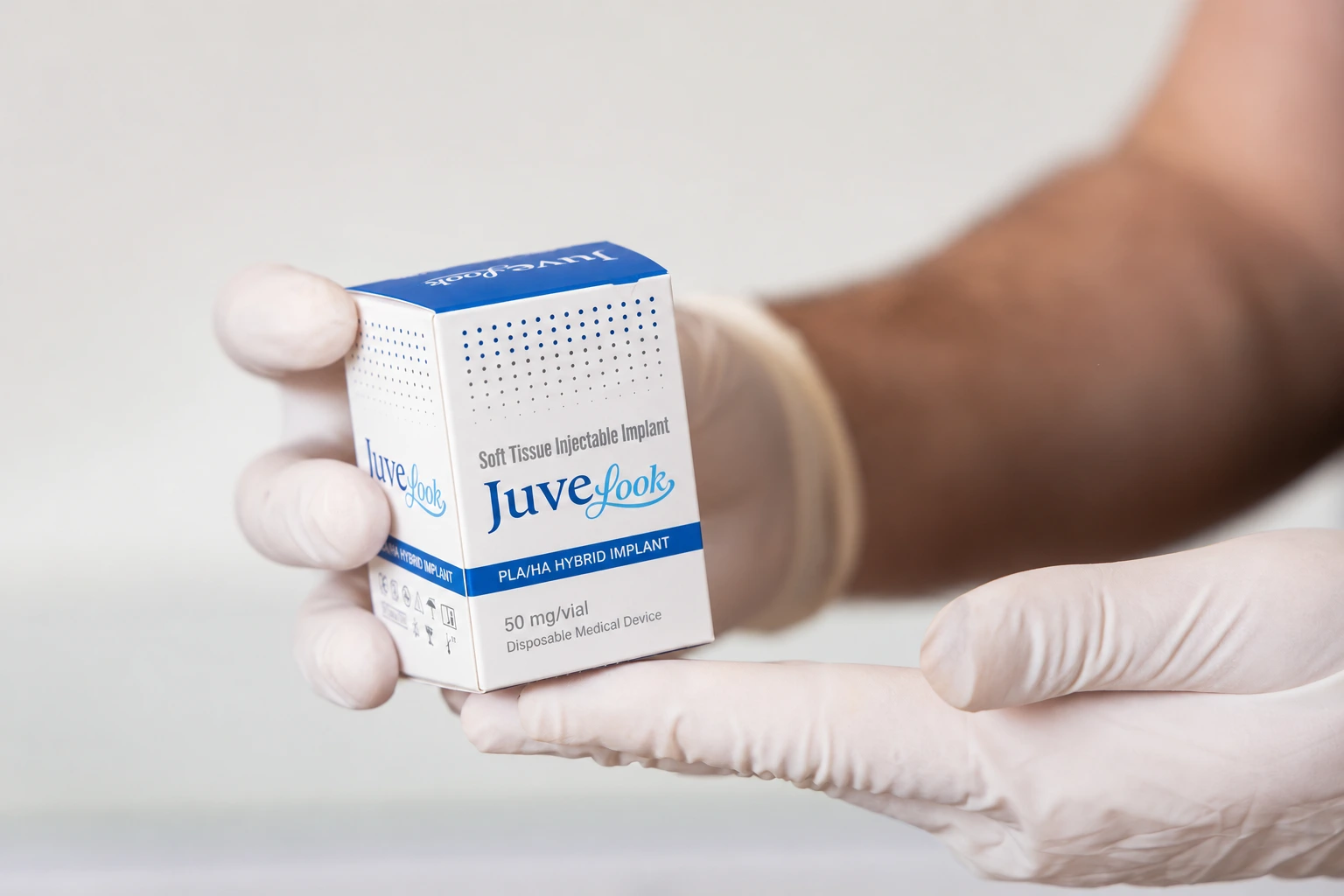
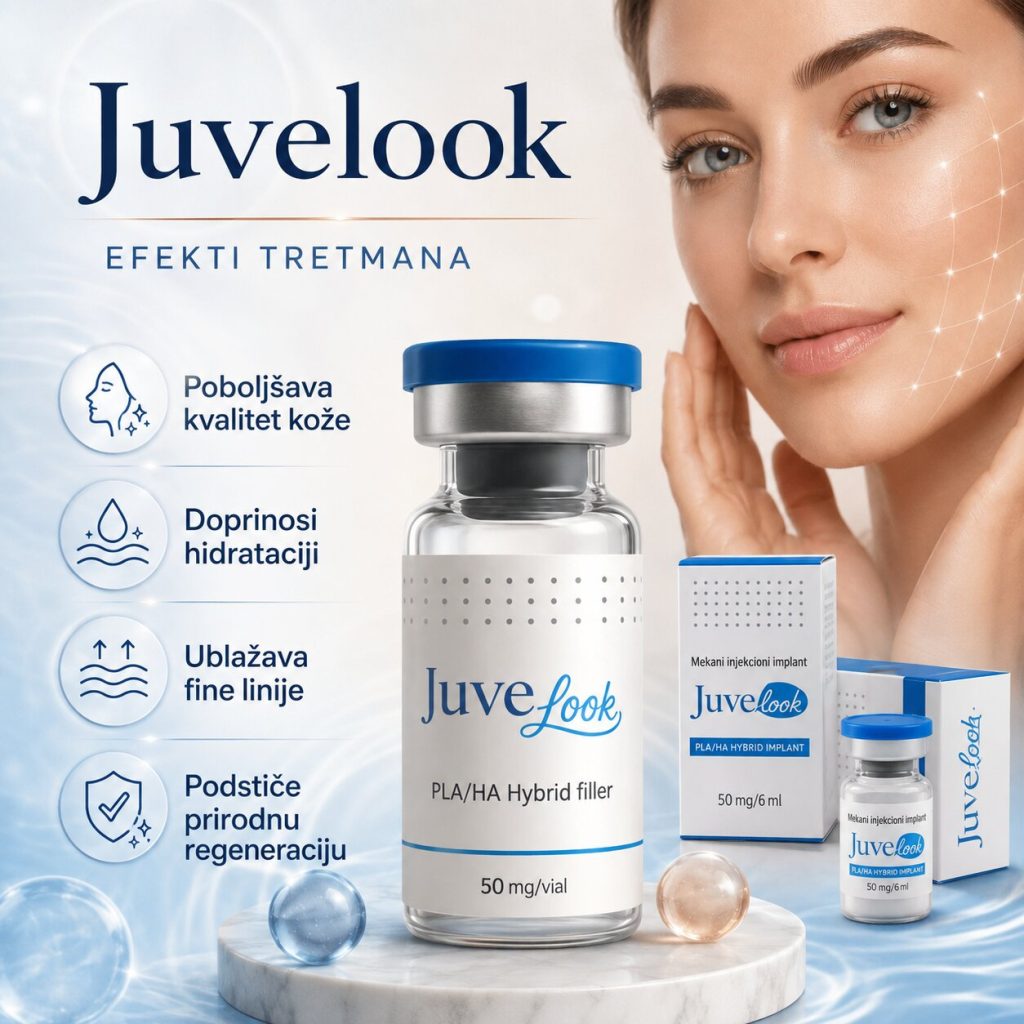
Juvelook is a collagen stimulator based on poly-D,L-lactic acid and non-cross-linked hyaluronic acid. It encourages the skin to build its own collagen and restores density, even texture and tone — for thin skin, visible pores, acne marks and fine lines.
Skin has its own rhythm of renewal. Fibroblasts in the dermis constantly build collagen — the network that gives skin thickness, resilience and that smooth, even glow by which we recognise youthful skin. After the age of 25, that rhythm slows down. Collagen production drops by about 1% per year, the fibres become thinned out, and the network loses its regularity.
Change is rarely noticed all at once. First comes the feeling that skincare no longer gives the same result. Then the texture becomes uneven, pores more visible, skin thinner and slower to recover. The complexion looks tired even when you are rested, though no single wrinkle explains it.
Juvelook speaks directly to that demographic, combining poly-D,L-lactic acid (PDLLA), which triggers the production of its own collagen, and non-cross-linked hyaluronic acid, which immediately restores hydration to the skin. It is injected into the deep dermis, where PDLLA particles stimulate fibroblasts over the coming weeks to rebuild — gradually, layer by layer.
Results do not happen overnight and do not change facial features. The skin becomes denser, more even and more resilient. At Imedic Polyclinic, we use Juvelook on the face, neck and décolletage, as well as in areas where the skin is particularly thin, such as the eye contour.
What is Juvelook?
Juvelook is a collagen stimulator that the skin uses as a boost to start rebuilding its own support again. It consists of two substances that work at different rates — one provides an immediate effect, while the other works over the coming months.
Two components, two tasks
The first is hyaluronic acid, is it the one naturally produced by the skin to retain moisture. In Juvelook it is not cross-linked, so it does not behave like a filler — it does not fill or alter facial contours. Its role is to immediately nourish the skin with moisture and evenly distribute the second component through the tissue. It stays for a few weeks and then fades away. Thanks to it, the skin looks more rested and fresher immediately after the treatment.
The second is poly-D,L-lactic acid, abbreviated as PDLLA. It is the real reason why this treatment is done. It concerns tiny particles that remain in the deeper layer of the skin and there, patiently, for months remind fibroblasts — the cells that produce collagen — to work at full capacity again. When they finish their job, the particles break down into water and substances that the body naturally excretes. Nothing foreign remains in the skin; what remains is the collagen that the skin made itself.
Because of that division of labour, the result develops in two waves. In the first few weeks, hydration and radiance are visible. Once the hyaluronic acid recedes, something more permanent slowly takes its place — denser, more even and more resilient skin.
It is also worth clarifying the most common confusion. Juvelook is not a filler. Fillers take up space in the tissue and thereby alter the facial contours. Juvelook does not fill anything; it alters the quality of the skin itself – its thickness, texture and tone, while facial features and expressions remain completely unchanged. That is why it belongs to the group collagen stimulator, treatments that work through the skin's own regenerative processes.
Why is it important what kind of lactic acid the preparation is made from?
Polylactic acid it is not new in medicine. It has been used for decades for surgical sutures and materials that dissolve on their own in the body, so its behaviour is well known. In aesthetic medicine, however, it appears in two versions — and they behave quite differently.
Older version, PLLA, it creates particles in the skin with irregular shapes and sharper edges. They do their job, but it is harder to distribute them evenly through the tissue.
PDLLA Juvelooku is built differently. Its particles are round and smooth on the outside, and hollow on the inside — a bit like a tiny sponge-like ball. That difference in shape changes three things that a patient actually notices:
- A more even distribution. A round particle passes through the needle more easily and spreads better through the skin, instead of gathering in one place.
- Mild skin reaction. Degradation begins from the inside and proceeds slowly, so the tissue response is also calm and predictable. For this very reason Juvelook has a good safety profile.
- There is no mandatory massage after the treatment. With a PLLA-based preparation, the patient massaged the treated region for days to distribute the particles. With Juvelook, that is not necessary — the shape of the particle and the injection technique take care of the distribution themselves.
This difference also explains why these two products are used for different purposes. Juvelook works within the skin and alters its quality. Products based on PLLA, such as Lanluma, it works deeper, in the subcutaneous tissue, where the aim is to restore density and support over larger areas.
How Juvelook stimulates your own collagen
Following the treatment, the skin does not receive a replacement for the lost collagen. It receives a stimulus to produce it again on its own.
What is happening in the skin?
PDLLA particles remain in the deeper layer of the skin, acting there as a mild, constant signal. The body recognises them, sends cells responsible for tissue repair, and they trigger fibroblasts — collagen-producing cells — to work again at full capacity.
Fibroblasts around the particles build a new network of fibres, specifically the type of collagen that gives skin its firmness and elasticity. The process takes weeks and is imperceptible; it is only noticed when the skin begins to look different. This is why the result of Juvelook lasts long after the product itself has broken down — what remains is not the product, but the collagen that the skin has produced itself. How collagen is formed and why it is lost is explained in the article on types of collagen.
Builds new and preserves the existing
As we age, the skin not only produces less collagen — it loses it faster too. The sun, stress and fatigue accelerate the breakdown of fibres, so after forty the loss happens faster than the renewal.
PDLLA works on both sides of that equation: it stimulates the creation of new collagen while simultaneously slowing down the breakdown of existing collagen. That is precisely why the result is maintained longer than would be expected from the small amount of product that is injected.
When is Juvelook chosen?
Juvelook is most commonly recommended for skin that has lost its quality — it has become thinner, uneven and recovers more slowly. Here are the situations where this is most commonly recognised.
Uneven texture and enlarged pores
Pores widen with age for a simple reason: the skin around them loses its tone. That is why peels and thorough cleansing provide only short-term improvement — they work on the surface, whereas the cause lies deeper.
Juvelook works specifically on skin tone. As the collagen network repairs, the skin around the pores becomes firmer and the pores visually appear smaller, while the texture becomes more even. The result is not immediate, but unlike surface treatments, it is lasting. For more pronounced changes, the texture is often improved by combining it with ClearSkin laser or chemical peels.
Acne scars and atrophic scars
Depressed scars occur where inflammation has destroyed collagen and the skin has healed with a lack of support. Juvelook does what the scar needs most – it restores tissue density beneath the depression, so the edges become softer and the shadow that makes the scar visible weaker.
It is important to say that acne scars are rarely resolved with a single treatment. The best results come from a combination, where each method does its part — we write about this in detail on the page about acne scars, and in tethered scars that are bound to deeper tissue, it often precedes subcision.
Eye area
The skin around the eyes is the thinnest on the face and the most sensitive to collagen loss. It becomes translucent, finely wrinkled and easily betrays fatigue, and most stronger preparations for that region are not suitable.
Juvelook is an exception here — the small particle size and low concentration allow treatment in a delicate area. The procedure is performed using a cannula, carefully and in a thin layer, with the aim of thickening and evening out the skin. It does not remove dark circles caused by shadows or volume loss, but it makes the skin in that area denser and more resilient. Which type of dark circles you have and which treatment works for them is explained on the page removal of dark circles under the eyes.
Thin skin and fine lines
There are faces that have nothing that needs filling. The contours are in place, the volume is satisfactory, and yet the skin appears tired — it is thin, finely wrinkled, and lacks radiance.
This is the most typical candidate for Juvelook. The goal is not to change the appearance, but to restore quality: skin that handles facial expressions better, reflects light more evenly and looks rested.
Neck, décolletage and hands
The areas that reveal age the fastest, yet are most frequently skipped. The skin here is naturally thinner and has fewer sebaceous glands, so fine wrinkling appears earlier than on the face.
Juvelook is applied in these zones in thinner layers and with more patience, but the effect is worth it — the skin becomes firmer, fine lines less noticeable, and the texture more even. In cases of pronounced dryness and loss of tone, it complements well with Profhilo.
Stretch marks
Stretch marks are, in essence, scars caused by the sudden stretching of the skin. Old, white stretch marks cannot be removed completely, but they can be alleviated — biostimulation restores some of their density and makes them less noticeable. Juvelook is most commonly used for this indication alongside laser stretch mark treatments.
When is the right moment?
The most common mistake is waiting. Biostimulation gives the best results while the skin still has the capacity to respond — so when the first signs are visible, rather than when they have progressed. The earlier you start, the less is needed to maintain it.
Signs your skin is sending you:
- the texture has become uneven, and the complexion dull
- pores are more visible than a few years ago
- the skin appears thinner and creases into fine lines more easily
- Negra no longer gives the same result as before
- acne marks remain that you are failing to fade
- Your face looks tired even when you are well-rested
- skin heals more slowly and takes longer to recover
Juvelook is a good choice if:
- you want better skin quality, not a change in appearance
- you don't want fillers or anything that changes your facial features
- you are in your thirties and thinking about prevention
- you have thin and sensitive skin that does not react well to stronger active ingredients
- you prefer a gradual result that nobody notices as a treatment
What does a Juvelook treatment look like at the Imedic Polyclinic
Consultation
It all starts with a consultation. The doctor assesses the quality and condition of the skin, and goes through your treatment history. Only then is it decided what is being treated, how many sessions are needed, and at what intervals — because the plan differs for the thin skin around the eyes compared to the décolletage or acne scars.
The treatment itself
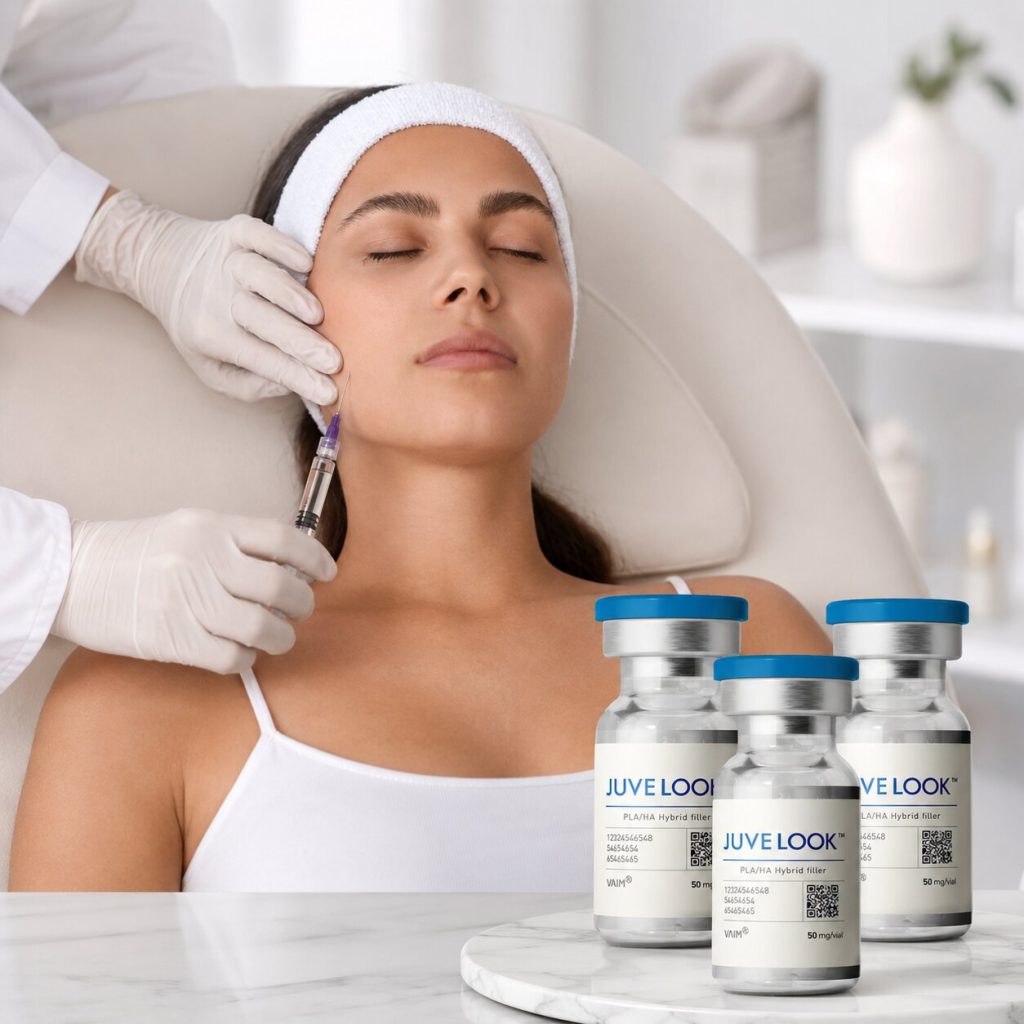
An anaesthetic cream is applied to the skin first and left to take effect, so the whole procedure is entirely bearable — most patients describe it as a series of brief stings.
It is injected with a very thin needle into the deeper layer of the skin, and in sensitive regions such as the eye area, a cannula is used, which is soft and reduces the possibility of bruising. The treatment of one region takes about 30 to 45 minutes, along with the preparation.
How many sessions and at what intervals?
Standard protocols are three sessions spaced six weeks apart. The spacing is not arbitrary — that is roughly how long it takes for new collagen to form and mature, so each subsequent session builds upon what the previous one initiated.
The number of sessions is adjusted. For prevention and mild changes, two are sometimes enough; for more pronounced acne scars or thin skin on the neck and décolletage, a fourth may be necessary. After completing the course, one maintenance session per year to once every year and a half preserves what has been achieved.
Recovery
Recovery is practically non-existent. On the first day, mild redness, tenderness to the touch, and tiny bumps at the injection sites are possible, which subside within a few hours to a day or two. Bruising is possible, especially in thinner regions, but is rare when using a cannula.
For the first 48 hours, it is recommended to avoid saunas, sunbeds and intense workouts, along with regular hydration and sun protection. Makeup can be applied as early as the next day.
What you don't need to do is massage. With PLLA-based products, the patient massages the treated region themselves for days to distribute the particles — with Juvelook this is not necessary, as the distribution is achieved by the particle shape and the injection technique.
When will the results be visible?
The first impression comes quickly: after just a few days, the skin looks more hydrated and rested, thanks to hyaluronic acid. It is a pleasant, but fleeting effect.
The real results are built in the background. The first actual changes in texture and density are noticed after two to four weeks, and the full effect usually two to three months after the last session — when the new collagen has formed and matured.
The results are maintained for up to about 16 months, with variations from person to person. The duration depends on age, the condition of the skin prior to treatment, the number of sessions and habits — smoking and unprotected sun exposure shorten it the most.
Juvelook or Lenisna
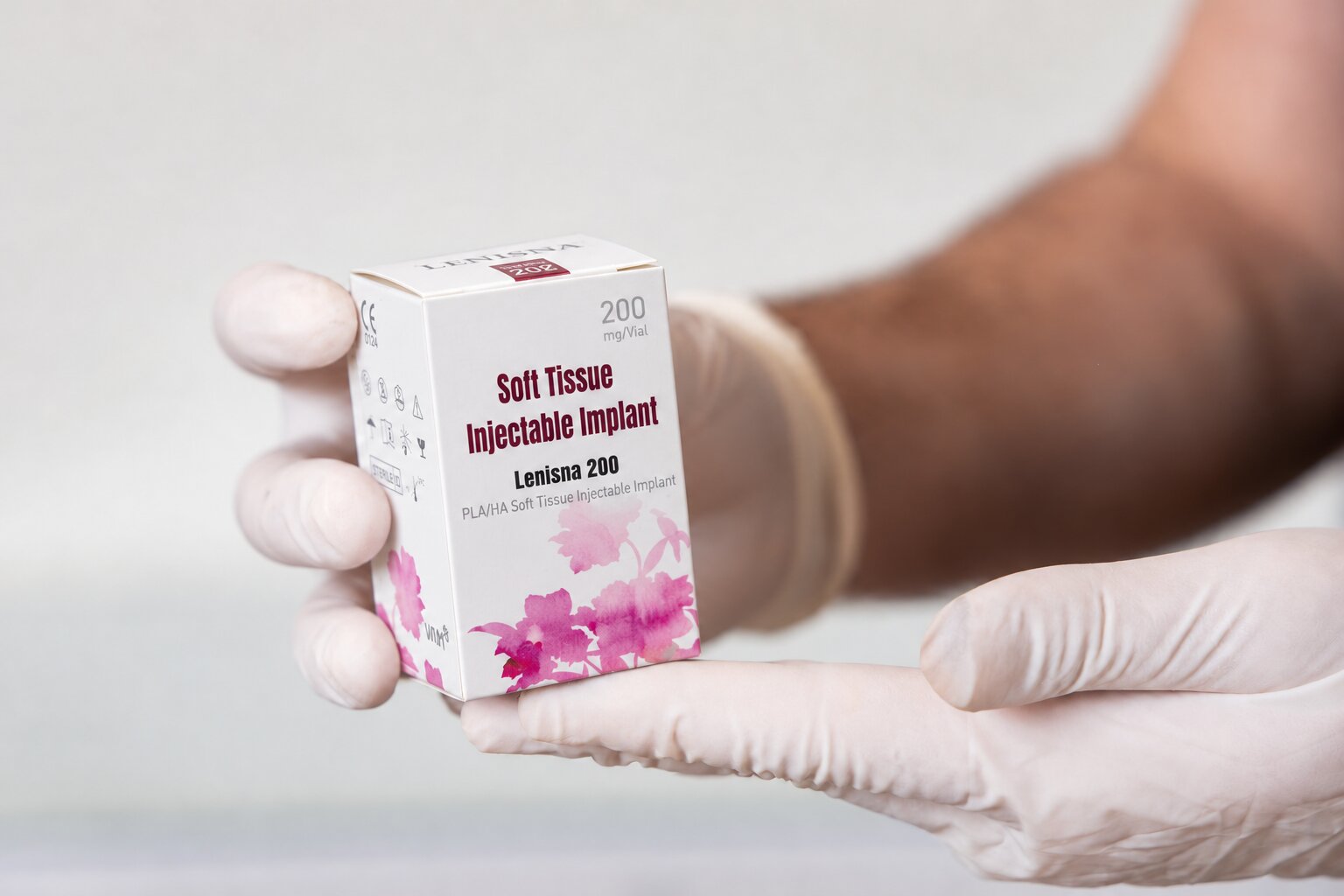
Juvelook and Lenisna are preparations from the same family — both combine PDLLA and non-crosslinked hyaluronic acid. They differ in concentration and particle size, which determines the layer into which they are injected and what they do.
Juvelook has finer particles and works within the skin. Its goal is quality: texture, density, and tone.
Lenisna has larger particles and a higher concentration, so it is injected deeper into the subcutaneous tissue. There, the objective changes — instead of texture, the focus is on tissue density and the gradual lifting of sagging skin.
| Juvelook | Lenisna | |
|---|---|---|
| Application layer | deep layer of the skin | subcutaneous tissue |
| Purpose | skin quality and texture | tissue density and lifting |
| Regions | face, around the eyes, neck, décolletage | cheeks, lower third of the face, jawline |
| Protocol | 3 sessions, 6 weeks apart | 3 sessions, 8 weeks apart |
| Duration | up to 16 months | up to 24 months |
In practice, the choice depends on what is bothering you. If the skin is thin and uneven, and the contours are in place, Juvelook is chosen. If the skin has started to sag and the tissue has lost density, the choice is Lenisna. In some patients, both are combined, in different regions and different layers.
Juvelook compared to other treatments
There are several collagen stimulators, and each is developed with a different goal. None is universally better — it is a question of what is being addressed.
In short: fillers they restore volume, Radiesse and Lanluma They work on support and tissue density, while Juvelook works on the quality of the skin itself. An overview of all the preparations we use can be found on the page about collagen stimulators.
We recommend planning your injectable treatment at least two weeks before an important event. If a series of treatments is required, the plan should start earlier to allow enough time for the full effect to develop.

Updated: