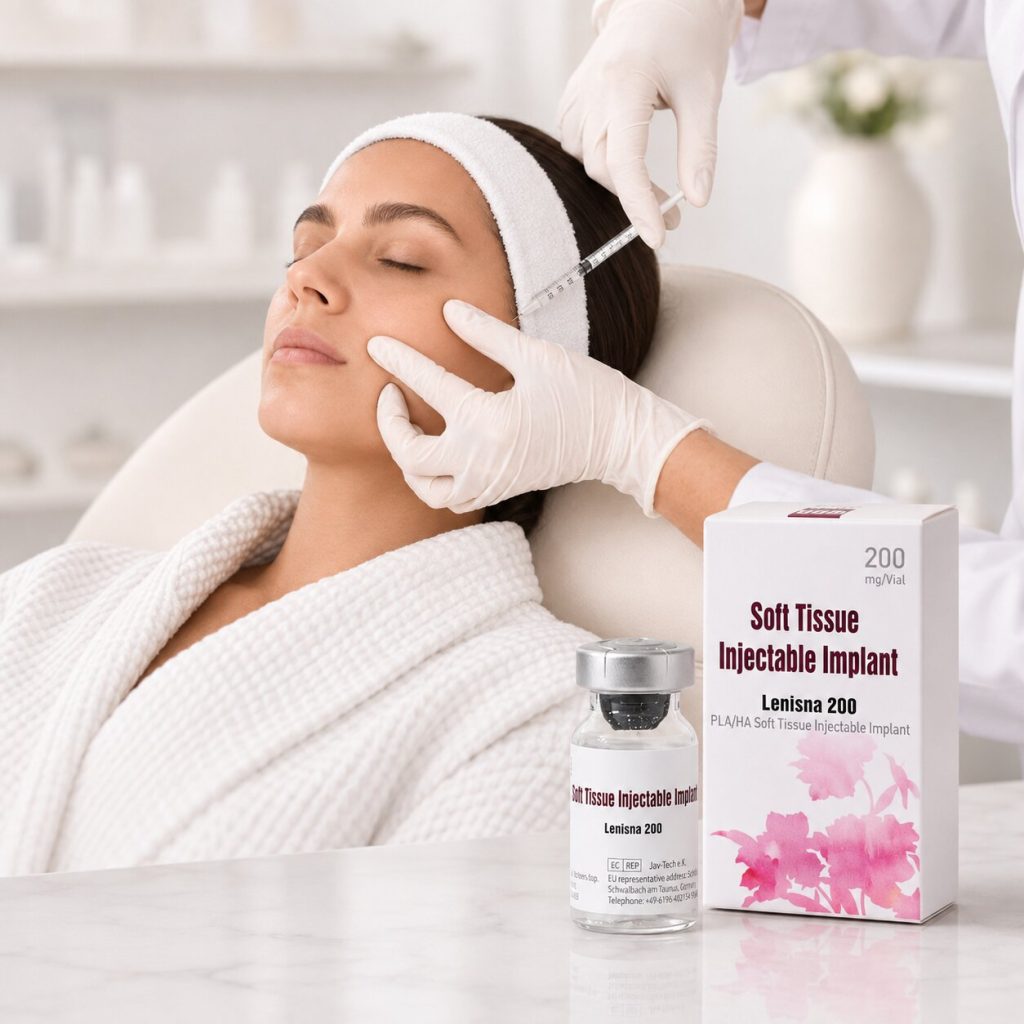
Lenisna, which the manufacturer in Korea sells under the name Juvelook Volume, is a collagen stimulator based on poly-D,L-lactic acid and non-cross-linked hyaluronic acid. It acts in the subcutaneous tissue, where it gradually restores density and support for sagging skin, pronounced wrinkles and loss of facial volume.
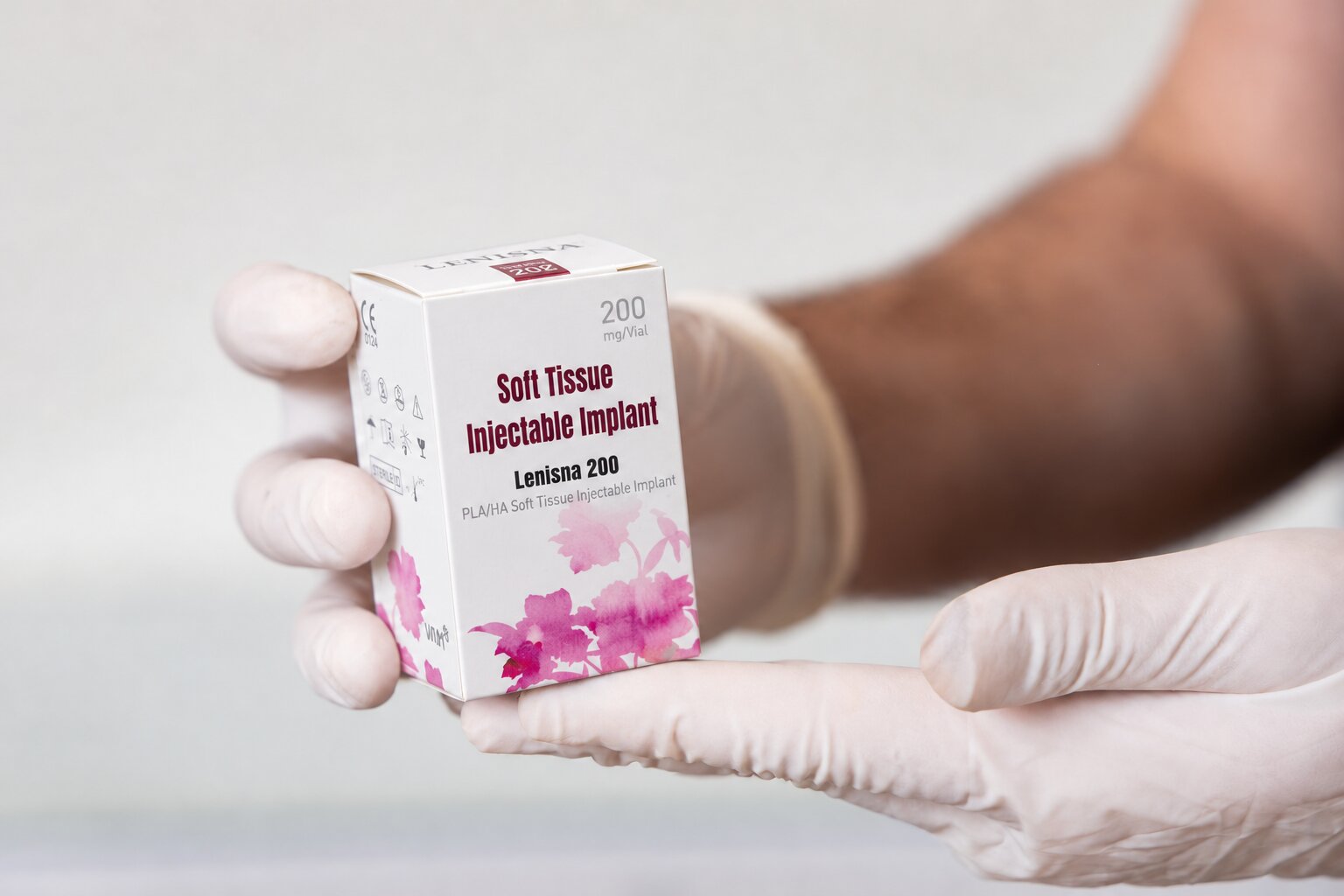
If you've already read about Juvelook, the easiest way to picture Lenisna is as its older sister. Same manufacturer, same technology, same ingredients — just in a significantly stronger concentration and with larger particles that penetrate deeper.
This difference also changes what the treatment can do. Juvelook works within the skin and improves its quality. Lenisna goes beneath it, into the subcutaneous tissue, right where the structural support that gives the face its shape has weakened. That is why it is chosen when the cheeks look hollow, when the nasolabial folds are visible even at rest, or when the jawline is no longer as defined as it used to be.
The effect comes in two steps. Hyaluronic acid immediately restores some fullness and contour, so the change is visible as soon as you leave the clinic. The permanent effect builds over months — PDLLA particles stimulate the body to produce its own collagen where support has weakened, so the face gradually gains a framework that holds even after the product has broken down.
At Imedic poliklinika, we use Lenisna on the cheeks, temples, the lower third of the face and along the jawline.
Lenisna and Juvelook Volume: same preparation, two names
If you were looking for information on foreign websites, you probably came across the name Juvelook Volume — and thought it was a third preparation.
No, it isn't. The manufacturer VAIM sells the exact same formulation in Korea as Juvelook Volume and on international markets as Lenisna. Same composition, same vial, same protocol; only the name on the box is different. In Serbia, the name Lenisna is used.
Its relationship with Juvelook is not a “competitive” one. These are not two rival preparations where one chooses the better one, but two strengths of the same technology, made for different layers and different problems.
| Juvelook | Lenisna | |
|---|---|---|
| Vial contents | 50 mg | 200 mg |
| PDLLA and hyaluronic acid | 42.5 + 7.5 mg | 170 + 30 mg |
| Particle size | smaller | 40–60 µm |
| Application layer | deep layer of the skin | subcutaneous tissue |
| What changes | skin quality | tissue density and facial fullness |
Practically speaking, this means the following: if the facial contours are in place but the skin has lost its quality, Juvelook is chosen. If the face has started to lose its fullness and support, Lenisna is chosen. For some patients, both treatments are performed, most often separately, and the products are injected into different layers without interfering with each other.
What is Lenisna?
Two components, two tasks
Each vial contains 170 mg of poly-D,L-lactic acid (PDLLA) and 30 mg of non-cross-linked hyaluronic acid.
Hyaluronic acid is the same substance that the skin produces naturally. In Lenisna, it is not cross-linked, so it behaves differently than in a filler — it does not remain as a gel that takes up space, but rather distributes evenly within the tissue and is resorbed over time. Its effect is immediate: it restores some fullness and hydration immediately after the treatment.
PDLLA is a long-acting component. Its particles remain in the subcutaneous tissue for months, acting as a signal that stimulates the production of new collagen. Once fully degraded, nothing foreign remains in the tissue—just the support that the body has built itself.
Because of this, the result is more long-lasting than with fillers, but also slower. What is visible on the first day is not the final effect, but merely the beginning.
Why are the particles larger than in Juvelook?
Particle size determines two things: how deeply the product can be injected and how long it will stimulate the tissue.
Larger particles break down more slowly, so the stimulation lasts longer and is stronger. That is why Lenisna provides a more pronounced effect on tissue density and is maintained for longer. The same advantage is also the reason for caution: a product with larger particles must be placed in a deeper layer and in areas where there is enough tissue. It has no place in thin skin, which we discuss in more detail below.
Everything else is shared across the entire PDLLA family — the particle is round and smooth on the outside and porous on the inside, which allows for an even distribution through the tissue and a calm skin response. Because of this shape, the treated area does not need to be massaged after Lenisna, unlike with poly-L-lactic acid-based preparations such as Lanluma.
Lenisna belongs to the group of treatments that work through the tissue's own regenerative processes, rather than by filling.
How does Lenisna restore density and support?
The face does not age only on the surface. Beneath the skin lies a layer of fatty tissue and connective structures that give it shape and hold it in place — and it is right here that the majority of the change we see in the mirror takes place.
What is happening in the tissue?
After injection, PDLLA particles remain in the subcutaneous layer and act there as a constant, mild signal. The body recognises them and triggers fibroblasts — collagen-producing cells — to build a new network of fibres around them.
That network is not the same as scar tissue; it is collagen that the body normally produces and which acts as a natural support. As it builds up, the tissue becomes denser and more compact, and the face regains the support it has lost over the years. The process takes months and cannot be felt — it is only noticed when looking at an older photograph.
When PDLLA eventually breaks down into water and substances that the body naturally excretes, the result remains. What maintains it is not the product, but the collagen the body has produced itself. You can read more about how collagen is formed and why it is lost in our article on the subject.
Facial ligaments — where does the lifting effect come from?
There is a part of the story that explains why, after Lenisna, the face seems not only fuller, but also lifted.
Passing across the face are the so-called retaining ligaments — bands of connective tissue that originate from the bone, pass through the deeper layers and attach them to the skin. They are the reason why the face holds its shape in youth. Over time, they elongate and weaken, so the tissue they were holding begins to slide downwards. This is one of the main reasons why the cheeks drop and the jawline loses its definition.
A paper has been published in which PDLLA was injected precisely into the area of the zygomatic ligament, with ultrasound monitoring before and after the treatment. The ligament became thickened after a series of sessions, and no adverse reactions were recorded during the entire period. The product used was Lenisna.
Why does the result last longer than with most treatments?
The larger particle degrades more slowly, so the stimulation does not stop after a few weeks — it lasts for months and builds upon itself during that time.
That is why the effect of Lenisna lasts between 18 and 24 months in most patients, considerably longer than hyaluronic acid fillers. The exact duration depends on age, tissue condition before treatment, number of sessions, and lifestyle; smoking and unprotected sun exposure shorten it the most.
When is Lenisna chosen?
Lenisna is recommended when the face has started to lose its support — when not only has the skin lost its quality, but the tissue beneath it has also changed.
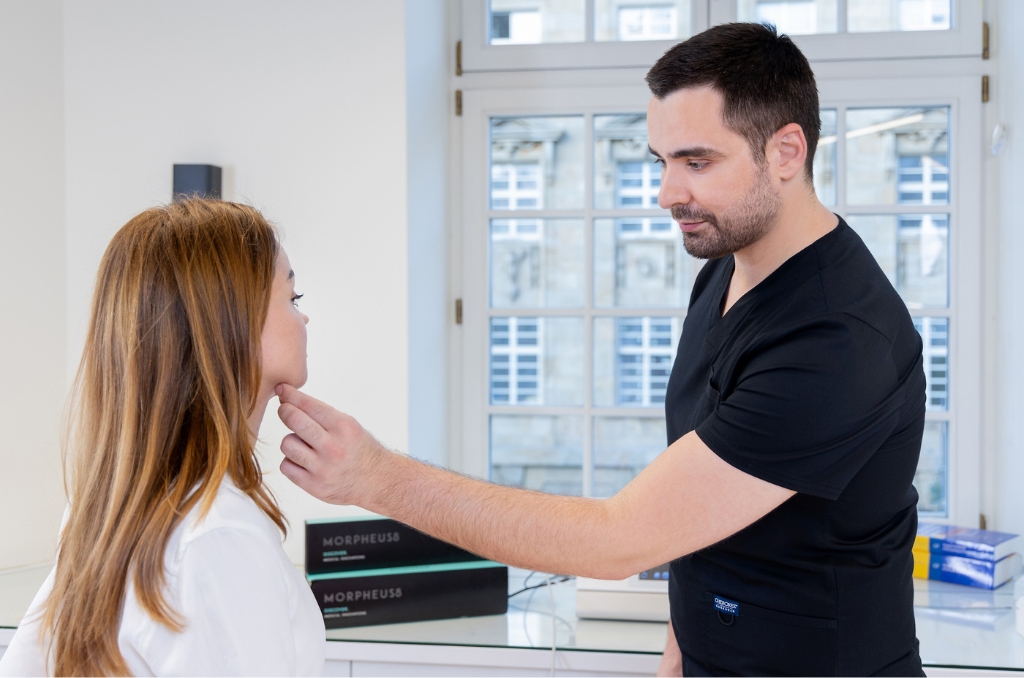
Laxity of the lower third of the face and jawline
The lower third of the face is the first to reveal a loss of support. The jawline becomes softer, tissue gathers along its edge, and the boundary between the face and neck loses definition.
Lenisna is injected here along the jawline and in the area that supports it, where it gradually restores tissue density and thereby contour definition. The result is subtle and does not change the shape of the face — it simply restores the sharpness it had before. If you are interested in how this area is treated with other methods, we have written in detail about the options for this area.
Sunken cheeks
Volume loss in the middle third of the face is rarely noticed as such. More often it is experienced as fatigue that does not go away — the eyes appear more sunken, the face smaller, and the shadows more pronounced.
In this area, Lenisna works gradually. The hyaluronic component restores some fullness immediately, and over the coming months new collagen takes over the supporting role. Unlike fillers, the fullness does not appear suddenly, so there is no phase where the face appears overfilled.
Nasolabial folds and marionette lines
These folds form when the tissue loses support and begins to sag. Because of this, simply filling the fold itself often fails to give a natural result — the problem lies beneath it, not in it.
Lenisna takes a different approach: it restores tissue density, so the fold softens on its own. For more pronounced changes, it is combined with fillers, where each of them does its own part of the job — as we have also shown in one of our case studies.
Neck
The skin on the neck is thinner and has less supporting tissue, so sagging appears there earlier than on the face.
Lenisna is used on the neck with a tailored protocol, using smaller amounts and a shallower technique than on the face. The aim is not volume, but firmer tissue and less visible horizontal creases.
Skin that has lost its density
There are individuals who have no pronounced wrinkles or striking volume loss, and yet something is missing. The skin looks thin, weakened and lax.
That is one of the most rewarding indications for Lenisna, because it does not ask for a change — it asks for a return of density.
Which areas is Lenisna not suitable for?
It is equally important to say where it is not used.
The area around the eyes and the tear trough are not suitable for Lenisna. The skin there is the thinnest on the face, there is practically no supporting tissue, and larger particles under such conditions can be distributed unevenly and create visible bumps. For this area, what is used is a finer formulation of the same technology.
This also applies to the lips and the nose area, as well as the delicate skin of the décolletage, where milder products are chosen. The decision on what goes into which area is made during the consultation and, with this type of treatment, it is more important than the choice of the product itself.
When is Lenisna recommended?
When it comes to biostimulation, a simple rule applies: the greater the tissue's own capacity to respond, the better the result. That is why Lenisna yields the best results when the first signs of lost support are visible and changes are still in their early stages—rather than when a point has been reached where surgery is being considered.
Signs worth recognising:
- The jawline is no longer as defined as it was in photographs from a few years ago.
- the cheeks look hollow and the face smaller than before
- nasolabial folds are visible even when the face is at rest
- tissue gathers along the jawline, so the border towards the neck fades
- the face looks drooping in photographs, although it doesn't look like that in the mirror
- the skin has become thin and soft, without the firmness that held its shape
Lenisna is a good choice if:
- you want a natural lifting effect, with no prolonged recovery time
- you do not want the “overfilled” look that sometimes accompanies fillers
- you are looking for a result that lasts for more than a year
- You are over forty and have noticed a loss of support, not just wrinkles
- you have had fillers before, but want firmness rather than extra volume
What the treatment looks like at Imedic poliklinika
Consultation
The consultation is more important for this treatment than for most others. The doctor assesses exactly where the support has given way, how much tissue there is in individual areas and whether Lenisna is even the appropriate product for what is bothering you — or whether a better option exists among the groups of biostimulatory treatments.
Only after that is the plan determined: which areas, how much product and how many sessions.
Preparation and technique
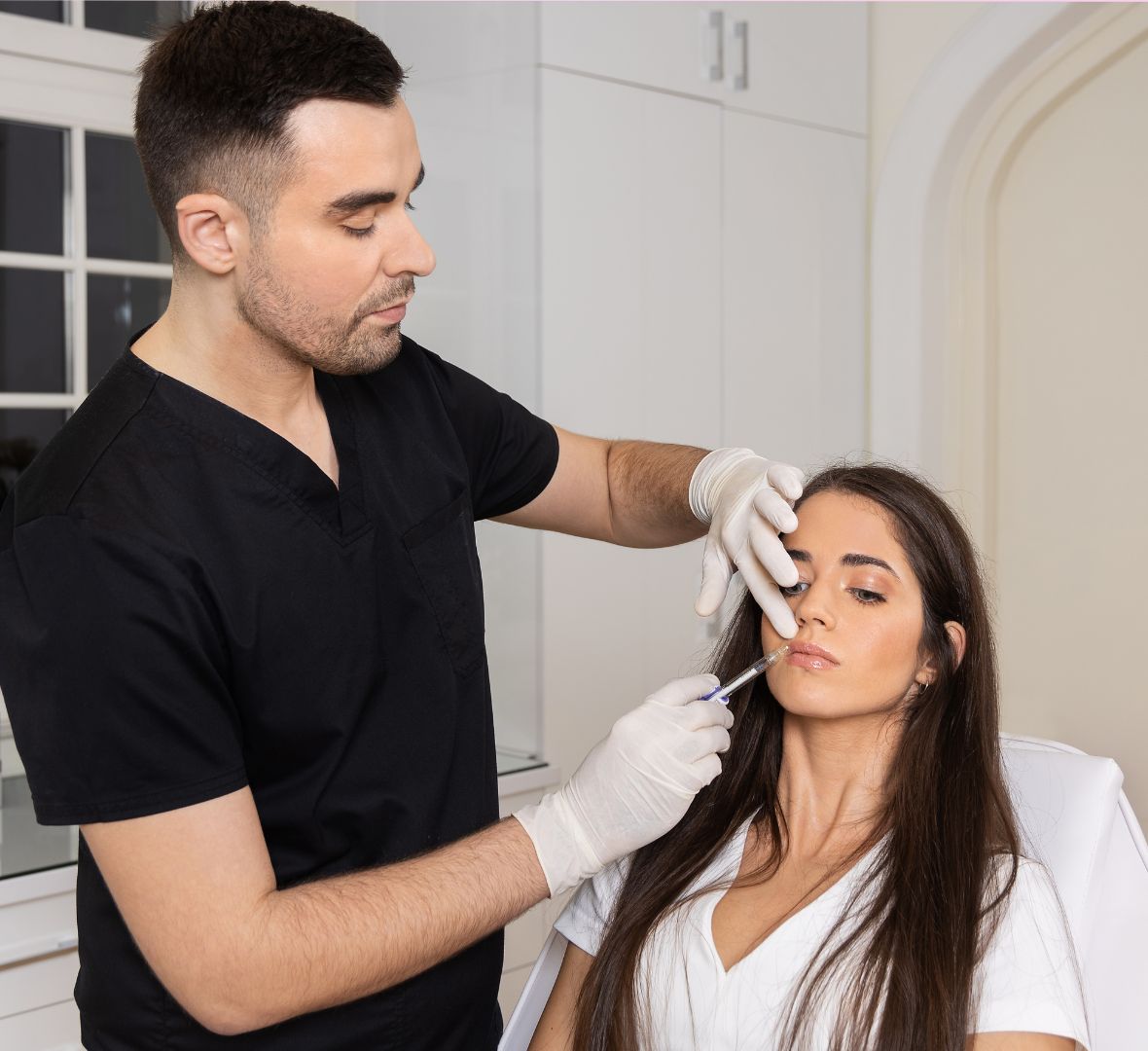
Anaesthetic cream is applied before the treatment. Lenisna is injected with a cannula – a blunt-tipped instrument that moves through the tissue much more gently than a needle, reducing the possibility of bruising and allowing the product to be distributed evenly across a larger area. Treating one area takes about 30 to 45 minutes, including preparation.
How many sessions and at what intervals?
The standard protocol is three sessions spaced eight weeks apart. The interval is longer than with Juvelook and this is not arbitrary — a larger particle breaks down more slowly, so the tissue also needs more time to build collagen before a new amount is added.
The number of sessions is tailored to the individual. For milder changes, two are sufficient, while for more pronounced loss of support, sometimes four are needed. Following the completed cycle, a maintenance session every two years preserves the achieved results.
Recovery
Recovery is short. On the first day, mild redness, swelling and tenderness to the touch are possible, which subside within a day or two. Bruising is possible, but with the use of a cannula it is rare.
For the first 48 hours, avoid saunas, sunbeds, intense workouts and pressure on the treated area. Makeup can be applied as early as the next day.
Massage is not required. With poly-L-lactic acid-based products, the patient massages the treated area themselves for days to distribute the particles — with Lenisna, the particle shape and cannula technique take care of that.
When will the results be visible?
The first effect is visible immediately. The hyaluronic component restores some of the fullness and contour, so the face already looks more rested as soon as you leave the clinic. That effect is pleasant, but temporary — it fades over a few weeks, and that is normal.
Real results are built in the background. The first actual changes in tissue density are noticed after four to six weeks, and the full effect usually three to four months after the final session, once the new collagen has formed and matured.
In most patients, the achieved result is maintained for between 18 and 24 months.
We recommend planning your injectable treatment at least two weeks before an important event. If a series of treatments is required, the plan should start earlier to allow enough time for the full effect to develop.

Updated: