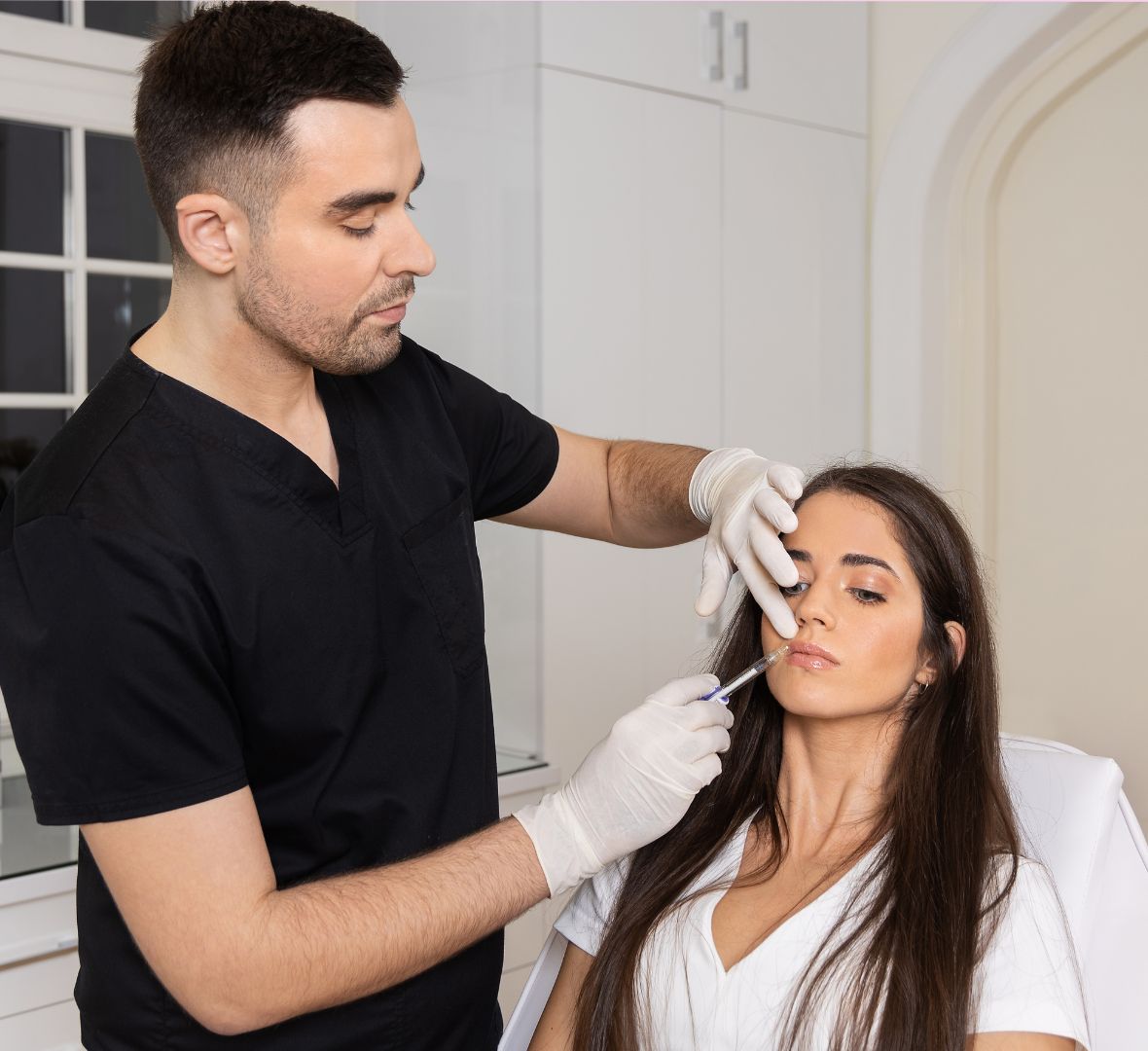
Case report: facial contouring with fillers in a female patient in her mid-thirties. Tear troughs, middle and lower thirds of the face, HArmonyCa for lifting.

She asked for it not to be noticed.
And that was the most accurate description of what we needed to do.
A patient in her mid-thirties came in for a consultation with a sentence we hear almost every day: I feel like I look tired, even when I'm not. No specific request, no photo on her phone, no desire to change her facial features. Just the feeling that something in her expression no longer matches how she actually feels.
When we look for the cause of this impression during the examination, we rarely find it in wrinkles. We find it in how the face catches the light — where shadows have appeared that were not there before and where the contour has ceased to be clear.
In this case study, we take you through the entire plan: what we saw during the examination, the order in which we performed facial contouring with fillers, and why in one area we deliberately avoided filler and opted for the HArmonyCa collagen stimulator.
What did we find during the examination?
The face rarely looks tired because of wrinkles. Much more often it is because the support beneath the skin has weakened — and that is what we look for during the examination.
Middle third of the face — the place where it all begins
The fat pads of the mid-face lose volume over time and change position — moving downwards and backwards. No hollow forms that you can see with the naked eye. Something more elusive happens: the cheekbone area stops to be the brightest point of the face.
That is why people in their thirties often say that “something is off in photos”, without being able to point out what. The light simply no longer stops where it used to.
Under the eyes — a shadow sleep cannot fix
When the middle third loses support, the transition between the lower eyelid and the cheek becomes sharper. A shadow is formed, which we all call dark circles under the eyes. Read more about the various causes and treatment options on our page about Dark Circles and Under-Eye Treatment.
In this patient, the shadow was not pigment. It was a hollow with a clearly defined tear trough — and no cream, no concealer and no amount of sleep can change that, because the problem isn't the skin colour but the topography beneath it.
Jawline — a receding contour
The jawline was still present, but it was no longer sharp along its entire length. Towards the angle of the jaw, it was beginning to blend into the neck.
And there we identified the most important thing for the whole plan: slight tissue laxity in the lateral part of the face, in front of the ear. In anatomy, this zone is called the periauricular region — the area surrounding the ear and connecting the side of the face to the jawline.
It sounds like a secondary spot, but it isn't. This is where the points to which the facial tissue is most firmly anchored are located, and it is here that it is decided whether the cheek and jawline will stay in place or continue to sag. When this lateral support gives way, filling the mid-face does not help — the mid-face becomes fuller, while the lower third continues to drop.
That is why in planning we always work from the periphery towards the centre. First we secure what holds, and only then do we fill in what is missing.
The conclusion of the assessment was clear: her face did not need more volume. It needed its structural support to be restored — starting sequentially from the lateral points.

Why a combination, rather than a single treatment?
The logical question arises: if support is needed, why not just sort everything out with filler?
Because a filler and a collagen stimulator do two different jobs.
Hyaluronic acid filler is a gel that adds volume. Placed in a precise location and exact layer, it immediately restores support and alters the contour. You see the result as soon as you get out of the chair. That is what we needed in the mid-face, the under-eye area and along the jawline — places where the change was measurable and where we knew exactly how much was lacking. For those areas, we used Juvéderm fillers, choosing different densities depending on the placement depth.
HArmonyCa works differently. It is a hybrid preparation: it contains hyaluronic acid, which provides immediate support, and calcium hydroxylapatite particles, which activate fibroblasts and trigger the production of the body's own collagen. That second mechanism is not immediately visible — it develops over the following months.
In the periauricular region, we didn't need volume. We needed tissue firmness. A filler there would have added weight to an area that is already sagging, whereas a collagen stimulator does the opposite — it strengthens the very structure that holds that tissue together.
Hence the name of the protocol we use — Lift-Up. A filler restores what was lost, a collagen stimulator strengthens what remains.
Step-by-step treatment plan
The order is not arbitrary. Each area changes the appearance of the adjacent one, so the next step is only evaluated once the previous one is completed.
1. Middle third of the face — support above all else
We started from the cheek area, specifically from the lateral part, not the centre. We placed the filler deep, against the bone, at the points that provide the most support with the smallest amount of product.
The effect was immediately visible even in areas we hadn't touched. When the middle third is lifted, the transition to the lower eyelid becomes smoother on its own.
2. Under-eye area — only then, and minimally
This is the most sensitive point of the whole plan and the region where people most often overdo it.
That is why we never treat the under-eye area first. Once the middle third was supported, we reassessed the shadow — and what remained was significantly less than at the beginning. We placed a very small amount of filler, deeply, using a cannula, exclusively in the tear trough area.
The rule we follow: in this area, it is better to leave something undone than to add too much. Too much shows here much sooner than too little.
3. Jawline — definition of the lower third
Along the jawline, we placed a denser filler with the aim of restoring the sharpness of the contour where it had begun to blend into the neck. We worked symmetrically, following the natural shape of the jaw without altering its proportions.
4. Periauricular region — HArmonyCa
The final step, and the one that takes the longest.
We placed HArmonyCa in the side of the face, in front of the ear, in the deep subcutaneous layer. The goal was not to add volume, but to strengthen support in the zone that holds the cheek and jawline.
This part of the result was not visible at the two-week follow-up. It builds up over months as new collagen is created.
The entire treatment lasted around 60 minutes, with topical anaesthetic cream. The patient resumed her normal activities the very next day.
Result: what was seen immediately and what later?
Immediately after the treatment
The change in the middle third of the face was visible immediately. The cheekbone area once again became the brightest point of the face, and the shadow under the eyes noticeably receded — to a large extent even before we touched that region at all.
There was mild swelling and individual puncture marks, which is expected and resolves within a few days.
After two weeks
This is the moment when the result is truly assessed. The swelling has subsided, the filler has integrated into the tissue, and the contours have settled. The “after” photo was taken at this follow-up visit.
The jawline was once again clearly separated from the neck, and the shadow beneath the eyes reduced to a degree that no longer read as fatigue. The expression remained unchanged — not a single feature shifted, nothing gained more volume than it had before.
The face looks refreshed, and yet it is still the same face. And that was exactly the goal.
What do we expect over the next three months?
The part of the result that is not yet visible in this photo.
HArmonyCa in the periauricular region is only just starting to stimulate the body's own collagen production — a process that unfolds gradually over the coming months. We expect the skin on the side of the face to become firmer, and the support holding the cheek and jawline to become more stable.
This is exactly why a result like this looks natural: change doesn't happen overnight, so there is no moment when people “notice something has been done”. The patient is due back for a follow-up visit in three months, when we will assess how far that process has progressed.
How long does the result last?
The duration varies by region and by the type of product. Hyaluronic acid fillers in the mid-face and along the jawline last the longest — usually between 12 and 18 months. The reason is that they are placed deeply, against the bone, where tissue mobility is lower, so the product breaks down more slowly.
The area beneath the eyes is an exception. Very small quantities are used there, and the result is evaluated sooner, as the effect itself is more subtle.
HArmonyCa works on a different principle. The hyaluronic acid part breaks down within a few months, but the collagen that has been created in the meantime remains even after that. That is why the effect in the periauricular region is not lost suddenly — it fades gradually, over a period that is most commonly measured in years.
The duration is affected by metabolism, sun exposure, smoking, and general skin condition. These are differences that can be seen in practice and are why we avoid promising an exact number of months.

Is this kind of plan the right choice for you?
This protocol is not a universal solution. It worked for this female patient because certain circumstances aligned.
This approach makes sense when:
- The face looks tired, and there are no pronounced wrinkles to explain it
- A shadow under the eyes is present in the morning, after a good night's sleep
- The jawline is receding, but the skin is not yet significantly sagging
- The goal is for the result to be imperceptible to others
- There is a willingness to wait months for part of the effect, instead of everything being finished on the same day
This approach is not the first choice when:
- There is pronounced skin laxity, where support is no longer sufficient and other treatments are being considered
- Dark under-eye circles stem from pigmentation rather than hollows — in that case, a filler will not change the skin colour
- A visible change in facial features is expected, as this protocol intentionally does the opposite
- A larger amount of filler has previously been injected into the same areas and has not yet broken down.
What cannot be assessed from a photo is tissue depth, skin quality and the arrangement of support. This is why every plan is created only after an examination, and why two faces that look similar on the outside often receive a completely different protocol.
If you recognise the described condition, book a consultation — during the examination, we determine the cause of the tired appearance and whether this plan is applicable in your case.
You can view more results in our gallery, and a similar case focusing on cheekbones and chin is described in a separate article.

Updated: