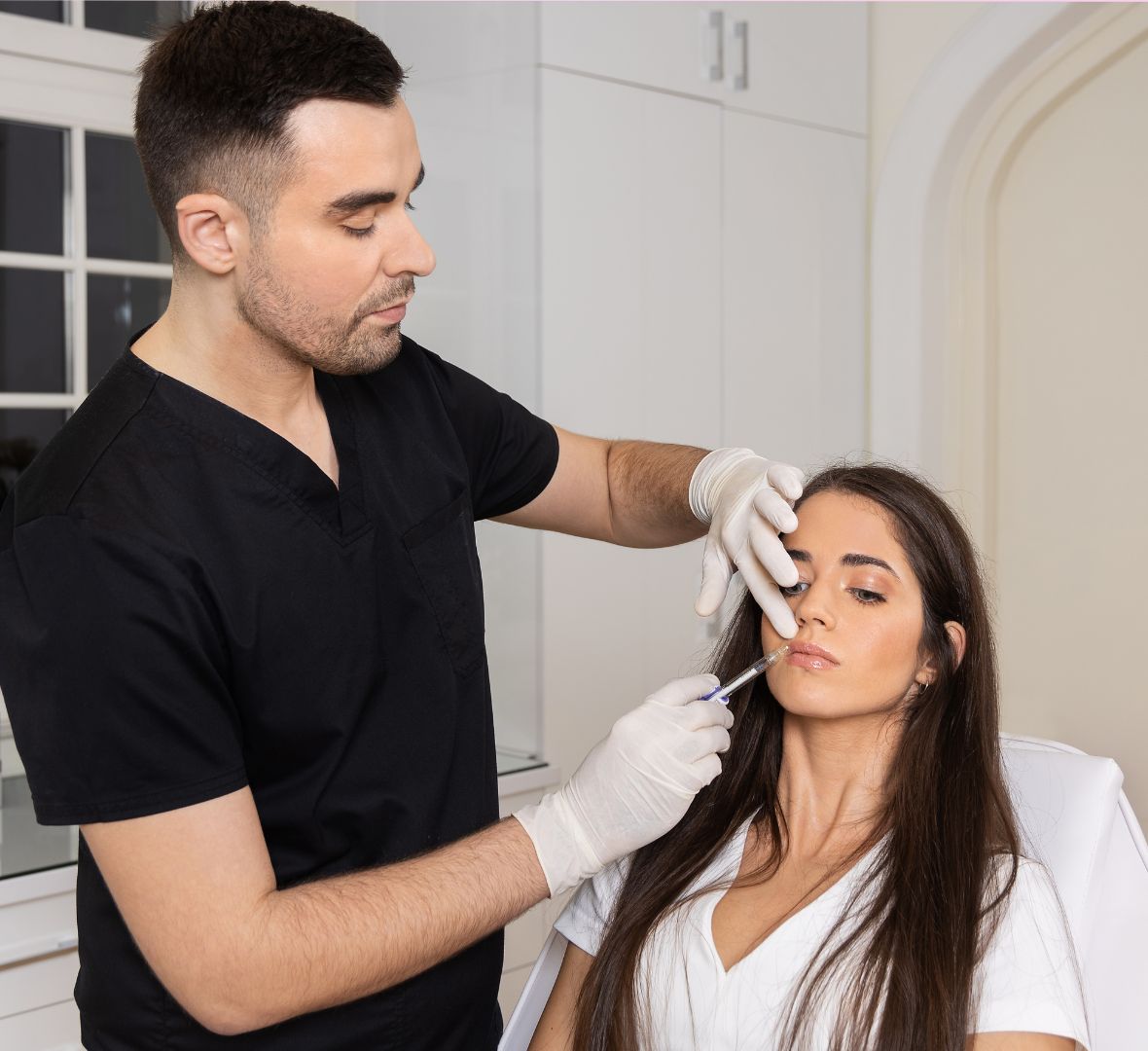
One of our patients, well-groomed, active and cheerful, came to us with a wish we often hear – for her face to look the way she still feels inside. There was no talk of major changes, nor of dissatisfaction with her own appearance. It was more about the fact that she had noticed her features and contours had become less defined, and that …

One of our patients, well-groomed, active and cheerful, came to us with a wish we often hear – for her face to look the way she still feels inside. There was no mention of major changes, nor of dissatisfaction with her own appearance. It was more about having noticed that her features and contours had become less defined, and that looking in the mirror more and more often left her with the impression of slight exhaustion – even though she did not feel that way.
“I wouldn't change anything, I'd just love to look more rested and rejuvenated,” she said during the consultation. She was clear about her wishes – she was not looking for drastic effects, but for the effortless freshness she used to have. Precisely for this reason, we opted for a treatment that would discreetly refresh her features – without altering her expression, without unnatural contours, without overdoing it. The focus was on two areas where signs of ageing become etched and affect the overall appearance of the face: the cheekbones and the chin.
Cheekbones and chin: areas that change the whole expression
When we talk about hyaluronic acid filler treatment, one often thinks first of the lips or nasolabial folds. In practice, however, the most visible effects when it comes to rejuvenation are in completely different areas — the middle and lower thirds of the face.
Volume loss in the apples of the cheeks, even if mild, immediately creates the impression of a tired look. The face appears “flat” and slack. The cheekbones are the part that naturally provides support to the midface, and when this support weakens, the entire visual balance changes too. The chin, on the other hand, is often neglected when planning treatments. Yet it actually plays a key role in the proportions of the lower third of the face. When it loses its definition over time, the entire jawline appears softer and the face becomes less defined, particularly in profile.
Precisely for this reason, for this patient, we decided that the treatment should include both the cheekbones and the chin. Not because “something was lacking” there, but because these are the areas where the first mild changes had already affected the overall facial expression. The goal was not to accentuate those areas, but to bring them back into balance with the rest of the face.
When filler rejuvenation is used this way — in small amounts, in the right places — the result doesn't look “done”. It looks rested, familiar and most often provokes that reaction we all want to hear:
“Something is different – but I don't know what.”
Consultation and treatment planning
Based on an assessment of the face in motion and at rest, we focused primarily on the mid and lower face. The cheekbones had lost definition, which gave a tired appearance. The lower jawline was softer than before, and the chin was recessed just enough to disrupt the proportions in profile. The aim was to restore everything to its place without altering what is authentic. We devised a plan so the face would regain the structure it once had, but without the effect of anything having been added. When everything remains within familiar bounds, the result is not perceived as an intervention, but as a rested expression.
Cheek treatment
In this patient, the midface was key to her overall expression. There was no pronounced sagging, but the volume that was previously there had disappeared. Because of this, the face took on a mild yet persistent impression of tiredness. The first phase of the treatment involved carefully restoring that volume in the cheekbones. Not to “accentuate” them, but to restore support to the midface. When this is done precisely, it does not create an overfilled look – it restores freshness.
Chin treatment
In most patients after forty, the lower part of the face begins to lose its structure — not just due to skin changes, but because bone resorption and loss of subcutaneous tissue occur. This affects both the length and projection of the chin, making the face rounder, softer, and without a clear contour. For our patient, we opted for a gentle lengthening and contouring of the chin. Not to change its shape, but to restore what was there before and has been lost over time. A lengthened chin restores proportion to the lower third of the face, and the jawline becomes clearer, especially in profile.
What does a treatment like this actually change?
When the face loses its structure, makeup no longer helps. You can add blusher or contour, but if there is no structure to support them, the effect is temporary. This type of treatment restores volume where it has vanished and support where it has weakened. The cheekbones don't stand out, but when they are not there, everything looks droopy. You don't notice the chin until it is no longer there.
The aim is not to look different, but for your face to have clearer contours once more, such that you do not have to think about what lighting you are being photographed under.
After treatment
In the before photo, the face looked flatter – features softer, the midface sagging, the chin short, the jawline without definition. Following the treatment, everything gained more expression: the cheekbones have regained their structure, the jawline its definition, and the lips have been discreetly filled to round off the lower part of the face. The character of the face has not been changed – only what already made sense has been enhanced. By adding subtle volume to the lips, the face also gained a note of attractiveness, as well as a better balance in relation to the rest of the contours. Nothing changes in the expression – but the face leaves a different impression: cleaner, more harmonious and more confident.

A fine result is one you would wish for yourself
A good result in aesthetic medicine does not draw attention. It does not leave the impression that something has been “done”. It just looks better. This is often only noticed when you see someone and think “they look great”, without knowing why. This treatment is precisely like that. It does not change your facial structure, it does not fish for compliments, there is no “new face”. It simply brings back what was already there, but has been weakened or lost over time. When a treatment is well done, it is hard to say what has changed, but you can see that the face looks better.
These are the results that make women stop asking “where did you have that done?” and instead quietly think:
“Maybe it's time I did something too.”
How do I book an appointment?
With a good plan and precise application, fillers can restore what time has taken away – clean contours, more defined features and a face that looks younger, yet still completely your own. This treatment does not change your expression. It merely softens the signs of tiredness and ageing right where they first appeared. If you think this kind of approach might suit you too, call us on 064/237-0707 and book a consultation.
More before and after examples and an explanation of the treatment can be found on our page about hyaluronic fillers.
Related topics

Updated: