PRP hair treatment
PRP hair treatment – in brief
| What it treats | Hair loss and thinning, as long as the follicles are not permanently atrophied |
|---|---|
| Method | Plasma from the patient's own blood |
| Anaesthesia | Anaesthetic cream, if needed |
| Duration of treatment | 30 to 40 minutes |
| Number of treatments | Usually 3 to 4 treatments once a month, then maintenance every 3 to 6 months |
| Result | Less hair loss after 1 to 3 months, thicker hair after 3 to 6 months |
| Recovery | Brief; possible mild scalp sensitivity or redness |
What is PRP hair treatment?
PRP hair therapy
First step: examination and trichoscopy
Before deciding on PRP treatment, the cause of hair loss is determined. A doctor examines the scalp and hair using a trichoscope, a device that magnifies the follicles and hair shafts. If necessary, they also request blood tests, for example iron, thyroid function and hormone levels.
If the cause is an iron deficiency or a thyroid disorder, that is treated first. Read more about the examination on our page about trichoscopy.
Why does hair fall out?
Hair loss is a natural process and losing a certain number of hairs every day is considered normal. The problem arises when hair loss becomes more intense or when visible thinning is noticed.
The most common cause in men and women is androgenetic alopecia, meaning increased sensitivity of the follicles to hormones. The hair then gradually becomes thinner, shorter and weaker, especially in the frontal and temporal areas. The causes of hair loss can also be stress, hormonal imbalance, nutritional deficiencies or certain systemic diseases, which is why an expert assessment is necessary before treatment.
How does PRP hair treatment work?
Who is a candidate for PRP hair treatment?
PRP hair treatment is intended for people with early and moderate stages of hair thinning, whose follicles are still preserved. The therapy is used for diffuse hair loss, early androgenetic alopecia, and weakened, thinner hair strands. It is also used for increased hair loss after stress, illness, or hormonal changes (telogen effluvium), while in cases of alopecia areata, the decision to use it is made by a dermatologist after an examination.
It can also be used as a supplementary procedure following hair transplantation, with the aim of supporting regeneration and preserving the transplanted hairs. In advanced stages of hair loss, when the follicles are permanently atrophied, PRP has no significant effect.
What does PRP hair treatment look like?
PRP treatment begins with a consultation and examination, during which we assess the condition of the scalp and the degree of hair thinning. Based on this, a treatment plan and an approximate number of sessions are defined.
Next, a small amount of blood is taken, as for a routine blood test. The blood is processed in a centrifuge to isolate platelet-rich plasma, which is then injected via micro-injections into the areas where the hair is weakened or thinning.
The procedure itself takes about 30 to 40 minutes. After the treatment, mild sensitivity or redness of the scalp may occur, which subsides shortly.
How many treatments are needed?
The number of treatments depends on the cause of hair loss and the condition of the follicles. The initial series is usually three to four treatments, once a month.
Maintenance sessions then follow every three to six months, depending on how the hair responds.
Benefits of PRP hair treatment
Hair growth phases and a realistic timeframe for results
Every hair goes through a growth phase, which lasts for several years, and a resting phase of about three to four months, after which it falls out. In healthy hair, about 85% of hairs are in the growth phase.
PRP works by prolonging the growth phase and strengthening weakened follicles. That is why change takes time:
- After 1 to 3 months: hair loss usually decreases.
- After 3 to 6 months: hair looks thicker and stronger.
- After 6 to 12 months: the doctor assesses the overall effect, comparing photographs and trichoscopy findings.
What treatment success depends on
- Hair loss phase: PRP works on preserved follicles, so the effect is better when started early.
- Cause of hair loss: the most data exists for androgenetic alopecia.
- Plasma quality: platelet concentration and the method of extraction are important.
- Technique: plasma is evenly injected into the scalp skin, at the depth where the follicles are located.
- Regularity: initial series and maintenance. Without maintenance, the effect gradually fades.
- Combination with therapy: in hormone-related hair loss, PRP does not replace the therapy prescribed by a dermatologist, but complements it.
PRP after hair transplant
PRP is also used alongside hair transplantation: during the procedure or in the months following it. In a randomised study, transplanted hairs in patients treated with PRP grew faster and shed less than in patients without PRP. The study was small, so these data are considered promising.
The timing and number of treatments after the transplant are agreed with your doctor, in line with the surgeon's instructions.
Preparation and aftercare
Before treatment:
- A few days beforehand, tell your doctor which medicines and supplements you are taking, especially those that affect blood clotting. Do not stop your treatment without consulting your doctor.
- Do not drink alcohol the day before.
- On the day of the treatment, have breakfast and drink enough water, as blood will be taken.
- Arrive with clean hair, free of gel, hairspray and other products.
After treatment:
- Do not wash your hair for 24 hours.
- Postpone colouring and chemical treatments for a few days, until the scalp settles down.
- For the first two days, avoid the sauna, swimming pool, intense workouts, and direct sunlight on your scalp.
- Do not rub or massage your scalp on the first day.
- Resume your at-home hair treatment as instructed by your doctor, usually after a few days.
We recommend planning your injectable treatment at least two weeks before an important event. If a series of treatments is required, the plan should start earlier to allow enough time for the full effect to develop.
PRP or hair mesotherapy?
Both methods are used for hair loss and thinning, but they differ in what is introduced and how they work.
| PRP hair treatment | Hair mesotherapy | |
|---|---|---|
| What is injected | platelet-rich plasma, from your blood | ready-made preparation: vitamins, amino acids, peptides and other ingredients |
| How it works | platelet-derived growth factors stimulate follicles and prolong the growth phase | ingredients support follicle nourishment and the scalp |
| Initial plan | 3 to 4 treatments, once a month | 6 to 10 treatments, every 7 to 14 days |
| Maintenance | every 3 to 6 months | 1 to 2 treatments a year |
| Blood draw | Yes | No |
| When is it most commonly chosen | early and moderate-stage androgenetic alopecia, increased hair shedding | weak, thin hair and increased hair loss, when a doctor considers it sufficient |
These two methods have not been compared with each other in large randomised studies. The outcome depends on the cause of the hair loss and on the specific preparation or plasma separation system.
That is why the doctor chooses the method after an examination, and sometimes the two are combined. Read more about the other method on our page about hair mesotherapy.
PRP hair treatment before and after
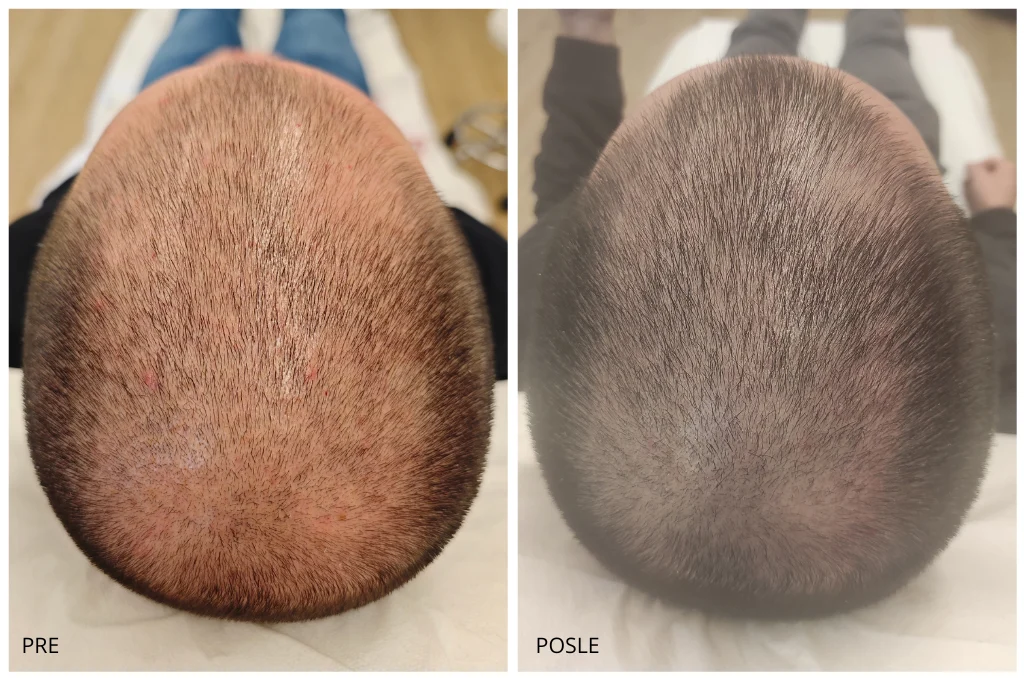
The hair thickens gradually as the follicles recover. The photographs show the crown before and after PRP treatment: the thinning is less noticeable, and the hair appears thicker.
Treatment plan
Usually 3 to 4 treatments, once a month
Less hair loss
After 1 to 3 months
Thicker hair
After 3 to 6 months
PRP hair treatment price
The price of PRP hair therapy depends on the degree of thinning, the number of treatments required and the individual treatment plan. With regenerative procedures, the number of sessions and the interval between them are determined after an examination and assessment of the scalp condition.
Current prices for PRP hair therapy are available in our Price list, where all treatment options are listed. The final recommendation and therapy plan are defined by a doctor after a professional assessment.
Have a question?
Answers to frequently asked questions
Is PRP treatment painful?
Most patients describe the treatment as tolerable. Before application, an anaesthetic cream can be applied if necessary to keep discomfort to a minimum. Given that autologous plasma is used, the body generally tolerates the therapy well.
A feeling of mild tension or sensitivity of the scalp may last briefly after the treatment, but patients most commonly return to their daily activities immediately.
Does PRP hair therapy really work?
PRP therapy can be effective for people with preserved, but weakened hair follicles. It works by stimulating microcirculation and prolonging the hair growth phase, but the results depend on the cause of hair loss and the stage of the problem.
In multiple randomised studies and meta-analyses, PRP increased hair density and thickness in androgenetic alopecia compared to placebo. The effect varies from person to person and depends on the method of plasma preparation.
When are the results of a PRP hair treatment visible?
A reduction in hair loss is usually seen within the first three months, and the change in density over three to six months. The maintenance plan is agreed upon according to the hair's response.
How long does the effect of PRP hair therapy last?
The effect is maintained with an initial series of treatments and occasional maintenance therapy. Without maintenance, the effect may gradually weaken, especially in hormonally induced hair loss.
Can PRP restore hair to completely bald areas?
No. PRP does not create new hair follicles. The therapy can only act on follicles that are still present, but weakened.
Can PRP therapy be combined with other treatments?
Yes, PRP can be combined with other hair loss treatments, subject to a doctor's assessment. It is often used as a supplementary method alongside medical therapy or following hair transplantation.
Is there any recovery time after a PRP hair treatment?
Following the treatment, mild scalp sensitivity or slight redness may occur, which subsides shortly. Most patients resume their daily activities the same day.
Contraindications
Book a PRP hair treatment in Belgrade
Imedic poliklinika is located at Kneza Miloša 23, 2nd floor, Belgrade. Opening hours: Monday–Sunday, 9:00–21:00.
Appointments can be booked by phone: 064 237 0707. If you contact us from abroad, we are also available via Viber and WhatsApp on the same number.
Related topics

Author: Dr Ivica Jeremić
PhD in Medical Sciences (Molecular Medicine and Immunology), rheumatology subspecialist, dermatology resident.
Updated:
Expert sources
- Meta-analysis of randomised trials of PRP in androgenetic alopecia, 2023
- Donnelly i saradnici, 2024 — sistematski pregled PRP-a kod muškaraca sa androgenetskom alopecijom
- Stevens i Khetarpal, 2019 — pregled literature i predlog protokola PRP-a kod androgenetske alopecije
- Garg, 2016 — randomizovana studija PRP-a tokom transplantacije kose
- Stefanis i saradnici, 2024 — PRP i mezoterapija kod androgenetske alopecije
- Aristizabal i saradnici, 2024 — strukturisan pristup PRP terapiji kose
- Hughes i saradnici — telogeni efluvijum i ciklus rasta kose (StatPearls)


