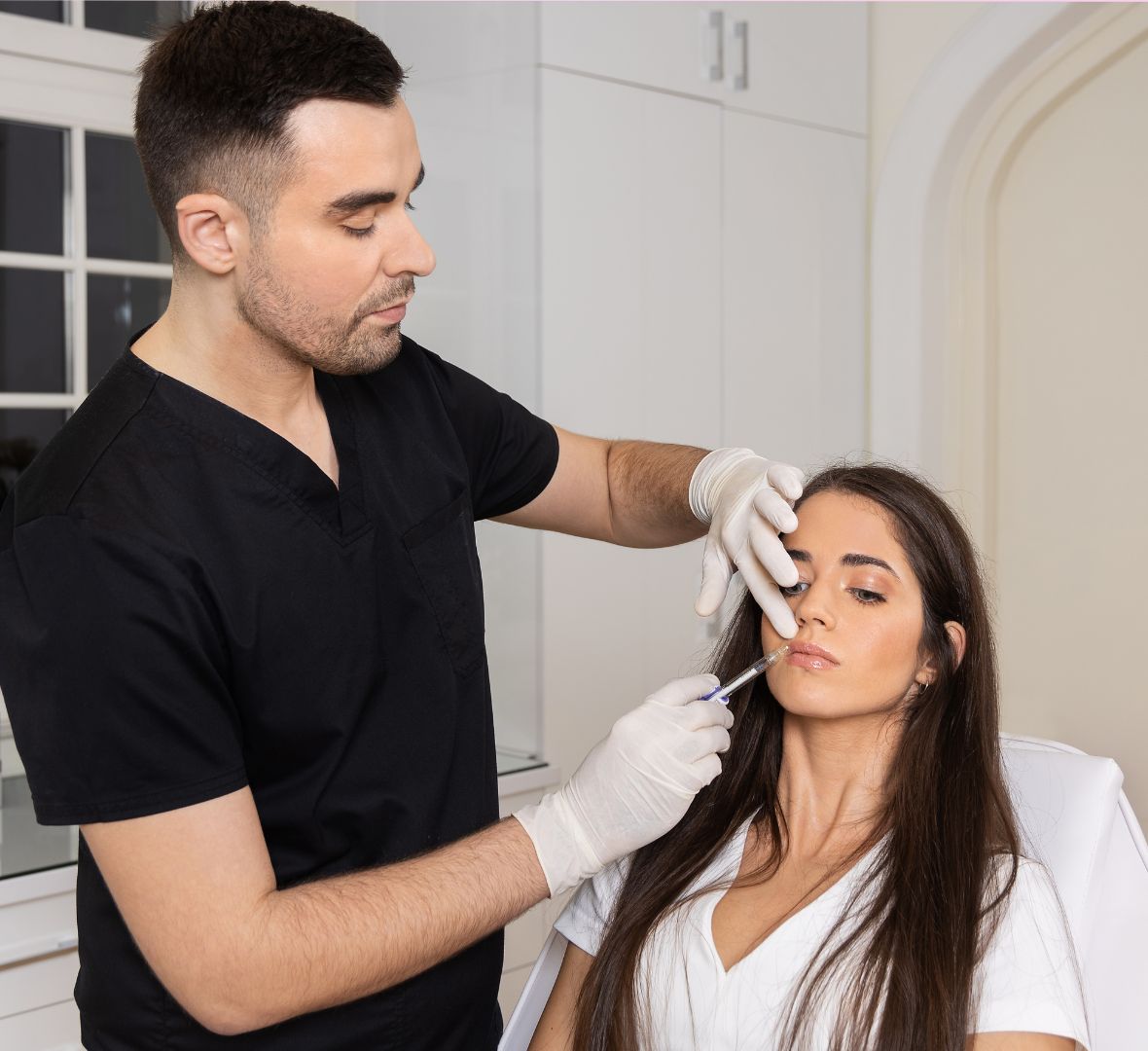
Male pattern baldness, also known as androgenetic alopecia, affects as many as two-thirds of men and is also the most common form of hair loss. It first manifests as receding temples, and then hair loss occurs on the crown, with the hair not growing back. Treatment can slow down the hair loss and improve hair density, especially when started early. With the therapy that …

Male pattern baldness, or so-called androgenetic alopecia, affects as many as two-thirds of men and is at the same time the most common form of hair loss. It first manifests as a receding hairline, followed by hair loss on the crown, with the hair not growing back. Treatment can slow down hair loss and improve hair density, especially when started early. Along with therapy prescribed by a dermatologist, PRP treatment and hair mesotherapy are also used.
Everyone, regardless of whether they are a woman or a man, loves to have healthy, well-kept, and voluminous hair. It gives us confidence and makes us feel better in our own skin. However, due to various internal and external factors, hair loss often increases, the hair thinsand ultimately, unfortunately, baldness sets in.
There are different types of baldness, or alopecia, such as alopecia areata, traumatic or telogen, as well as androgenetic – the most common form of baldness in both men and women. In this article, we focus on that form in men.
What is male pattern baldness?
Baldness can occur in men at all ages and, according to some statistics, affects more than 50 per cent of the male population over the age of 40. Nevertheless, most men begin to notice the early stages of hair loss in their thirties, although it can start as early as the late teens or early twenties. In other men, hair loss begins to occur in middle or later life, and the rate of thinning varies from person to person. For many men, baldness often has a psychological and emotional impact and affects their quality of life.
It begins with a gradual loss of hair, and the first signs are thinning along the hairline and receding at the temples, then the hair falls out at the crown and finally it can lead to complete hair loss. That is why it is extremely important to react at the very earliest stage, because that way the treatment of baldness itself will be more effective.
Causes of male pattern baldness
The influence of hormones, genetic predisposition, and also age, are the most common causes of such frequent baldness in men.
- Genetics can play an important role in the onset of male pattern baldness. You are more likely to be affected at some point in your life if there is a family history of this condition. According to some theories, if your father is bald, you are twice as likely to experience male pattern baldness yourself;
- Dihydrotestosterone (DHT) is the hormone that has the greatest impact on regulating hair growth, and consequently on the hair loss process itself, in individuals with a genetic predisposition to baldness. This hormone is produced from testosterone and is five times stronger than testosterone itself. When it comes into contact with hair follicles on the head and binds to receptors, the follicles shrink. This causes hair growth to slow down or stop completely, thereby leading to the onset of baldness. In other words, DHT shortens the anagen phase of hair growth, the follicles shrink and eventually disappear, and individual hairs become progressively thinner and shorter, a process also known as miniaturisation. The greatest sensitivity to DHT is in the parietal and frontal regions, as well as at the crown of the scalp;
- Age can be a factor that leads to the onset of baldness, and there are periods in life when hair falls out more slowly or more quickly, as well as more stable periods. Most commonly, with age, the overall volume of hair decreases.
Seven stages of male pattern baldness
The Norwood-Hamilton scale is a generally accepted classification for determining the stage of male pattern baldness, with seven stages. The scale helps doctors and patients assess the degree of hair loss, plan treatments—such as medical treatments or hair transplants—and also predict future progression.
| Stage | What can be seen |
|---|---|
| Stage 1 | Little to no hair loss or receding hairline |
| Stage 2 | Mild hair loss in the area between the ears and the forehead (temples) |
| Stage 3 | A deep receding hairline around the temples, the hairline may take on an M or U shape |
| Stage 4 | Very marked receding hairline and hair loss on the crown of the head |
| Stage 5 | A receding hairline merges with a bald patch on the crown |
| Stage 6 | The hair between the temples and the crown is thinning or has completely disappeared |
| Stage 7 | There is no hair on the top of the head, and only a thin fringe of hair remains around the sides of the head. |
PRP and mesotherapy make the most sense in stages 2 to 4, whilst the follicles are preserved.
Diagnosis
It is always best to react in the very earliest stages of the onset of baldness, as it is clear that the success rate of treatment is much higher then. Above all, it is important to consult a dermatologist in order to determine the type of baldness and the treatment options.
After a complete medical history has been taken – whether there are genetic predispositions, when the hair loss started, whether the patient suffers from any illness or is on a particular medication – comes a visual examination of the scalp.
After that, we often perform trichoscopy, a painless and non-invasive diagnostic procedure that uses a dermatoscope to examine the scalp and hair in detail. It allows for the examination of the entire surface of the head, the follicle openings, the appearance and shape of the hair, as well as the visualisation and inspection of blood vessels, the analysis of their structure, margins and colour, and it detects even the smallest changes. Trichoscopy is a significant diagnostic tool in identifying various conditions of the hair and scalp, among which is certainly androgenetic alopecia.
Treatment of male pattern baldness
Once the doctor confirms the diagnosis, meaning that it is indeed androgenetic alopecia, they will also consider various treatment approaches. Treatment most frequently begins with therapy prescribed by a dermatologist: topical preparations that prolong the hair growth phase and medications that reduce the effect of the hormone DHT on the follicles. In advanced stages, hair transplantation is considered.
In our clinic, we offer PRP treatment and hair mesotherapy, with a treatment plan made after the consultation.
PRP treatment for male pattern baldness
During the PRP treatment, platelet-rich plasma is isolated from your blood and introduced into the scalp. Growth factors strengthen weakened follicles, so the effect is best in the early and middle stages of thinning. Read about what the treatment looks like and how many treatments are needed on our page about PRP hair treatment.
Hair mesotherapy for male pattern baldness
With mesotherapy, a cocktail of vitamins, amino acids and other ingredients that support follicle nourishment is introduced into the scalp. It is carried out in a series of treatments, either on its own or alongside PRP. Read more on our page about hair mesotherapy.
Have a question?
Answers to frequently asked questions
Can male pattern baldness be prevented?
The hereditary form cannot be completely prevented, but it can be slowed down. The treatment prescribed by a dermatologist is best started early, and PRP and mesotherapy can be used as a complement.
What is the most common cause of hair loss in men?
The most common causes are hormonal factors, genetics, age and stress, but various scalp infections can also be responsible.
How can you recognise male pattern baldness?
Symptoms of male pattern baldness include thinning or hair loss at the crown and in the temple area, as well as a receding hairline.
When should you visit a doctor for hair loss?
Many do not visit a doctor for male pattern baldness. However, if you want to save your hair, you should contact your doctor as soon as you notice hair loss on the crown.
Why are PRP and hair mesotherapy combined?
PRP treatment is the primary procedure in the treatment of male pattern baldness, while mesotherapy is most commonly a complementary method. They can also be applied independently, and for some patients the doctor plans a combination. While platelet-rich plasma improves the quality of the scalp and activates growth factors, mesotherapy cocktails provide nutrients.
Who are PRP hair treatments and hair mesotherapy not intended for?
Men who have autoimmune or malignant diseases, bacterial infections, coagulation problems or platelet dysfunction are not candidates for these treatments.
Medically reviewed by: Dr Marina Ćirović, dermatologist
Expert sources
IMEDIC NOVOSTI
Be among the first to know about discounts and special offers
Sign up and receive notifications about current promotions, new treatments and useful advice from our doctors.
DISCOUNTS · NEW OFFERS · DOCTOR'S ADVICE
Sign-in is currently unavailable. Please try again in a few moments.
One more step: check your email and click on the confirmation link.
Want to see our new texts on Google more often?
Add imedic.rs as a preferred source in Google Search. When we publish a new text on skincare, aesthetic medicine or dermatology, Google will show it to you more frequently among the top stories. Setup takes a few seconds and can be changed at any time.

Dr Miloš Živković
The Imedic team writes educational articles on dermatology, aesthetic medicine and skincare – clear, reliable information for patients.
Updated: