How collagen stimulation preserves skin firmness and quality — from prevention to mature skin. Treatment overview: polynucleotides, Morpheus8, ClearLift and Profhilo.
Collagen is what gives skin its firmness, density and ability to return to its original state when you pull it or smile. The problem is that over time we produce less and less of it, and once it is lost, it is much harder to restore than to preserve. That is why one should think about it in good time, not just when the first wrinkles and sagging appear, but while the skin is still producing it in sufficient quantities.
This is where the idea comes in skinvestment, skin investment that isn't seen overnight, but pays off years later. Collagen stimulation encourages the skin to produce new collagen on its own, thus building a reserve for the future. It makes sense at any age: for younger skin it's prevention, in the thirties and forties it's structure building, and during menopause, when the decline suddenly accelerates, precisely that previously created reserve makes the difference.
In this text, we explain why collagen stimulation is worthwhile at any age and highlight several treatments from our offer specifically designed for that purpose. Injectable preparations that promote collagen production are described separately on the page collagen stimulators.
Why does collagen decline?
Collagen is the most abundant protein in the body and provides the fundamental support for the skin. It is produced by cells called fibroblasts, and from our mid-twenties, their activity begins to wane, with the skin losing roughly 1% of collagen every year. Over the course of a decade, this adds up to visibly thinner and less elastic skin, slower healing, and a loss of that tautness which makes young skin plump.
The decline is not even throughout life. In women, during the first few years after the menopause, due to the drop in oestrogen, collagen loss suddenly accelerates, during which time the skin can lose a significant portion of its reserve in a relatively short period. This is why many women notice for the very first time then that their skin appears thinner, that wrinkles appear faster, and that it sags more easily.
There are also external factors that accelerate that process regardless of age. UV radiation is the single biggest culprit; the vast majority of visible skin ageing is a consequence of sun exposure throughout life. Smoking, chronic stress, lack of sleep and a diet rich in sugar also accelerate the breakdown of collagen. The good news is that these factors are under our control, so they can be influenced.
The topic of collagen loss dr Ivica Jeremić he covered it in detail in our video materials and on the blog, so if you want a deeper explanation of the process itself, you will find more there.
What does it mean to invest in collagen?
Unlike treatments that immediately fill wrinkles or add volume, collagen stimulation works on a longer-term plan. The goal is not an immediate effect, but rather to encourage fibroblasts, cells that produce collagen, to start working more actively again.
The result is not visible immediately; new collagen takes several months to form and mature, but once it does, the improvement comes from within, from the skin's structure itself, rather than from the surface.
That is precisely why skinvestment A good word for this approach. Every treatment is a kind of investment: skin that builds up a reserve of collagen today loses its firmness more slowly later on and retains its quality more easily. And skin quality is what really changes here, not just the number of wrinkles, but the texture, density, tone and ability of the skin to recover.
Because of this, these treatments work differently at different stages of life. In your twenties and early thirties, the role is purely preventive: you build up a reserve while the decline is still slow. In your late thirties and forties, you maintain and build upon the structure, at a time when the first signs of sagging are just beginning to show. And during the menopause and for mature skin, when natural decline is at its fastest, previously invested collagen and regular stimulation help the skin to handle these changes much better.
It is never too late to start in any case; the skin remains capable of producing new collagen throughout life, it just needs the right stimulus.
Collagen stimulation treatments in focus
The treatments in this text encourage the skin to produce collagen on its own, each in its own way. Each of them activates fibroblasts and triggers the formation of new collagen.
We chose them because they complement each other well and together cover different needs. Polynucleotides restore the skin from within and improve its quality. The laser acts on the surface and tone, and combines nicely with polynucleotides. Morpheus8 goes the deepest and provides tightening where the skin has already begun to sag. This covers the full range, from mild regeneration in younger skin to more noticeable tightening in mature skin.
What they also have in common is that they build results gradually, over weeks and months, rather than providing an instant change. Because of this, we view them as an investment in the skin. Below, we describe each one individually, how it works, what it improves and who it suits best.
Polynucleotides
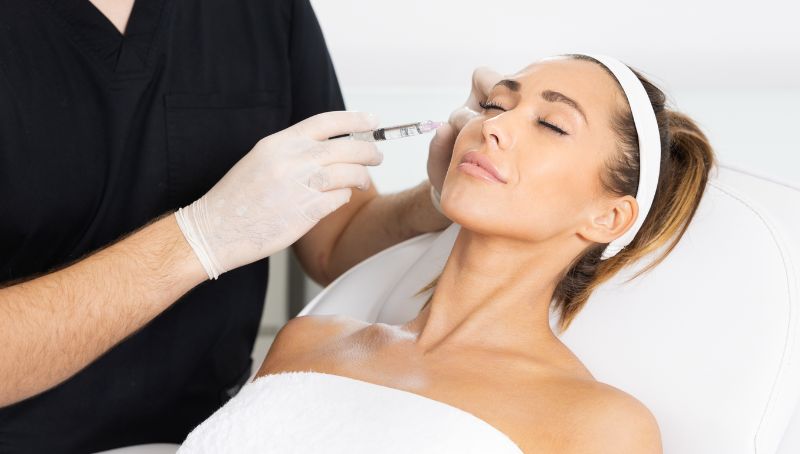
Polynucleotides are chains of DNA fragments, purified from salmon and trout, whose structure is close to human, so the skin easily recognises and accepts them. Unlike fillers, they do not fill or alter the contours of the face. They work deeper, at the cellular level. When injected into the dermis, they send a signal to the skin to start its own regeneration process: they activate fibroblasts, stimulate the production of new collagen and elastin, bind moisture and calm inflammation.
The treatment itself is quick and simple. Before it begins, a skin examination and consultation are carried out, and an anaesthetic cream is applied to the treated area, so discomfort is minimal. The polynucleotides are then injected into the middle layer of the skin using fine needles, following a predetermined pattern. The entire procedure takes around 20 to 30 minutes. Afterwards, mild redness or tiny dots at the injection sites are possible, but these usually subside within 24 to 48 hours, so most people return to their routine the very next day. For the full effect, a series of three treatments is recommended, spaced three to four weeks apart, which is how long the skin needs to go through the collagen renewal cycle.
Who are they suitable for and what results can you expect?
What makes polynucleotides suitable for almost everyone is that they work regeneratively without changing facial features. If you are noticing that your skin is looking more tired than before, has lost its radiance, that the first fine lines have appeared or that it struggles to retain moisture, this is a treatment that mitigates those signs from within. It is equally well-suited for younger skin as a prevention and for mature skin that needs deeper regeneration, and due to its gentle action, it is also applied to sensitive areas such as the eye contour.
Two effects stand out in particular. The first is skin quality: it becomes plumper, smoother and better hydrated, with a tone that looks rested. The second is longevity: because the skin builds new collagen itself, the result is not lost as soon as the treatment passes, but lasts for months. The effect is also scientifically confirmed, with experimental studies showing that polynucleotides stimulate the synthesis of type I and III collagen via fibroblasts and significantly improve collagen density and skin elasticity over time.¹
Polynucleotides can be done all year round. As after any skin-resurfacing treatment, in the days following the procedure the skin should be protected from the sun and a high SPF should be used regularly, in order to preserve the achieved result.
Morpheus8
While polynucleotides work gently from within, Morpheus8 goes a step further, targeting areas where the skin has already begun to noticeably slacken. It is a treatment for that moment when you notice your jawline is no longer as defined as it used to be, the lower face has dropped slightly, or your neck gives away your age even before your face does.
The secret lies in the combination of two technologies. Tiny needles create micro-channels in the skin and deliver radiofrequency waves through them deep into the tissue. This energy heats the deeper layers, and the heat does two things at once: existing collagen shrinks and tightens immediately, while in the background, fibroblasts are stimulated to produce completely new collagen fibres for months afterwards. What truly sets Morpheus8 apart is the depth; the energy does not stop at the surface, but reaches all the way to the subcutaneous fat. Because of this, it not only tightens, but also melts smaller fat deposits, making it a frequent choice for the double chin and lower face contour.
What do the treatment and recovery look like
It all starts with a consultation, where the depth and intensity are adjusted specifically for your skin and the target area; the skin of the neck and double chin is not treated the same way. An anaesthetic cream is applied, so a mild tingling sensation and warmth are felt during the treatment. The procedure takes anywhere from half an hour to an hour. Afterwards, redness, mild swelling and tiny needle marks are entirely expected and fade within a few days.
The full effect is built up in a series, usually three treatments spaced a few weeks apart, and the result matures gradually: you will feel the first tightening in just a few weeks, while firmness, smoothness and a clearer contour continue to improve over the next three to six months. That the heat driving all of this is not just theory is also confirmed by clinical research; a study on the lower third of the face and neck (Dayan et al., 2020) recorded that the heating of deeper layers triggers the creation of new collagen and elastin, alongside measurable skin tightening.
One note is important. Morpheus8 can be done all year round, but it requires a bit more attention than milder treatments. Since radio waves heat the skin, it remains more sensitive to the sun for a few days after the procedure, which is why avoiding direct sun and a high protection factor are mandatory then, as much to preserve the results as for the health of the skin itself.
ClearLift laser
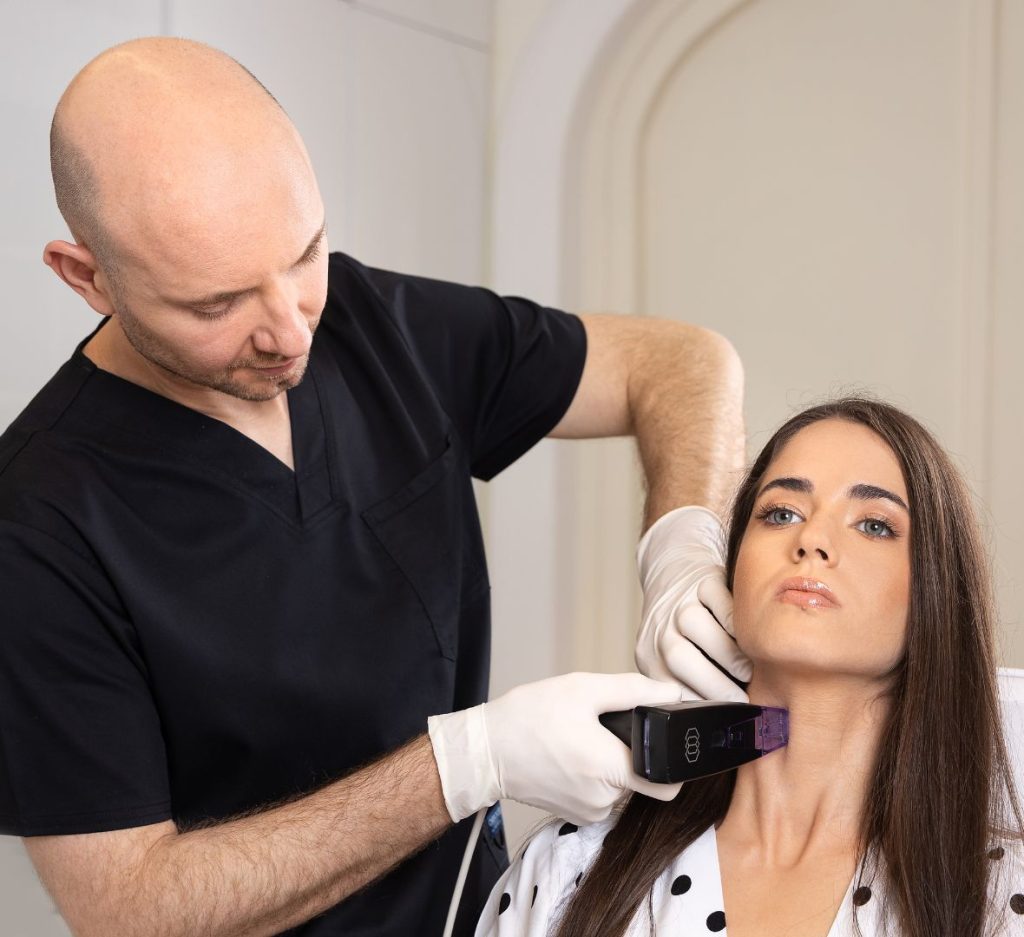
There is a reason why ClearLift is called the “Hollywood lunchtime facelift”. After ClearLift there is no peeling or recovery time, and while your skin might be slightly pink for a short while, you can go straight back to work. And yet it does serious work beneath the surface.
The trick is that ClearLift uses a Q-switched Nd:YAG laser which skips the upper layer of the skin and acts where collagen is actually built, in the deeper layer, the dermis. Instead of stripping the surface like fractional ablative lasers, it delivers short, precise pulses that stimulate collagen remodelling, while the epidermis remains intact. Hence the absence of downtime: no peeling or scabbing, just skin that begins to regenerate from within.
Why are we combining it with polynucleotides?
ClearLift refreshes the complexion, tightens pores, reduces hyperpigmentation and blemishes, and provides a mild skin-tightening effect. But when combined with polynucleotides, two things complement each other nicely. The laser stimulates skin renewal while the polynucleotides provide hydration and fuel for the cells to build new collagen fibres at that very moment. One triggers, the other nourishes, so the result is more pronounced and lasts longer than from either treatment individually. That is precisely why we single out this combination for those who want to tackle uneven skin tone alongside tightening.
The treatment lasts around 45 minutes, only a mild warming sensation is felt, and a series of three to four treatments is recommended. The initial freshness is visible immediately, while the full effect matures over six to eight weeks, which is how long the skin needs to produce new collagen. Because it does not damage the skin surface, ClearLift can be performed throughout the year, alongside standard sun protection, which preserves the achieved result after every collagen-stimulating treatment.
What about hydration? Here is Profhilo
All treatments so far build skin structure, collagen, firmness, and tightness. But there is another ingredient of healthy skin that is lost with age, and without which even the best structure looks tired: moisture. Skin that is not sufficiently hydrated looks dull, fine lines are more visible, and that youthful skin glow fades. That is why we view hydration as a natural continuation of investment in the skin, and Profhilo is an excellent choice there!
Profhilo is a stabilised hyaluronic acid, but unlike dermal fillers, it does not fill wrinkles or add volume. It is injected at just a few points and has a dual action: it provides deep and long-lasting hydration while gently stimulating the skin to regenerate collagen. Due to its high concentration of hyaluronic acid, it gives that characteristic radiance, plumpness and suppleness to the skin. The result is skin that looks rested, fresh and healthy on the face, neck, decolletage and hands. It is ideal for thinner faces and dull, tired, dry skin types.
The effect is built up in two sessions, usually a month apart, and is maintained with occasional top-ups. Therefore, Profhilo is the perfect complement to collagen treatments: while they strengthen the structure from within, it restores the moisture and radiance to the skin that make that structure visible. Together, they achieve what no single treatment can fully do on its own: skin that is both firm and hydrated, and healthy and glowing.
How to start with collagen stimulation
The best time to invest in collagen is while your skin is still producing it. The treatments from this text are performed individually or combined into a plan according to the condition of the skin:
- Polynucleotides, skin regeneration and quality from within, suitable for almost any skin type.
- Polynucleotides + ClearLift laser, a combination that, along with renewal, evens out the complexion and fades blemishes.
- Profhilo, deep hydration and radiance, for skin that looks rested and healthy.
- Morpheus8 (face + neck), deep tightening and a clearer contour of the face and neck.
Which one is right for you is best assessed during an examination. Book a consultation at our polyclinic, we will examine the condition of your skin, listen to what you want and propose a plan that truly pays off for you, today and for years to come. The prices of all treatments can be found on the page Price list.
Updated: