Postpartum abdominal separation that does not go away even with exercise has a name — diastasis. Why it happens, why sit-ups can actually make it worse, what really helps, and when it is safe to begin treatment.
Many women do everything “right” after giving birth — they return to exercise, watch their diet, are patient — and their stomach still sticks out, especially down the middle. It's not about weight and it's not down to effort. Very often the reason is diastasis: a separation of the abdominal muscles that occurred during pregnancy and didn't close on its own. With diastasis, classic sit-ups not only don't help, but can actually make things worse. That is why it is important to first understand what is actually happening to the abdominal wall, and then what really helps to get the stomach back into shape. Below we explain why diastasis occurs, why exercise is often not enough, what helps and when it is safe to start treatment after childbirth.
What is diastasis and why does it occur after childbirth?
Diastasis (diastasis recti abdominis) is the separation of the rectus abdominis muscles down the middle of the stomach. Those two muscles normally lie side by side, joined by a thin band of connective tissue (linea alba). Whenthis band stretches and thins, the muscles move apart and the middle of the abdominal wall loses its firmness.
During pregnancy, this is a completely natural process. As the baby grows, the stomach expands, and the abdominal muscles separate to make room — alongside this, hormonal changes soften the connective tissue and make it more stretchy. In most women, the gap gradually narrows on its own after childbirth. For some women, however, it does not close completely and remains permanently present.
This is not a rare problem. According to data, diastasis affects between 30 and 60% of women in the postpartum period, and for many it persists even months after the baby is born. How pronounced it will be is influenced by genetics, the number of pregnancies, age, and how the pregnancy itself progressed.
It is easiest to spot when lying down: when the head is raised or the stomach is strained, a bulge appears down the middle or a longitudinal “channel” can be felt between the muscles. This is also the reason why the stomach appears soft and bulging in the middle, even though weight and diet are not an issue — the muscles simply no longer hold the abdominal wall as taut as before.
Why exercise is often not enough (and why sit-ups can sometimes do more harm than good)
It is logical to think that the solution for a soft belly is more crunches. With diastasis, unfortunately, that does not apply, and sometimes it even makes things worse.
The problem is that traditional sit-ups and similar exercises increase intra-abdominal pressure and push the stomach forwards. When the connective tissue down the centre is already stretched and weakened, this pressure pulls the muscles further apart instead of bringing them together. This is why women with pronounced diastasis often notice that the middle of their stomach “pops out” even more after a set of sit-ups — the body is doing the exact opposite of what is desired.
Even standard strengthening exercises do not always reach the right spot. To get the abdominal wall to tighten up again, you need to activate the deep abdominal muscles that hold the centre — and these are difficult to hit through voluntary contraction, especially while the midline connection is weakened. Because of this, many women spend months doing sit-ups with no progress, or even with the impression that things are worse.
That does not mean that exercises are useless. Targeted exercises for diastasis, most commonly with a physiotherapist, can help — but they are chosen carefully and those that raise pressure are specifically avoided. For some women, even that is not enough to close the gap, and that is where treatments that purposefully strengthen the abdominal wall come into play.
What helps with diastasis, and where does Emsculpt come in?
To reduce diastasis, two things need to be achieved: strengthen and thicken the rectus abdominis muscles and thereby reduce the gap between them. In cases of mild diastasis, targeted exercises with a physiotherapist can help. When that is not enough, or when the gap remains persistent, treatments that specifically strengthen the abdominal wall come into play — and among them is Emsculpt.
Emsculpt works via so-called supramaximal contractions, which are stronger and more frequent than a muscle can achieve on its own through voluntary exertion. The goal is to strengthen and thicken the rectus abdominis muscles, which can reduce the gap in some women.
What sets this treatment apart is that there is a study conducted specifically on postpartum women. In a pilot study published in the Journal of Clinical and Aesthetic Dermatology (Jacob and Rank, 2020), ten women received four treatments after childbirth, and the results were monitored using MRI. Three months after the treatment, the separation of the abdominal muscles was reduced by an average of 22.7%, the thickness of the rectus abdominis muscle increased by 21.3%, and the thickness of the fat layer decreased by 20.1%. In all four women who initially had pronounced diastasis, the separation returned to within normal limits during this period, and the results remained stable at the six-month follow-up. It is important to note that this is a small pilot study with only ten participants: the results show what is possible, but do not guarantee the same outcome for every woman or apply to every degree of diastasis. The treatment does not replace abdominal wall rehabilitation.
It must be said, however, where the limits lie. Diastasis comes in different grades, and in severe cases — when the gap is large or the connective tissue is badly damaged — this treatment is not enough. Therefore, the first step is always an assessment: how large the gap is and whether in your case the right solution is Emsculpt or whether something else is needed. This is determined during an examination. If, alongside diastasis, there is back pain, involuntary urination, a feeling of weakness in the abdominal wall, or a bulge that may indicate a hernia, an examination by a gynaecologist, physiatrist or surgeon is necessary, because in such cases it is not just a matter of the appearance of the stomach.

When is it safe to start after childbirth?
The body needs time to recover after childbirth, and there is no rushing that. Exactly how long you should wait depends on how the birth went, whether you had a caesarean section and how your recovery is progressing — and that is individual and differs from woman to woman.
Therefore, the rule is simple and without exception: before any treatment, the approval of the gynaecologist monitoring your recovery is required. They know best whether your body is ready and when the right moment has come to begin.
Another important point: Emsculpt is not performed during breastfeeding. If you are currently breastfeeding, it doesn't mean the treatment is not for you, but rather that the right time is a little later. Until then, targeted exercises with a physiotherapist can be done, and the treatment can be added when the time is right.
There are also general contraindications that have nothing to do with childbirth — implants in the body, a pacemaker, serious heart problems. And that is another reason why a consultation before starting is mandatory, rather than a formality.
When there is excess skin alongside muscle — combination of treatments
Emsculpt works on the muscle: the goal is to strengthen the abdominal wall. However, after childbirth, the belly often has two more issues that the muscle alone does not solve — loose skin that stretched during pregnancy and remaining fat deposits. For a more complete result, treatments can be combined.
For loose skin and excess fat, Alma PrimeX is a good fit. It combines two complementary technologies: ultrasound, which targets and breaks down fatty deposits to reduce volume, and radiofrequency waves, which heat the deeper layers of skin, stimulate collagen production and tighten the skin. While Emsculpt builds and tightens muscle deep down, Alma PrimeX works on the layer above it — the skin and fat.
That is why, in the case of a postpartum belly, the combination often yields a more complete result: Emsculpt works on the abdominal wall muscles, while Alma PrimeX works on the skin and fatty deposits. What you need — just muscle strengthening, or also work on the skin and fat — depends on the condition of the belly and is assessed during a consultation.
One thing is worth saying honestly: with pronounced excess skin, even a combination of treatments is not always enough, so the doctor assesses at the examination what can realistically be expected. However, with moderate changes, which are also the most common, this kind of approach can improve the firmness and shape of the stomach without a long recovery.
What does the treatment look like and when are the results visible?
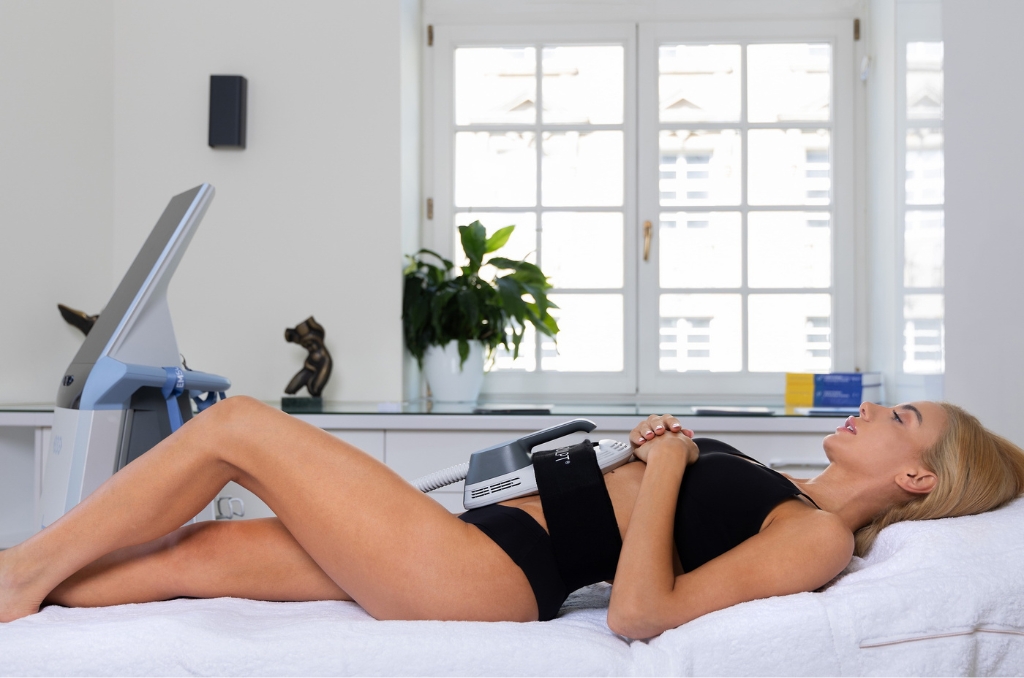
The treatment itself is simple and requires no preparation. You lie back relaxed, the applicator is placed on your stomach and secured, and the intensity is gradually increased to a level that feels comfortable for you. What you feel are strong contractions of the abdominal muscles, along with a mild tingling sensation — like a very intense workout, only without any effort on your part. One treatment lasts about 30 minutes.
A standard course consists of four treatments, with a few days between each. There is no recovery period after the treatment and you go straight back to your day, which is important for mums with a baby. The only possible side effect is mild muscle soreness for the next day or two, similar to that after a good workout.
Results do not come overnight, because a muscle needs time to build and tone. The first changes are usually noticed a few weeks after the course, and the full effect develops over the next two to three months. It is the same principle as with training — the muscle strengthens gradually, in the weeks following the stimulus. In a study on postpartum women, the results were stable even at the six-month follow-up, but the sample is small, so the longevity of the results for each woman is assessed at a follow-up visit.
What to realistically expect
Diastasis is common and not a sign that you did something wrong — your body did a tremendous job carrying and giving birth to a child, and the separation of the abdominal muscles is part of that. You do not have to just live with it. When exercises are not enough, Emsculpt can be an addition to rehabilitation, and Alma PrimeX acts on the skin and fat deposits. How much improvement is possible depends on the degree of diastasis and the condition of the abdominal wall. The first step is always an assessment.
During the consultation, the size of the gap and the condition of the stomach are measured, and only then is a plan made that suits you specifically — just Emsculpt, or in combination with another treatment. Along with that comes an agreement on the right time, in accordance with your recovery and your gynaecologist's approval.
Treatment and package prices can be found in our body treatments price list. During the consultation, we will determine together what the right solution is for your stomach.
We describe how the tummy changes after birth and what helps at each stage in our article about Postpartum belly, and tightening loose skin in our article about Excess stomach skin. For swelling and fatigue after pregnancy, another helpful option is pressotherapy.

Updated: