The stomach is a place where the body remembers a lot: pregnancy, weight changes, age. After childbirth or weight loss, the skin on the stomach often remains softer and looser than before, sometimes with stretch marks. This is completely natural, because the skin was stretched for months and needs support to firm up again. In this text we explain why excess …
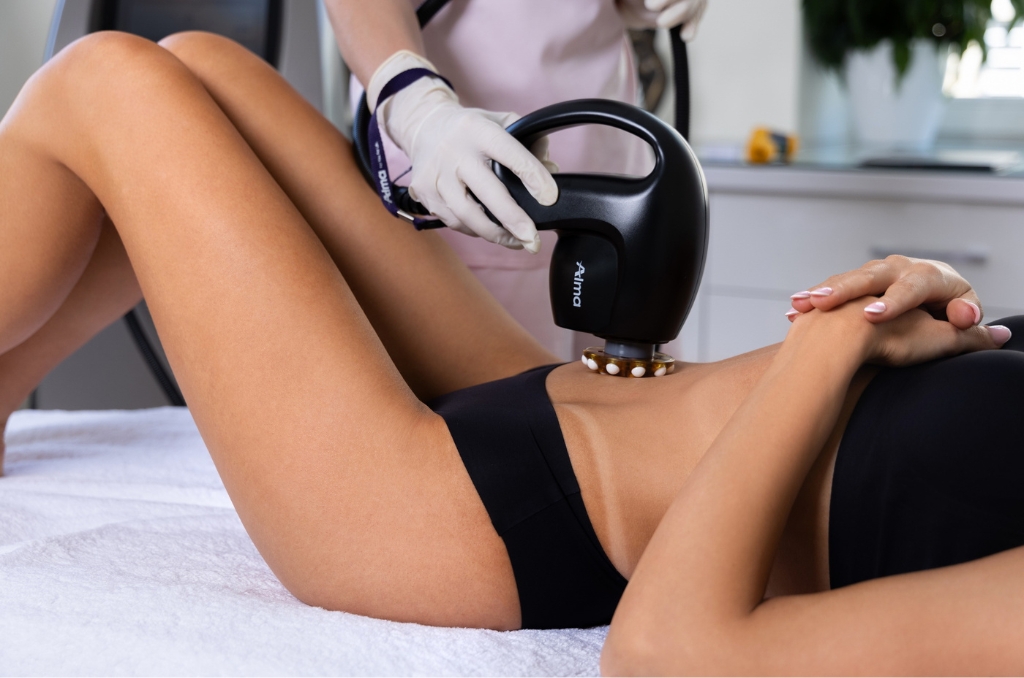
The stomach is a place where the body remembers a great deal: pregnancy, weight changes, age. After childbirth or weight loss, the skin on the stomach often remains softer and looser than before, sometimes with stretch marks. This is completely natural, as the skin has been stretched for months and needs support to firm up again. In this article, we explain why excess skin occurs, what you can do yourself and how we choose between Alma PrimeX, Morpheus8, Ultraformer III and Attiva radiofrequency treatments for stomach skin, as well as when Emsculpt makes sense as an add-on to improve muscle tone.


Why excess skin remains on the stomach
During pregnancy or weight gain, the skin on the stomach stretches, and the collagen and elastic fibres become thinner in the process. When the circumference decreases, the skin cannot always return to its previous state, so it remains loose, particularly below the navel. The greater and faster the change, the more likely it is that excess skin will remain. This is also influenced by age, as the body produces less and less collagen, as well as heredity, hormones, and a lack of exercise. Abdominal fat tissue is stubborn, so even with a proper diet, minor deposits sometimes remain on the belly and hips. After pregnancy, the abdominal wall muscles sometimes separate, so the belly looks protruding even when there is little fat tissue. We describe how the belly changes after pregnancy in our article Postpartum belly, and we write about the separation of the abdominal muscles in our article about postpartum diastasis.What you can do yourself
A diet with enough protein, vegetables and fruit, and less sugar and processed food, helps to reduce fat deposits gradually. Walking, cycling and abdominal exercises strengthen the abdominal wall. If you are planning to lose weight, it is better to do it gradually, about half a kilogram to 800 grams a week, because rapid weight loss leaves more loose skin. Enough sleep, less stress and less alcohol also help. When the skin remains loose despite all that, treatments that work in the deeper layers of the skin and stimulate the production of new collagen can help.How we choose your treatment
During the examination, we assess skin quality and thickness, the degree of laxity, fat deposits, stretch marks, and the condition of the abdominal wall. For the skin, we can consider Alma PrimeX, Morpheus8, Ultraformer III or Attiva radiofrequency, whereas Emsculpt has a different role: muscle stimulation. The method, number of sessions, and intervals are determined individually. In cases of pronounced excess skin, diastasis, or suspected hernia, an appropriate medical evaluation is required first.Alma PrimeX
Alma PrimeX combines ultrasound and radiofrequency. The ultrasound targets fat cells while the radiofrequency energy heats the skin and subcutaneous tissue, causing collagen fibres to contract and the skin to produce new collagen. The vacuum holds the applicator firmly against the skin to ensure the energy is delivered evenly. Treatment lasts between 10 and 20 minutes and is performed without anaesthesia. During the treatment you feel warmth, and afterwards you can immediately return to your daily activities. The doctor selects one of three protocols:- PrimeX Classic for fatty deposits, usually 4 treatments a week apart;
- PrimeX Pro for tightening larger areas, such as the stomach, usually 3 treatments spaced 7 to 14 days apart;
- PrimeX Premium for skin tightening and cellulite, 2 to 4 treatments spaced 7 to 14 days apart.
Morpheus8
Morpheus8 combines microneedling and radiofrequency. The needles deliver energy deep into the skin, up to 8 mm on the body, where they stimulate the production of collagen and elastin and reduce minor fatty deposits. On the stomach, it tightens the skin, improves its texture and softens stretch marks, making it a good choice after pregnancy. An anaesthetic cream is applied before the treatment, so only a mild stinging and pressure are felt. The treatment takes 15 to 30 minutes. After the treatment, the skin is red and mildly swollen for one to three days. Usually, 3 treatments are performed, and the full effect is visible around three months after the last one. Read more about the treatment on our page about Morpheus8.
Ultraformer III for stomach skin tightening
Ultraformer III uses focused ultrasound for controlled tissue heating at selected depths. It is performed over the skin's surface, without needles or cannulas, with the aim of gradually improving skin firmness. It is considered for mild to moderate laxity, when an examination shows that a non-surgical approach can provide a useful result.
Transducers and parameters are adapted to the tissue thickness and the anatomy of the stomach. The result develops over the coming weeks and months; the number of sessions and the need for repetition are determined individually. This method does not remove a large hanging excess of skin. Read more about the procedure on our page about Ultraformer III.
Attiva radiofrequency for abdominal skin
Attiva is a minimally invasive radiofrequency treatment. A thin cannula is inserted under the skin through a small entry point, and controlled tissue heating promotes collagen contraction and remodelling. The aim is to improve skin firmness and abdominal contour, with patient selection based on examination findings.
The procedure is performed under local anaesthesia and with temperature monitoring. Swelling, tenderness or bruising may occur, so the doctor provides individual instructions for care and the resumption of activities. The result develops gradually, and the number of treatments depends on the initial condition and tissue response. More details: Attiva radiofrequency.
When does Emsculpt make sense as an add-on?
If there is also weaker muscle tone in addition to sagging skin, following an examination, we may consider Emsculpt. Electromagnetic stimulation induces muscle contractions and is used to strengthen and tone them. Emsculpt does not remove excess skin and does not replace a treatment intended for the skin.
We determine the combination plan based on what the main problem is. When diastasis or a hernia is suspected, the abdominal wall is assessed first; aesthetic treatment does not replace diagnostics and individual rehabilitation.
Skin, adipose tissue or abdominal wall
The same “excess” on the belly can be loose skin, subcutaneous fat, or a weaker, separated abdominal wall (diastasis), and it is often a combination of these. Skin is assessed by how thin it is and how much it hangs, fat by the thickness of the skin fold, and the abdominal wall by examination lying down. Non-surgical treatments can provide limited to moderate improvement for mild to moderate skin laxity. In cases of a large excess of skin hanging over the pubic region, pronounced diastasis, or suspected hernia, an examination by a plastic or general surgeon is necessary, as devices are not an appropriate solution in those instances.
Updated: