Training regularly but your glutes and abs aren't progressing? Find out how Emsculpt complements gym training and helps you break through a plateau.
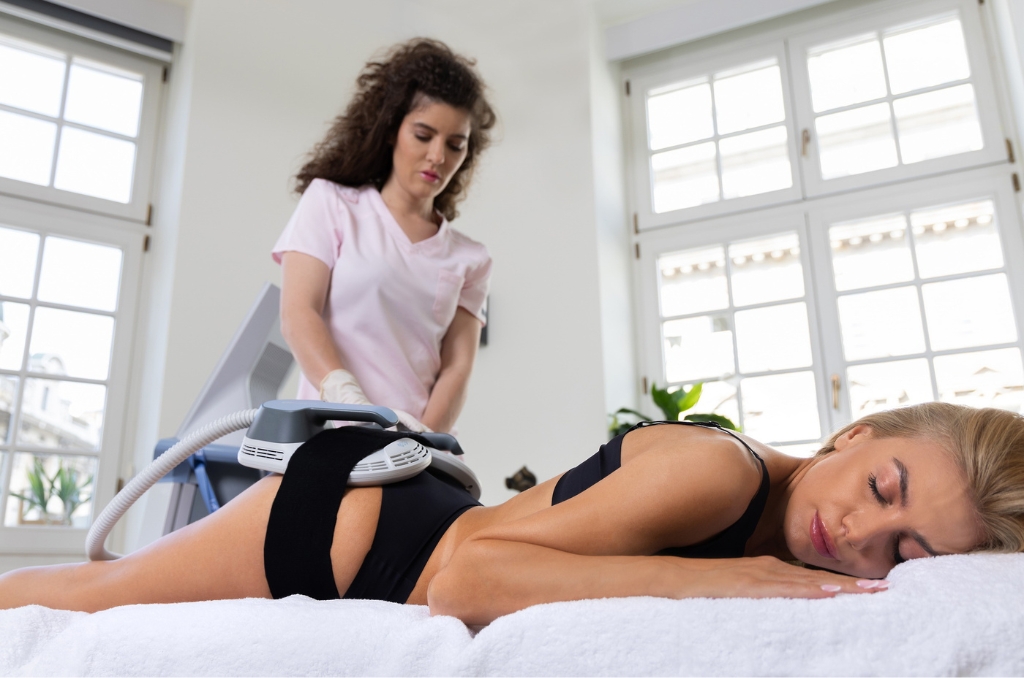
When someone trains seriously, it shows — in their strength, in their fitness, in their physical appearance. And then there is a muscle group that stubbornly lags behind. Most often it is the glutes: the weights on the hip thrust and squat go up, leg training is regular, and the shape and fullness of the buttocks still do not match the effort put in. For others it is the lower stomach that remains soft despite a clean diet, or the inner thighs. What is most annoying is precisely the fact that the effort is there. Emsculpt does not replace the gym; it acts as a boost for an area that responds poorly to everything you throw at it. Below, we get specific: where it will genuinely help you — on your glutes, tummy and thighs — and where its limits lie.
Why do even dedicated exercisers get stuck on a plateau?
The body adapts quickly. When the same routine goes on for months, the muscle adapts to the load and progress stalls — a plateau catches up with everyone sooner or later, regardless of experience. To shift it, you need a new stimulus, and some muscle groups are much harder to move than others.
Activation is also part of the story. The glutes are a textbook example: people who spend most of the day sitting activate them less, so hip thrusts and squats are partly taken over by the hamstrings and lower back. The consequence is that the glutes lag behind even though the legs are worked properly. It is similar with the lower abs and deep abdominal muscles — no matter how many crunches are done, that area is difficult to reach through voluntary contraction.
Added to that is the distribution of body fat, which does not depend on effort. For many people, including those who train regularly, the lower stomach and the inner thighs hold onto fat the longest and shed it last. The combination of those three things — adaptation, poor activation and stubborn fat — explains why, despite a proper training routine, a certain area can remain stuck.
What does Emsculpt do for a muscle group that training struggles to reach?
Emsculpt works through supramaximal contractions — stronger and more frequent than a muscle can manage on its own through voluntary exertion. It thus targets the fibres in a way that is difficult to replicate with traditional exercise, whether it be the glutes, abdominal wall or thighs.
For anyone who trains, this means a targeted hit on a lagging muscle group. On the glutes, it helps with shape, fullness and lift — things that are built slowly and unevenly with squats. On the stomach, clinical studies record an increase in rectus abdominis muscle thickness and measurable strengthening of the abdominal wall after a series of treatments, with values in the region of 15 to 20% in certain trials. These figures refer to muscle thickness measured by imaging (MRI or ultrasound), rather than strength or conditioning, and were obtained in studies on the stomach, with a small number of participants, so they should not be generalised to other outcomes or areas. The figures vary from protocol to protocol, but the direction is the same: the area gets stronger and muscle tone increases.
The benefit isn't just in the appearance. Stronger and more active glutes and a firmer abdominal wall mean better core stability and cleaner force transfer — which is felt in the squat, deadlift and running. In other words, you get a better foundation for everything else in the gym, not just a nicer-looking rear or a more defined stomach.
How does Emsculpt fit into training?
Let's get one thing straight right away: Emsculpt does not replace the gym and is not a shortcut around the work. It builds upon what is already being done, specifically targeting those areas that barely respond no matter how many sets you perform. Squats, hip thrusts, deadlifts and isolation exercises remain — the treatment acts as an additional, targeted strike on a lagging muscle group.
The principle is familiar to anyone who has experienced stagnation. Training provides the foundation: strength, fitness, overall mass. If the glutes were worked, it makes no sense to go for a heavy leg day the following day — it is better to let the group recover, just as the same muscle group is not worked two days in a row at full intensity. Training of the other groups continues without disruption; the rest applies only to the area that was treated.
Recovery follows the same rules that someone who exercises already knows. Enough protein for the muscle to have something to build from, enough sleep and hydration, with no crash dieting. Emsculpt activates the muscle, but the rest still depends on what is done outside of treatment — nutrition, rest and the training itself. Anyone who sticks to this gives the group the best conditions to respond to the stimulus.

Who will benefit from Emsculpt?
To be completely honest: Emsculpt is not for everyone and does not do the same thing for everyone. It works best for someone who is already training and has hit a specific wall — glutes that lag behind the quads and hamstrings, a lower stomach that refuses to give in despite a clean diet, or an area where most of the work has already been done and all that is missing are the finishing touches. That is where it acts as reinforcement on an already established foundation and where it makes the most sense.
What it is not is a solution for significant excess weight, nor a substitute for training and diet. If the muscle beneath the fat layer receives no stimulus and calories are not under control, the treatment alone will not shape the figure. Emsculpt strengthens and tones the muscle, but it does not melt fat in place of a calorie deficit, nor does it build the habits for you. Whoever is looking for a shortcut to skip the work won't find it here.
As for how many treatments, which area and what schedule — there is no one-size-fits-all answer. It depends on what is lagging behind, how much and what condition the rest of the physique is in. The smartest thing to do is to come for a consultation, where, through an assessment of the area and your goals, a plan is put together that fits into the training you are already doing.
Conclusion
If training is going well and one group is stubbornly lagging behind, the problem is usually not effort, but rather that the area is responding poorly to what it is being offered. That is where Emsculpt makes sense — as a targeted reinforcement for the glutes, abs or thighs, on top of the foundation you are already building. It is not a shortcut and does not replace training, but it can kick-start progress where it has been stalled for a long time.
During the consultation, we will assess together how Emsculpt fits into the training you are already doing. The prices for treatments and packages can be found in our body treatments price list.

Updated: